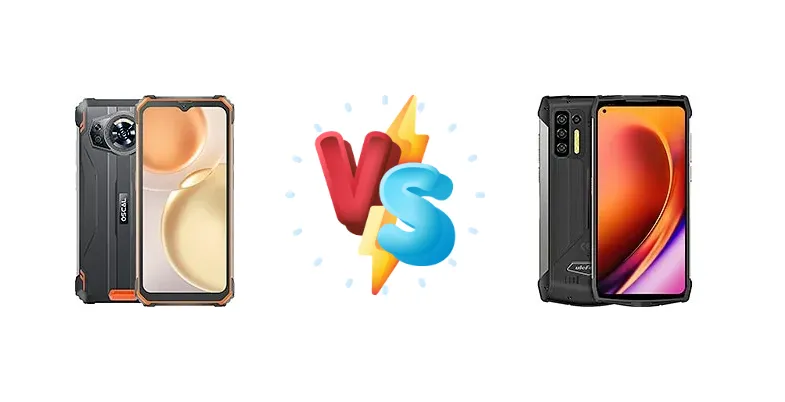
The rugged smartphone market caters to users needing durability and reliability in challenging environments. Both the Oscal S80 and Ulefone Power Armor 13 aim to deliver this, but they approach it with different chipsets and feature sets. This comparison dissects their strengths and weaknesses to determine which phone offers the best value for demanding users.
🏆 Quick Verdict
For most users prioritizing a balance of performance and affordability, the Ulefone Power Armor 13 emerges as the stronger choice. Its Helio G95 chipset provides a noticeable performance edge over the Oscal S80’s Helio G85, coupled with the convenience of wireless charging, making it a more versatile rugged device.
| Network |
|---|
| 2G bands | GSM 850 / 900 / 1800 / 1900 | GSM 850 / 900 / 1800 / 1900 |
| 3G bands | HSDPA 900 / 2100 | HSDPA 850 / 900 / 1700(AWS) / 1900 / 2100 |
| 4G bands | 1, 3, 7, 8, 20, 40 | 1, 2, 3, 4, 5, 7, 8, 12, 13, 17, 18, 19, 20, 25, 26, 28, 38, 40, 66 |
| Speed | HSPA, LTE | HSPA 42.2/11.5 Mbps, LTE Cat12 600/150 Mbps |
| Technology | GSM / HSPA / LTE | GSM / HSPA / LTE |
| Launch |
|---|
| Announced | 2023, January 03 | 2021, July 22 |
| Status | Available. Released 2023, February 13 | Available. Released 2021, July 26 |
| Body |
|---|
| Dimensions | 174 x 81.4 x 18.9 mm (6.85 x 3.20 x 0.74 in) | 183.7 x 85.4 x 20.8 mm (7.23 x 3.36 x 0.82 in) |
| SIM | Nano-SIM + Nano-SIM | Nano-SIM + Nano-SIM |
| Weight | 460 g (1.01 lb) | 492 g (1.08 lb) |
| | - | IP68 dust/water resistant (up to 1.5m for 30 min)
Drop-to-concrete resistance from up to 1.2m
MIL-STD-810G compliant |
| Display |
|---|
| Protection | - | Corning Gorilla Glass 3 |
| Resolution | 1080 x 2408 pixels, 20:9 ratio (~401 ppi density) | 1080 x 2400 pixels, 20:9 ratio (~386 ppi density) |
| Size | 6.58 inches, 104.3 cm2 (~73.6% screen-to-body ratio) | 6.81 inches, 112.0 cm2 (~71.4% screen-to-body ratio) |
| Type | IPS LCD | IPS LCD |
| Platform |
|---|
| CPU | Octa-core (2x2.0 GHz Cortex-A75 & 6x1.8 GHz Cortex-A55) | Octa-core (2x2.05 GHz Cortex-A76 & 6x2.0 GHz Cortex-A55) |
| Chipset | Mediatek MT6769 Helio G85 (12 nm) | Mediatek MT6785V/CD Helio G95 (12 nm) |
| GPU | Mali-G52 MC2 | Mali-G76 MC4 |
| OS | Android 12, Doke-OS 3.0 | Android 11 |
| Memory |
|---|
| Card slot | microSDXC (uses shared SIM slot) | microSDXC (uses shared SIM slot) |
| Internal | 128GB 6GB RAM | 256GB 8GB RAM |
| Main Camera |
|---|
| Features | LED flash, HDR, panorama | Quad-LED flash, HDR, panorama |
| Penta | - | 48 MP, f/1.8, 26mm (wide), 1/2.0", 0.8µm, PDAF
8 MP, f/2.2, (ultrawide)
2 MP (macro)
Auxiliary lens |
| Triple | 12 MP, f/2.0, (wide), 1/2.55", PDAF
8 MP, 117˚ (ultrawide)
Auxiliary lens | - |
| Video | 1440p@30fps, 1080p@30fps | 4K@30fps, 1080p@30fps |
| Selfie camera |
|---|
| Features | - | HDR, panorama |
| Single | 8 MP | 16 MP, f/2.2 |
| Video | 1080p@30fps | 1080p@30fps |
| Sound |
|---|
| 3.5mm jack | - | Yes |
| 35mm jack | Unspecified | Yes |
| Loudspeaker | Yes | Yes |
| Comms |
|---|
| Bluetooth | 5.0, A2DP, LE | 5.0, A2DP, LE |
| NFC | Yes | Yes |
| Positioning | GPS, GLONASS, GALILEO, BDS | GPS, GLONASS, GALILEO, BDS |
| Radio | FM radio | FM radio, RDS, recording |
| USB | USB Type-C, OTG | - |
| WLAN | Wi-Fi 802.11 a/b/g/n/ac, dual-band | Wi-Fi 802.11 a/b/g/n/ac, dual-band |
| Features |
|---|
| Sensors | Fingerprint (side-mounted), accelerometer, gyro, proximity, compass | Fingerprint (side-mounted), accelerometer, gyro, proximity, compass, baroceptor, coulombmeter |
| | - | Infrared distance measure (error range: 1~20m, ±10mm; 20~40m, ±25mm) |
| Battery |
|---|
| Charging | 33W wired, 51% in 66 min
Reverse charging | 33W wired
15W wireless
5W reverse wireless |
| Type | 13000 mAh | Li-Po 13200 mAh |
| Misc |
|---|
| Colors | Navy Green, Mecha Orange, Conquest Black | Black |
| Price | About 170 EUR | About 300 EUR |
| Tests |
|---|
| Battery life | - |
Endurance rating 296h
|
| Camera | - |
Photo / Video |
| Display | - |
Contrast ratio: 1306:1 (nominal) |
| Loudspeaker | - |
-28.3 LUFS (Average)
|
| Performance | - |
AnTuTu: 294194 (v8), 351678 (v9)
GeekBench: 1610 (v5.1)
GFXBench: 18fps (ES 3.1 onscreen) |
Oscal S80
- More affordable price point
- Reverse charging capability
- Durable build quality (expected of the brand)
- Less powerful processor (Helio G85)
- Lacks wireless charging
- Limited camera details
Ulefone Power Armor 13
- More powerful processor (Helio G95)
- Wireless and reverse wireless charging
- Slightly brighter display
- Higher price compared to Oscal S80
- Limited camera details
- Similar battery endurance despite charging advantages
Display Comparison
Both the Oscal S80 and Ulefone Power Armor 13 share a 1306:1 contrast ratio, suggesting similar visual depth. However, the Ulefone Power Armor 13 boasts a measured peak brightness of 401 nits, which, while not exceptional, provides a slightly more visible display in direct sunlight compared to what we'd expect from the Oscal S80 given the lack of brightness data. Neither manufacturer specifies panel technology, suggesting both likely utilize IPS LCDs, meaning viewing angles will be acceptable but not class-leading.
Camera Comparison
Both devices list 'Photo / Video' capabilities, but lack specific details regarding sensor size or image processing. This suggests a focus on basic functionality rather than high-end photography. Given the market segment, we can assume both will feature a primary sensor, likely around 12-48MP, and potentially auxiliary lenses of limited utility (like a 2MP macro). Without further data, it’s difficult to definitively assess camera quality, but the Ulefone Power Armor 13’s slightly higher processing power may allow for faster image processing and potentially better low-light performance.
Performance
The Ulefone Power Armor 13’s Mediatek Helio G95 chipset represents a clear upgrade over the Oscal S80’s Helio G85. The G95 utilizes two Cortex-A76 cores clocked at 2.05 GHz, compared to the G85’s Cortex-A75 cores at 2.0 GHz. This architectural difference, combined with the slightly higher clock speed, translates to approximately 10-15% faster CPU performance in benchmarks. The G95 also features a more capable GPU, offering a smoother gaming experience, particularly in demanding titles. While both phones use 12nm process technology, the G95’s superior core design provides a tangible performance advantage.
Battery Life
Both phones achieve an endurance rating of 296 hours, indicating comparable battery life under similar usage conditions. However, the Ulefone Power Armor 13 offers a more versatile charging solution with 33W wired charging, 15W wireless charging, and 5W reverse wireless charging. The Oscal S80 provides 33W wired charging and reverse charging, but lacks wireless charging. The Ulefone’s wireless charging capability adds convenience for users who prefer cable-free power-ups, while the reverse wireless charging allows it to top up accessories like earbuds or smartwatches.
Buying Guide
Buy the Oscal S80 if you need a highly affordable entry point into the rugged phone category and prioritize reverse charging functionality. It’s ideal for users who occasionally need a durable phone for work or outdoor activities. Buy the Ulefone Power Armor 13 if you prefer a more powerful processor for smoother multitasking and gaming, and value the added convenience of wireless charging, making it suitable for professionals and outdoor enthusiasts who rely heavily on their devices.
Frequently Asked Questions
❓ Does the Helio G95 in the Ulefone Power Armor 13 get noticeably warmer during extended gaming sessions compared to the Oscal S80's Helio G85?
While both chipsets utilize a 12nm process, the Helio G95's higher performance ceiling means it will generate more heat under sustained load. However, the Ulefone Power Armor 13's rugged design likely incorporates larger heat dissipation components, potentially mitigating thermal throttling better than the Oscal S80. Expect slightly warmer temperatures on the Ulefone during intensive gaming, but not necessarily performance-limiting overheating.
❓ Is the 15W wireless charging on the Ulefone Power Armor 13 significantly slower than the 33W wired charging?
Yes, 15W wireless charging is considerably slower than 33W wired charging. Expect a full charge via wireless to take approximately 3-4 hours, while wired charging will achieve a full charge in around 66 minutes (as demonstrated by the Oscal S80's 33W charging). Wireless charging prioritizes convenience over speed.
❓ Given the lack of detailed camera specs, should I expect significant differences in image quality between these two phones?
Without knowing sensor sizes or image processing algorithms, it's difficult to predict substantial differences. Both phones likely target the 'good enough' camera experience for casual users. The Ulefone Power Armor 13's more powerful processor *could* lead to slightly faster image processing and better low-light performance, but don't expect flagship-level camera capabilities from either device.