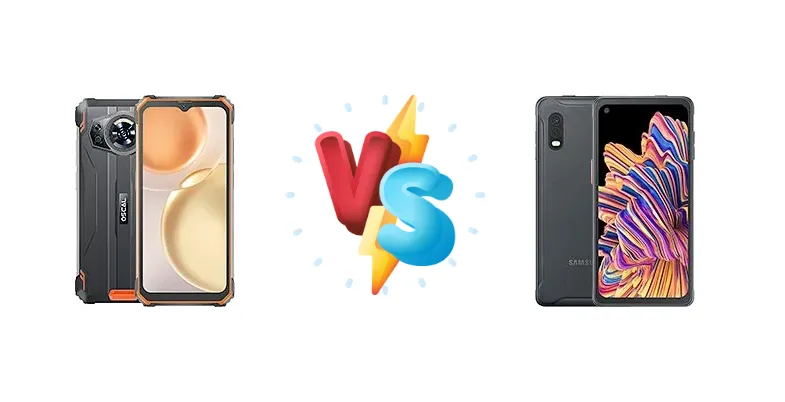
The rugged smartphone market caters to a specific need: durability. Both the Oscal S80 and Samsung Galaxy XCover Pro aim to deliver that, but they take different approaches. The Oscal S80 focuses on delivering modern specs at a disruptive price, while the Samsung XCover Pro leverages Samsung’s brand recognition and software support with a more established, though older, chipset.
🏆 Quick Verdict
For the average user prioritizing raw performance and faster charging, the Oscal S80 is the clear winner. Its Mediatek Helio G85 chipset and 33W charging offer a noticeable advantage over the Samsung Galaxy XCover Pro’s Exynos 9611 and 15W charging, all at a potentially lower price point.
| Network |
|---|
| 2G bands | GSM 850 / 900 / 1800 / 1900 | GSM 850 / 900 / 1800 / 1900 |
| 3G bands | HSDPA 900 / 2100 | HSDPA 850 / 900 / 1900 / 2100 - International |
| 4G bands | 1, 3, 7, 8, 20, 40 | 1, 2, 3, 5, 7, 8, 20, 28, 38, 40, 41 - International |
| Speed | HSPA, LTE | HSPA 42.2/5.76 Mbps, LTE (3CA) Cat11 600/50 Mbps |
| Technology | GSM / HSPA / LTE | GSM / HSPA / LTE |
| | - | 1, 2, 3, 4, 5, 7, 12, 13, 14, 20, 29, 38, 40, 41, 66 - Canada |
| Launch |
|---|
| Announced | 2023, January 03 | 2020, January |
| Status | Available. Released 2023, February 13 | Available. Released 2020, January |
| Body |
|---|
| Dimensions | 174 x 81.4 x 18.9 mm (6.85 x 3.20 x 0.74 in) | 159.9 x 76.7 x 10 mm (6.30 x 3.02 x 0.39 in) |
| SIM | Nano-SIM + Nano-SIM | · Nano-SIM· Nano-SIM + Nano-SIM |
| Weight | 460 g (1.01 lb) | 218 g (7.69 oz) |
| | - | IP68 dust/water resistant (up to 1.5m for 35 min)
Drop-to-concrete resistance from up to 1.5m
MIL-STD-810G compliant*
*does not guarantee ruggedness or use in extreme conditions |
| Display |
|---|
| Protection | - | Corning Gorilla Glass 5 |
| Resolution | 1080 x 2408 pixels, 20:9 ratio (~401 ppi density) | 1080 x 2340 pixels, 19.5:9 ratio (~409 ppi density) |
| Size | 6.58 inches, 104.3 cm2 (~73.6% screen-to-body ratio) | 6.3 inches, 97.4 cm2 (~79.4% screen-to-body ratio) |
| Type | IPS LCD | IPS LCD |
| Platform |
|---|
| CPU | Octa-core (2x2.0 GHz Cortex-A75 & 6x1.8 GHz Cortex-A55) | Octa-core (4x2.3 GHz Cortex-A73 & 4x1.7 GHz Cortex-A53) |
| Chipset | Mediatek MT6769 Helio G85 (12 nm) | Exynos 9611 (10 nm) |
| GPU | Mali-G52 MC2 | Mali-G72 MP3 |
| OS | Android 12, Doke-OS 3.0 | Android 10, upgradable to Android 13, One UI 5 |
| Memory |
|---|
| Card slot | microSDXC (uses shared SIM slot) | microSDXC (dedicated slot) |
| Internal | 128GB 6GB RAM | 64GB 4GB RAM |
| Main Camera |
|---|
| Dual | - | 25 MP, f/1.7, 26mm (wide), PDAF
8 MP, f/2.2, 123˚ (ultrawide), 1/4.0", 1.12µm |
| Features | LED flash, HDR, panorama | Dual-LED flash, HDR, panorama |
| Triple | 12 MP, f/2.0, (wide), 1/2.55", PDAF
8 MP, 117˚ (ultrawide)
Auxiliary lens | - |
| Video | 1440p@30fps, 1080p@30fps | 1080p@30fps |
| Selfie camera |
|---|
| Features | - | HDR |
| Single | 8 MP | 13 MP, f/2.0, (wide), 1/3.1", 1.12µm |
| Video | 1080p@30fps | 1080p@30fps |
| Sound |
|---|
| 3.5mm jack | - | Yes |
| 35mm jack | Unspecified | Yes |
| Loudspeaker | Yes | Yes |
| Comms |
|---|
| Bluetooth | 5.0, A2DP, LE | 5.0, A2DP, LE |
| NFC | Yes | Yes |
| Positioning | GPS, GLONASS, GALILEO, BDS | GPS, GLONASS, GALILEO, BDS |
| Radio | FM radio | FM radio (market/region dependent) |
| USB | USB Type-C, OTG | USB Type-C 2.0 |
| WLAN | Wi-Fi 802.11 a/b/g/n/ac, dual-band | Wi-Fi 802.11 a/b/g/n/ac/k/v/r, dual-band, Wi-Fi Direct |
| Features |
|---|
| Sensors | Fingerprint (side-mounted), accelerometer, gyro, proximity, compass | Fingerprint (side-mounted), accelerometer, gyro, proximity, compass |
| | - | ANT+ |
| Battery |
|---|
| Charging | 33W wired, 51% in 66 min
Reverse charging | 15W wired |
| Type | 13000 mAh | Li-Po 4050 mAh, removable |
| Misc |
|---|
| Colors | Navy Green, Mecha Orange, Conquest Black | Black |
| Models | - | SM-G715FN/DS, SM-G715FN, SM-G715F, SM-G715W, SM-G715U, SM-G715U1 |
| Price | About 170 EUR | About 120 EUR |
| SAR EU | - | 0.47 W/kg (head) 1.23 W/kg (body) |
Oscal S80
- Faster 33W charging significantly reduces downtime.
- More modern CPU architecture (Cortex-A75) for better performance.
- Reverse charging adds versatility.
- Brand recognition is lower than Samsung.
- Long-term software support is uncertain.
Samsung Galaxy XCover Pro
- Established brand reputation and reliability.
- Samsung’s software ecosystem and potential for enterprise support.
- Potentially better availability of accessories.
- Slower 15W charging.
- Older CPU architecture (Cortex-A73) limits performance.
- Less efficient chipset.
Display Comparison
Neither device boasts a cutting-edge display. Details on panel type (IPS vs AMOLED) and resolution are missing for the Oscal S80, but given the price point, it's likely a standard IPS LCD. The Samsung XCover Pro also uses an IPS LCD. The key difference lies in processing power; the newer Helio G85 likely has a more efficient display driver, potentially leading to slightly better battery life during display-intensive tasks. Bezels are expected to be substantial on both, given the rugged design focus.
Camera Comparison
Detailed camera specs are limited, but both phones likely prioritize functionality over photographic excellence. The absence of information regarding sensor sizes makes a direct comparison difficult. However, the focus should be on practical usability in challenging conditions, rather than image quality in ideal lighting. Both phones likely feature basic image processing algorithms. The Oscal S80's camera is likely adequate for documentation and quick snapshots, while the XCover Pro's camera will likely be similar in performance.
Performance
The chipset is where the most significant difference lies. The Oscal S80’s Mediatek Helio G85 (12nm) utilizes a more modern CPU architecture – Cortex-A75 cores – compared to the Samsung Galaxy XCover Pro’s Exynos 9611 (10nm) with its older Cortex-A73 cores. While the Exynos 9611 has a slightly higher peak clock speed (2.3GHz vs 2.0GHz), the architectural improvements in the Helio G85, combined with the newer process node, should translate to better sustained performance and efficiency. The G85’s GPU is also likely to outperform the Exynos 9611’s Mali-G72 MP3, benefiting gaming and graphics-intensive applications. The Oscal S80 benefits from a more modern architecture.
Battery Life
Battery capacity is not specified for either device, making a direct mAh comparison impossible. However, the Oscal S80’s 33W wired charging is a significant advantage over the Samsung Galaxy XCover Pro’s 15W charging. The Oscal S80 can reach 51% charge in 66 minutes, while the XCover Pro will take considerably longer. This faster charging is crucial for users who need to quickly top up their battery during work or outdoor activities. The Oscal S80 also offers reverse charging, a feature absent on the XCover Pro, adding to its versatility.
Buying Guide
Buy the Oscal S80 if you need a rugged phone with a focus on performance for the price, and value fast charging capabilities. This phone is ideal for users who frequently use demanding apps or mobile games. Buy the Samsung Galaxy XCover Pro if you prioritize brand reliability, Samsung’s software ecosystem, and potentially easier access to enterprise support, even if it means sacrificing some processing power and charging speed.
Frequently Asked Questions
❓ Does the Exynos 9611 in the Samsung Galaxy XCover Pro tend to overheat during prolonged use, like gaming?
The Exynos 9611 is known to throttle under sustained load, meaning performance will decrease to manage heat. While not catastrophic, users engaging in extended gaming sessions or running demanding applications may experience noticeable slowdowns. The Oscal S80’s Helio G85, with its newer process node, is likely to manage thermals more effectively.
❓ Is the 33W charging on the Oscal S80 compatible with Power Delivery (PD) chargers?
While the Oscal S80 supports 33W charging, whether it utilizes the Power Delivery (PD) standard is not specified. It's likely to use Mediatek's proprietary fast charging protocol, meaning you may not achieve the full 33W speed with a standard PD charger. Using the included charger is recommended for optimal charging speeds.
❓ How does the software update policy differ between the Oscal S80 and the Samsung Galaxy XCover Pro?
Samsung typically provides several years of software updates and security patches for its devices, including the XCover Pro. Oscal, as a newer brand, has a less established track record. Expect a shorter software support lifespan for the Oscal S80, potentially limiting its long-term usability.
❓ What level of water and dust resistance can I expect from each device?
Both phones are marketed as rugged, but the specific IP rating is crucial. The Samsung Galaxy XCover Pro is IP68 rated, offering excellent protection against dust and water immersion. The Oscal S80's IP rating is not specified, so its level of protection may be lower. Check the official specifications for the Oscal S80 to confirm its water and dust resistance.