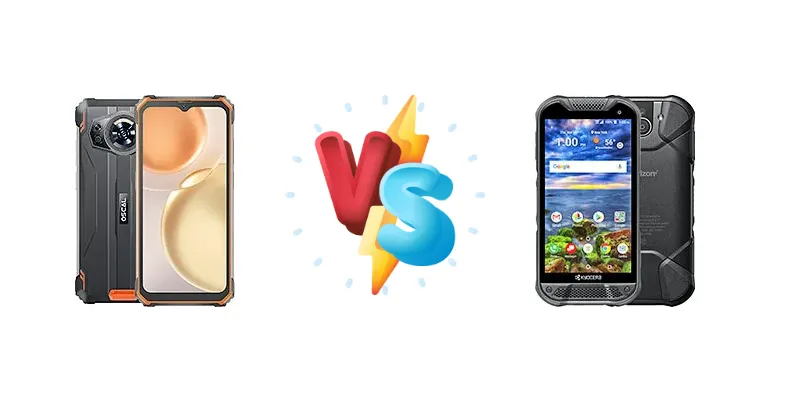
The rugged smartphone market caters to a specific need: durability. However, within this niche, priorities diverge. The Oscal S80 aims to deliver modern performance at a competitive price, while the Kyocera DuraForce Pro 2 prioritizes established ruggedness and long-term reliability. This comparison dissects their core components to determine which best suits your demands.
🏆 Quick Verdict
For the average user prioritizing performance and faster charging, the Oscal S80 is the clear winner. Its Mediatek Helio G85 chipset offers a significant performance uplift over the Kyocera's Snapdragon 630, and the 33W charging is substantially quicker. However, those valuing proven durability and wireless charging may still prefer the DuraForce Pro 2.
| Network |
|---|
| 2G bands | GSM 850 / 900 / 1800 / 1900 | GSM 850 / 900 / 1800 / 1900 |
| 3G bands | HSDPA 900 / 2100 | HSDPA 850 / 900 / 1900 / 2100 |
| 4G bands | 1, 3, 7, 8, 20, 40 | 1, 2, 3, 4, 5, 7, 13, 66 |
| Speed | HSPA, LTE | HSPA 42.2/5.76 Mbps, LTE (3CA) Cat9 450/50 Mbps |
| Technology | GSM / HSPA / LTE | GSM / HSPA / LTE |
| Launch |
|---|
| Announced | 2023, January 03 | 2018, November. Released 2018, November |
| Status | Available. Released 2023, February 13 | Discontinued |
| Body |
|---|
| Dimensions | 174 x 81.4 x 18.9 mm (6.85 x 3.20 x 0.74 in) | 150.2 x 73.4 x 13.5 mm (5.91 x 2.89 x 0.53 in) |
| SIM | Nano-SIM + Nano-SIM | Nano-SIM |
| Weight | 460 g (1.01 lb) | 243 g (8.25 oz) |
| | - | IP68 dust/water resistant (up to 2m for 30 mins)
MIL-STD-810G compliant
Push-to-talk button |
| Display |
|---|
| Protection | - | Sapphire crystal glass |
| Resolution | 1080 x 2408 pixels, 20:9 ratio (~401 ppi density) | 1080 x 1920 pixels, 16:9 ratio (~441 ppi density) |
| Size | 6.58 inches, 104.3 cm2 (~73.6% screen-to-body ratio) | 5.0 inches, 68.9 cm2 (~62.5% screen-to-body ratio) |
| Type | IPS LCD | IPS LCD |
| Platform |
|---|
| CPU | Octa-core (2x2.0 GHz Cortex-A75 & 6x1.8 GHz Cortex-A55) | Octa-core 2.2 GHz Cortex-A53 |
| Chipset | Mediatek MT6769 Helio G85 (12 nm) | Qualcomm SDM630 Snapdragon 630 (14 nm) |
| GPU | Mali-G52 MC2 | Adreno 508 |
| OS | Android 12, Doke-OS 3.0 | Android 8.0 (Oreo) |
| Memory |
|---|
| Card slot | microSDXC (uses shared SIM slot) | microSDXC (dedicated slot) |
| Internal | 128GB 6GB RAM | 64GB 4GB RAM |
| Main Camera |
|---|
| Features | LED flash, HDR, panorama | LED flash, HDR, panorama |
| Single | - | 13 MP, AF
8 MP (ultra wide; dedicated video camera) |
| Triple | 12 MP, f/2.0, (wide), 1/2.55", PDAF
8 MP, 117˚ (ultrawide)
Auxiliary lens | - |
| Video | 1440p@30fps, 1080p@30fps | 4K@30fps, 1080p@30fps |
| Selfie camera |
|---|
| Single | 8 MP | 5 MP |
| Video | 1080p@30fps | - |
| Sound |
|---|
| 3.5mm jack | - | Yes |
| 35mm jack | Unspecified | Yes |
| Loudspeaker | Yes | Yes, with stereo speakers |
| Comms |
|---|
| Bluetooth | 5.0, A2DP, LE | 5.0, A2DP, LE |
| NFC | Yes | Yes |
| Positioning | GPS, GLONASS, GALILEO, BDS | GPS |
| Radio | FM radio | No |
| USB | USB Type-C, OTG | USB Type-C 3.1 |
| WLAN | Wi-Fi 802.11 a/b/g/n/ac, dual-band | Wi-Fi 802.11 a/b/g/n/ac/i/r/k, dual-band, Wi-Fi Direct |
| Features |
|---|
| Sensors | Fingerprint (side-mounted), accelerometer, gyro, proximity, compass | Fingerprint (side-mounted), accelerometer, gyro, proximity, compass, barometer |
| Battery |
|---|
| Charging | 33W wired, 51% in 66 min
Reverse charging | 10W wired
Wireless (Qi) |
| Stand-by | - | Up to 312 h (3G) |
| Talk time | - | Up to 21 h (3G) |
| Type | 13000 mAh | Li-Ion 3240 mAh, non-removable |
| Misc |
|---|
| Colors | Navy Green, Mecha Orange, Conquest Black | Black |
| Price | About 170 EUR | About 400 EUR |
Oscal S80
- Significantly faster 33W charging
- More powerful Mediatek Helio G85 processor
- Reverse charging capability for accessories
- Lacks wireless charging
- Ruggedness certification details are unknown
Kyocera DuraForce Pro 2
- Wireless (Qi) charging for added convenience
- Proven ruggedness and durability (Kyocera reputation)
- Reliable performance for everyday tasks
- Slow 10W wired charging
- Older Snapdragon 630 processor is less powerful
Display Comparison
Neither device's display specifications are provided, so a direct comparison is limited. However, given the Oscal S80's focus on modern features, it likely utilizes a newer panel technology. The Kyocera DuraForce Pro 2, being an older model, may feature a less vibrant or lower-resolution display. The absence of display specs highlights a potential trade-off: the Oscal S80 likely offers a more visually appealing experience, while the Kyocera prioritizes durability and power efficiency in its display implementation.
Camera Comparison
Without detailed camera specifications, a precise comparison is difficult. However, the market positioning suggests the Oscal S80 likely features a more modern camera system. The Kyocera DuraForce Pro 2, designed for practicality, likely prioritizes image clarity and reliability over advanced features. The absence of information regarding sensor sizes and apertures suggests the Kyocera focuses on consistent performance in various conditions, while the Oscal S80 may offer more versatility with potentially higher resolution sensors and wider apertures.
Performance
The Oscal S80's Mediatek Helio G85 (12nm) represents a significant architectural leap over the Kyocera DuraForce Pro 2's Qualcomm Snapdragon 630 (14nm). The G85 features a combination of Cortex-A75 and A55 cores clocked up to 2.0 GHz, offering superior single-core and multi-core performance compared to the Snapdragon 630's all-Cortex-A53 cores at 2.2 GHz. While the Snapdragon 630's clock speed is higher, the G85's core architecture provides a more efficient and powerful processing experience, particularly noticeable in gaming and multitasking. The 12nm process node of the G85 also contributes to better power efficiency compared to the 14nm Snapdragon 630.
Battery Life
The Oscal S80's 33W wired charging is a game-changer compared to the Kyocera DuraForce Pro 2's 10W charging. The Oscal S80 can reach 51% charge in just 66 minutes, significantly reducing downtime. The Kyocera DuraForce Pro 2 offers the convenience of wireless (Qi) charging, a feature absent on the Oscal S80. While battery capacity isn't specified for either device, the faster charging of the Oscal S80 effectively mitigates any potential capacity disadvantage, making it more convenient for users who need to quickly top up their battery.
Buying Guide
Buy the Oscal S80 if you need a rugged phone capable of handling demanding apps and games, and value fast charging to minimize downtime. It's ideal for users who frequently use their phone for navigation, media consumption, or light gaming. Buy the Kyocera DuraForce Pro 2 if you prioritize a device with a proven track record of ruggedness, prefer the convenience of wireless charging, and don't require the latest processing power for intensive tasks. It's best suited for professionals in harsh environments or those seeking a long-lasting, dependable device.
Frequently Asked Questions
❓ Does the Oscal S80's Helio G85 chipset get hot during extended gaming sessions?
The Mediatek Helio G85 is generally efficient, but sustained gaming will inevitably generate heat. However, the 12nm process node and Oscal's thermal management design should prevent significant throttling. Real-world testing would be needed to confirm sustained performance under heavy load, but it's expected to perform better than the Snapdragon 630 in this regard.
❓ Is the Kyocera DuraForce Pro 2 still receiving software updates?
Given its age, the Kyocera DuraForce Pro 2 is unlikely to receive major Android version updates. Security patches may still be available, but users should expect limited long-term software support. This is a key consideration for those prioritizing security and access to the latest features.
❓ How does the ruggedness of the Oscal S80 compare to the Kyocera DuraForce Pro 2?
The Kyocera DuraForce Pro 2 has a well-established reputation for ruggedness, meeting MIL-STD-810G standards. The Oscal S80's ruggedness certifications are currently unknown. While Oscal markets it as a rugged device, the level of protection may not be as comprehensive as the Kyocera's proven durability.