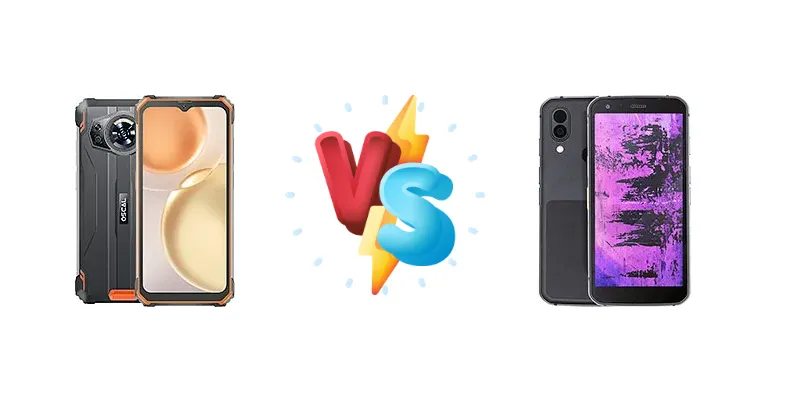
The rugged smartphone market caters to a specific need: durability. Both the Oscal S80 and Cat S62 Pro aim to deliver on that promise, but they take different approaches to internal hardware. The Oscal S80 leverages a newer Mediatek Helio G85 chipset, while the Cat S62 Pro relies on the older, but still capable, Qualcomm Snapdragon 660. This comparison will dissect the implications of these choices, focusing on performance, battery life, and overall user experience.
🏆 Quick Verdict
For the average user prioritizing modern performance and faster charging, the Oscal S80 emerges as the better value. Its Helio G85 chipset offers a noticeable performance uplift over the Snapdragon 660 in the Cat S62 Pro, and the 33W charging significantly reduces downtime. However, the Cat S62 Pro's established brand reputation and potentially more refined software experience may appeal to some.
| Network |
|---|
| 2G bands | GSM 850 / 900 / 1800 / 1900 | GSM 850 / 900 / 1800 / 1900 |
| 3G bands | HSDPA 900 / 2100 | HSDPA 850 / 900 / 1700(AWS) / 1900 / 2100 |
| 4G bands | 1, 3, 7, 8, 20, 40 | 1, 2, 3, 4, 5, 7, 8, 20, 28, 38, 40 |
| Speed | HSPA, LTE | HSPA 42.2/5.76 Mbps, LTE (2CA) Cat13 400/150 Mbps |
| Technology | GSM / HSPA / LTE | GSM / HSPA / LTE |
| Launch |
|---|
| Announced | 2023, January 03 | 2020, June 28. Released 2020, August 17 |
| Status | Available. Released 2023, February 13 | Discontinued |
| Body |
|---|
| Build | - | Glass front (Gorilla Glass 6), plastic back, aluminum frame |
| Dimensions | 174 x 81.4 x 18.9 mm (6.85 x 3.20 x 0.74 in) | 158.5 x 76.7 x 11.9 mm (6.24 x 3.02 x 0.47 in) |
| SIM | Nano-SIM + Nano-SIM | · Nano-SIM· Nano-SIM + Nano-SIM |
| Weight | 460 g (1.01 lb) | 248 g (8.75 oz) |
| | - | IP68/IP69 dust/water resistant (up to 1.5m for 35 mins)
Drop-to-concrete resistance from up to 1.8m
MIL-STD-810H compliant |
| Display |
|---|
| Protection | - | Corning Gorilla Glass 6 |
| Resolution | 1080 x 2408 pixels, 20:9 ratio (~401 ppi density) | 1080 x 2160 pixels, 18:9 ratio (~424 ppi density) |
| Size | 6.58 inches, 104.3 cm2 (~73.6% screen-to-body ratio) | 5.7 inches, 83.8 cm2 (~69.0% screen-to-body ratio) |
| Type | IPS LCD | IPS LCD |
| Platform |
|---|
| CPU | Octa-core (2x2.0 GHz Cortex-A75 & 6x1.8 GHz Cortex-A55) | Octa-core (4x2.2 GHz Kryo 260 Gold & 4x1.8 GHz Kryo 260 Silver) |
| Chipset | Mediatek MT6769 Helio G85 (12 nm) | Qualcomm SDM660 Snapdragon 660 (14 nm) |
| GPU | Mali-G52 MC2 | Adreno 512 |
| OS | Android 12, Doke-OS 3.0 | Android 10 |
| Memory |
|---|
| Card slot | microSDXC (uses shared SIM slot) | microSDXC (dedicated slot) |
| Internal | 128GB 6GB RAM | 128GB 6GB RAM |
| Main Camera |
|---|
| Dual | - | 12 MP, f/1.8, (wide), 1/2.55", 1.4µm, dual pixel PDAF
FLIR thermal camera (Lepton 3.5 module) |
| Features | LED flash, HDR, panorama | Thermal imaging, heat palettes, temp. spot meter, LED flash |
| Triple | 12 MP, f/2.0, (wide), 1/2.55", PDAF
8 MP, 117˚ (ultrawide)
Auxiliary lens | - |
| Video | 1440p@30fps, 1080p@30fps | 1080p@30fps, gyro-EIS |
| Selfie camera |
|---|
| Single | 8 MP | 8 MP |
| Video | 1080p@30fps | 1080p@30fps |
| Sound |
|---|
| 3.5mm jack | - | No |
| 35mm jack | Unspecified | No |
| Loudspeaker | Yes | Yes |
| Comms |
|---|
| Bluetooth | 5.0, A2DP, LE | 5.0, A2DP, LE |
| NFC | Yes | Yes |
| Positioning | GPS, GLONASS, GALILEO, BDS | GPS, GLONASS, GALILEO, BDS |
| Radio | FM radio | FM radio |
| USB | USB Type-C, OTG | USB Type-C 2.0, OTG |
| WLAN | Wi-Fi 802.11 a/b/g/n/ac, dual-band | Wi-Fi 802.11 a/b/g/n/ac, dual-band, Wi-Fi Direct |
| Features |
|---|
| Sensors | Fingerprint (side-mounted), accelerometer, gyro, proximity, compass | Fingerprint (rear-mounted), accelerometer, gyro, proximity, compass |
| Battery |
|---|
| Charging | 33W wired, 51% in 66 min
Reverse charging | - |
| Type | 13000 mAh | Li-Ion 4000 mAh |
| Misc |
|---|
| Colors | Navy Green, Mecha Orange, Conquest Black | Black |
| Price | About 170 EUR | About 530 EUR |
Oscal S80
- Faster 33W charging significantly reduces downtime.
- More modern Mediatek Helio G85 chipset offers better performance.
- Reverse charging capability adds versatility.
- Brand recognition is lower than Cat.
- Long-term software support is uncertain.
Cat S62 Pro
- Established brand reputation in the rugged phone market.
- Potentially more refined software experience.
- Wider availability of accessories.
- Older Snapdragon 660 chipset offers lower performance.
- Slower charging speeds.
- Less efficient 14nm process.
Display Comparison
Neither device's display specifications are provided, so a direct comparison is limited. However, given the market positioning, we can infer that both likely utilize IPS LCD panels. The Cat S62 Pro, being an older model, may have lower peak brightness and color accuracy. The Oscal S80, being newer, *could* benefit from improvements in panel technology, potentially offering a more vibrant and readable display outdoors. Bezels are likely comparable, focusing on durability rather than minimizing size.
Camera Comparison
Without detailed camera specifications, a precise comparison is difficult. However, the chipset difference suggests the Oscal S80 may have a more capable image signal processor (ISP), enabling faster image processing and potentially better low-light performance. The Snapdragon 660 is known for its reliable image quality, but the newer Helio G85 could offer improvements in dynamic range and detail. The presence of a 2MP macro lens on either device is unlikely to significantly impact overall camera performance; these are often included for marketing purposes rather than practical utility.
Performance
The core difference lies in the chipsets. The Oscal S80’s Mediatek Helio G85 (12nm) features an octa-core configuration with two Cortex-A75 cores clocked at 2.0 GHz and six Cortex-A55 cores at 1.8 GHz. This architecture prioritizes performance for gaming and multitasking. Conversely, the Cat S62 Pro’s Qualcomm Snapdragon 660 (14nm) utilizes a different core arrangement: four Kryo 260 Gold cores at 2.2 GHz and four Kryo 260 Silver cores at 1.8 GHz. While the Snapdragon 660’s Gold cores have a higher clock speed, the Helio G85’s newer Cortex-A75 cores generally offer superior single-core performance. The 12nm process of the Helio G85 is also more efficient than the 14nm process of the Snapdragon 660, potentially leading to better thermal management under sustained load. This translates to a smoother experience for demanding applications on the Oscal S80.
Battery Life
Battery capacity isn't specified for either device, making a direct mAh comparison impossible. However, the Oscal S80’s 33W wired charging is a significant advantage. It can reach 51% charge in 66 minutes, offering a much faster top-up than the Cat S62 Pro, which likely supports slower charging speeds. The Oscal S80 also offers reverse charging, a feature absent on the Cat S62 Pro, adding to its versatility. Even with a slightly smaller battery, the Oscal S80’s faster charging mitigates range anxiety.
Buying Guide
Buy the Oscal S80 if you need a rugged phone with a more responsive user experience for everyday tasks and light gaming, and if fast charging is a priority. You'll benefit from a more modern chipset and quicker power-ups. Buy the Cat S62 Pro if you prioritize a brand with a long history in the rugged phone space, potentially benefiting from more mature software and a wider ecosystem of accessories, and are less concerned with having the absolute latest processing power.
Frequently Asked Questions
❓ Does the Mediatek Helio G85 in the Oscal S80 get hot during extended gaming sessions?
While the Helio G85 is a capable chipset, sustained gaming will generate heat. However, the 12nm process node is more efficient than the Snapdragon 660's 14nm, suggesting the Oscal S80 will likely experience less thermal throttling and maintain higher frame rates for longer periods. The rugged design also provides more surface area for heat dissipation.
❓ Is the Cat S62 Pro still receiving software updates?
Given the Cat S62 Pro's age, software update support is likely limited to critical security patches. Oscal, being a newer brand, may offer a longer support window for the S80, but this is not guaranteed and should be verified before purchase.
❓ How does the ruggedness of the Oscal S80 compare to the Cat S62 Pro, given their certifications aren't specified?
Both phones are marketed as rugged, implying they meet certain drop, shock, and water/dust resistance standards (likely IP68 or similar). Cat has a longer history in this space and may have undergone more rigorous testing. However, Oscal is also focusing on durability, and both devices should withstand typical outdoor use and accidental drops.