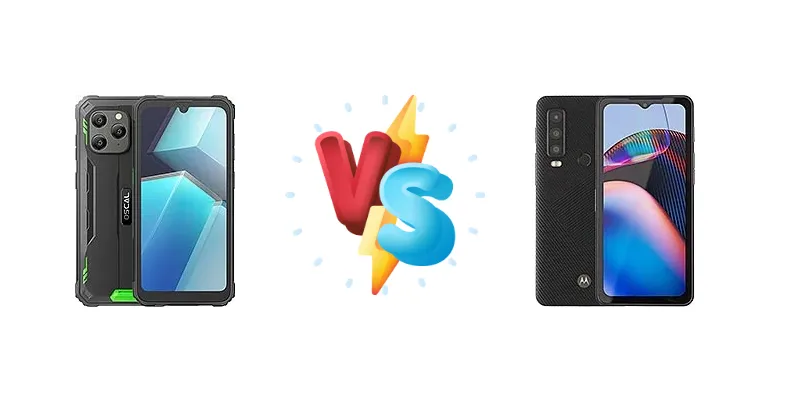
The Motorola Defy 2 and Oscal S70 Pro represent distinct approaches to the rugged smartphone market. The Defy 2 aims for a balance of durability and modern performance, leveraging a Mediatek Dimensity 930 chipset. Conversely, the Oscal S70 Pro prioritizes affordability, utilizing the older, but still functional, Mediatek Helio P35. This comparison dissects these choices, revealing which phone delivers the best experience for your needs.
🏆 Quick Verdict
For most users, the Motorola Defy 2 is the clear winner. Its Dimensity 930 chipset provides a dramatically faster and more responsive experience than the Oscal S70 Pro’s Helio P35. While the S70 Pro is cheaper, the performance gap is substantial enough to justify the price difference for anyone beyond the most basic smartphone tasks.
| Network |
|---|
| 2G bands | GSM 850 / 900 / 1800 / 1900 | GSM 850 / 900 / 1800 / 1900 |
| 3G bands | HSDPA 900 / 2100 | HSDPA 850 / 900 / 1700(AWS) / 1900 / 2100 |
| 4G bands | 1, 3, 7, 8, 19, 20, 28, 40 | 1, 2, 3, 4, 5, 7, 8, 12, 13, 14, 17, 20, 25, 26, 28, 30, 38, 40, 41, 46, 48, 66, 71 |
| 5G bands | - | 2, 5, 23, 25, 26, 28, 38, 41, 48, 66, 70, 71, 77, 78, 255, 256 SA/NSA/Sub6/mmWave |
| Speed | HSPA, LTE | HSPA, LTE, 5G |
| Technology | GSM / HSPA / LTE | GSM / HSPA / LTE / 5G |
| Launch |
|---|
| Announced | 2023, August | 2023, February 24 |
| Status | Available. Released 2023, August | Available. Released 2023, October |
| Body |
|---|
| Build | - | Glass front (Gorilla Glass Victus), plastic back, aluminum frame |
| Dimensions | 161.5 x 77.6 x 15 mm (6.36 x 3.06 x 0.59 in) | 171 x 80 x 11.9 mm (6.73 x 3.15 x 0.47 in) |
| SIM | Nano-SIM + Nano-SIM | Nano-SIM + Nano-SIM |
| Weight | 273 g (9.63 oz) | 268 g (9.45 oz) |
| | - | IP68/IP69 dust/water resistant (up to 5m for 35 min)
Drop-to-concrete resistance from up to 1.8m
MIL-STD-810H compliant |
| Display |
|---|
| Protection | - | Corning Gorilla Glass Victus |
| Resolution | 720 x 1560 pixels, 19.5:9 ratio (~282 ppi density) | 1080 x 2408 pixels, 20:9 ratio (~400 ppi density) |
| Size | 6.1 inches, 91.3 cm2 (~72.9% screen-to-body ratio) | 6.6 inches, 104.9 cm2 (~76.7% screen-to-body ratio) |
| Type | IPS LCD | IPS LCD, 120Hz |
| Platform |
|---|
| CPU | Octa-core (4x2.35 GHz Cortex-A53 & 4x1.8 GHz Cortex-A53) | Octa-core (2x2.2 GHz Cortex-A78 & 6x2.0 GHz Cortex-A55) |
| Chipset | Mediatek MT6765 Helio P35 (12 nm) | Mediatek Dimensity 930 (6 nm) |
| GPU | PowerVR GE8320 | IMG BXM-8-256 |
| OS | Android 12, Doke OS 3.1 | Android 12 |
| Memory |
|---|
| Card slot | microSDXC (dedicated slot) | microSDXC (uses shared SIM slot) |
| Internal | 64GB 4GB RAM | 128GB 6GB RAM |
| Main Camera |
|---|
| Features | LED flash | Dual-LED flash, HDR, panorama |
| Triple | 13 MP
other unspecified cameras | 50 MP, f/1.8, (wide), PDAF
8 MP, f/2.2, (ultrawide)
2 MP (macro) |
| Video | 1080p@30fps | 1080p@30fps |
| Selfie camera |
|---|
| Single | 8 MP | 8 MP, f/2.0, (wide) |
| Video | 1080p@30fps | 1080p@30fps |
| Sound |
|---|
| 3.5mm jack | - | No |
| 35mm jack | No | No |
| Loudspeaker | Yes | Yes |
| Comms |
|---|
| Bluetooth | 5.0, A2DP, LE | 5.1, A2DP, LE |
| NFC | Yes | Yes |
| Positioning | GPS, GLONASS, GALILEO, BDS | GPS (L1+L5), GLONASS, GALILEO, BDS |
| Radio | FM radio | Unspecified |
| USB | USB Type-C, OTG | USB Type-C 2.0, OTG |
| WLAN | Wi-Fi 802.11 a/b/g/n/ac, dual-band | Wi-Fi 802.11 a/b/g/n/ac, dual-band |
| Features |
|---|
| Sensors | Accelerometer, proximity, compass | Fingerprint (rear-mounted), accelerometer, gyro, proximity, compass |
| | - | Emergency SOS via satellite (Bullitt Satellite Connect service) |
| Battery |
|---|
| Charging | 10W wired
Reverse wired | 15W wireless |
| Type | 6580 mAh | Li-Po 5000 mAh |
| Misc |
|---|
| Colors | Black, Orange, Green | Black |
| Models | - | BM1S1B |
| Price | - | About 570 EUR |
Oscal S70 Pro
- Significantly lower price point
- Reverse wired charging capability
- Potentially more durable build (typical of Oscal)
- Outdated Helio P35 chipset
- Slow performance for modern apps
- Likely lower quality display
Motorola Defy 2
- Powerful Mediatek Dimensity 930 chipset
- 5G connectivity
- 15W wireless charging
- Higher price tag
- May not be as aggressively priced as the Oscal S70 Pro
- Rugged design may add bulk
Display Comparison
Neither device's display specifications are provided, so a direct comparison is limited. However, given the price point of the Oscal S70 Pro, it likely features a lower-resolution panel with standard LCD technology. The Motorola Defy 2, positioned higher in the market, likely benefits from a more vibrant and sharper display, potentially with improved color accuracy. The lack of information on refresh rates is notable; the Defy 2 *could* offer a smoother experience if it includes a 90Hz or 120Hz panel, a feature unlikely to be found on the S70 Pro.
Camera Comparison
Without detailed camera specifications, analysis is limited. However, the chipset difference indirectly impacts camera performance. The Dimensity 930 includes a more powerful image signal processor (ISP), enabling faster image processing and potentially better low-light performance on the Defy 2. While both phones likely feature multiple rear cameras, the image quality will be noticeably superior on the Defy 2 due to its more capable chipset and likely better sensor choices. The Oscal S70 Pro may rely heavily on software processing to compensate for its weaker hardware.
Performance
The performance disparity is the most significant difference. The Motorola Defy 2’s Mediatek Dimensity 930 (6nm) is a substantial upgrade over the Oscal S70 Pro’s Helio P35 (12nm). The Dimensity 930 features a more modern CPU architecture – Cortex-A78 cores versus the P35’s Cortex-A53 – resulting in significantly faster single-core and multi-core performance. The 6nm process node also contributes to better power efficiency and thermal management. This translates to smoother app launches, faster web browsing, and a more enjoyable gaming experience on the Defy 2. The P35 will struggle with demanding applications and multitasking.
Battery Life
Battery capacity isn't specified for either device. However, the Motorola Defy 2’s 15W wireless charging is a key advantage, offering convenient top-ups without needing a cable. The Oscal S70 Pro offers 10W wired charging and reverse wired charging, which is useful for charging accessories but slower for replenishing the phone's battery. The more efficient Dimensity 930 in the Defy 2 may also contribute to longer battery life despite potentially having a similar capacity to the S70 Pro.
Buying Guide
Buy the Oscal S70 Pro if you need an extremely affordable, basic smartphone for essential communication and light tasks, and prioritize reverse wired charging. Buy the Motorola Defy 2 if you value smooth multitasking, responsive gaming, 5G connectivity, and the convenience of wireless charging, even at a higher price point. The Defy 2 is for users who want a phone that *feels* modern and capable.
Frequently Asked Questions
❓ Will the Oscal S70 Pro struggle with popular apps like TikTok or Instagram?
Yes, the Helio P35 chipset in the Oscal S70 Pro is likely to exhibit noticeable lag and slowdown when running demanding apps like TikTok or Instagram, especially when multitasking. The processor simply lacks the power to handle these applications smoothly.
❓ Is the Motorola Defy 2 a good choice for mobile gaming?
The Motorola Defy 2, with its Dimensity 930 chipset, is a significantly better choice for mobile gaming than the Oscal S70 Pro. While it won't compete with flagship gaming phones, it can handle most popular titles at medium settings without significant frame drops. The Helio P35 in the S70 Pro will struggle with even less demanding games.
❓ Does the Motorola Defy 2 support 5G connectivity?
Yes, the Mediatek Dimensity 930 chipset in the Motorola Defy 2 includes an integrated 5G modem, allowing you to connect to 5G networks for faster download and upload speeds where available. The Oscal S70 Pro, with its Helio P35, is limited to 4G LTE.
❓ How long does it take to fully charge the Oscal S70 Pro with its 10W charging?
With its 10W charging, the Oscal S70 Pro will likely take over 3 hours to fully charge from 0% to 100%. This is considerably slower than the Motorola Defy 2's 15W wireless charging or even comparable wired charging solutions.