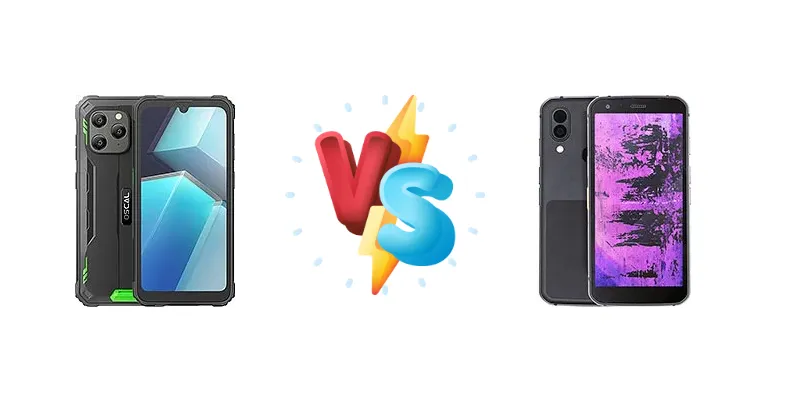
The rugged smartphone market caters to a specific user: those needing a device that can withstand harsh conditions. Both the Oscal S70 Pro and Cat S62 Pro aim to deliver this durability, but they differ significantly in their internal hardware. This comparison dives deep into the chipset, performance, and battery life to determine which phone offers the best value for demanding users.
🏆 Quick Verdict
For the average user prioritizing consistent performance and a more refined software experience, the Cat S62 Pro emerges as the better choice. While the Oscal S70 Pro offers a compelling price point, the Snapdragon 660’s superior architecture and efficiency provide a smoother, more reliable experience, especially under sustained load.
| Network |
|---|
| 2G bands | GSM 850 / 900 / 1800 / 1900 | GSM 850 / 900 / 1800 / 1900 |
| 3G bands | HSDPA 900 / 2100 | HSDPA 850 / 900 / 1700(AWS) / 1900 / 2100 |
| 4G bands | 1, 3, 7, 8, 19, 20, 28, 40 | 1, 2, 3, 4, 5, 7, 8, 20, 28, 38, 40 |
| Speed | HSPA, LTE | HSPA 42.2/5.76 Mbps, LTE (2CA) Cat13 400/150 Mbps |
| Technology | GSM / HSPA / LTE | GSM / HSPA / LTE |
| Launch |
|---|
| Announced | 2023, August | 2020, June 28. Released 2020, August 17 |
| Status | Available. Released 2023, August | Discontinued |
| Body |
|---|
| Build | - | Glass front (Gorilla Glass 6), plastic back, aluminum frame |
| Dimensions | 161.5 x 77.6 x 15 mm (6.36 x 3.06 x 0.59 in) | 158.5 x 76.7 x 11.9 mm (6.24 x 3.02 x 0.47 in) |
| SIM | Nano-SIM + Nano-SIM | · Nano-SIM· Nano-SIM + Nano-SIM |
| Weight | 273 g (9.63 oz) | 248 g (8.75 oz) |
| | - | IP68/IP69 dust/water resistant (up to 1.5m for 35 mins)
Drop-to-concrete resistance from up to 1.8m
MIL-STD-810H compliant |
| Display |
|---|
| Protection | - | Corning Gorilla Glass 6 |
| Resolution | 720 x 1560 pixels, 19.5:9 ratio (~282 ppi density) | 1080 x 2160 pixels, 18:9 ratio (~424 ppi density) |
| Size | 6.1 inches, 91.3 cm2 (~72.9% screen-to-body ratio) | 5.7 inches, 83.8 cm2 (~69.0% screen-to-body ratio) |
| Type | IPS LCD | IPS LCD |
| Platform |
|---|
| CPU | Octa-core (4x2.35 GHz Cortex-A53 & 4x1.8 GHz Cortex-A53) | Octa-core (4x2.2 GHz Kryo 260 Gold & 4x1.8 GHz Kryo 260 Silver) |
| Chipset | Mediatek MT6765 Helio P35 (12 nm) | Qualcomm SDM660 Snapdragon 660 (14 nm) |
| GPU | PowerVR GE8320 | Adreno 512 |
| OS | Android 12, Doke OS 3.1 | Android 10 |
| Memory |
|---|
| Card slot | microSDXC (dedicated slot) | microSDXC (dedicated slot) |
| Internal | 64GB 4GB RAM | 128GB 6GB RAM |
| Main Camera |
|---|
| Dual | - | 12 MP, f/1.8, (wide), 1/2.55", 1.4µm, dual pixel PDAF
FLIR thermal camera (Lepton 3.5 module) |
| Features | LED flash | Thermal imaging, heat palettes, temp. spot meter, LED flash |
| Triple | 13 MP
other unspecified cameras | - |
| Video | 1080p@30fps | 1080p@30fps, gyro-EIS |
| Selfie camera |
|---|
| Single | 8 MP | 8 MP |
| Video | 1080p@30fps | 1080p@30fps |
| Sound |
|---|
| 3.5mm jack | - | No |
| 35mm jack | No | No |
| Loudspeaker | Yes | Yes |
| Comms |
|---|
| Bluetooth | 5.0, A2DP, LE | 5.0, A2DP, LE |
| NFC | Yes | Yes |
| Positioning | GPS, GLONASS, GALILEO, BDS | GPS, GLONASS, GALILEO, BDS |
| Radio | FM radio | FM radio |
| USB | USB Type-C, OTG | USB Type-C 2.0, OTG |
| WLAN | Wi-Fi 802.11 a/b/g/n/ac, dual-band | Wi-Fi 802.11 a/b/g/n/ac, dual-band, Wi-Fi Direct |
| Features |
|---|
| Sensors | Accelerometer, proximity, compass | Fingerprint (rear-mounted), accelerometer, gyro, proximity, compass |
| Battery |
|---|
| Charging | 10W wired
Reverse wired | - |
| Type | 6580 mAh | Li-Ion 4000 mAh |
| Misc |
|---|
| Colors | Black, Orange, Green | Black |
| Price | - | About 530 EUR |
Oscal S70 Pro
- Significantly lower price point
- Reverse wired charging capability
- Rugged design for demanding environments
- Less powerful processor (Helio P35)
- Slower 10W charging
- Potentially lower build quality
Cat S62 Pro
- More powerful and efficient processor (Snapdragon 660)
- Likely better build quality and durability
- Potentially faster charging
- Higher price point
- May lack reverse wireless charging
- Potentially larger and heavier due to ruggedization
Display Comparison
Neither device boasts a cutting-edge display. Details on panel type, resolution, and refresh rate are missing for both, but the focus here is durability. Expect both to utilize hardened glass. The real difference will likely be in brightness; Cat, as a brand focused on professional use, may offer slightly better outdoor visibility, though this is speculative without specific nit ratings. Bezels are likely to be substantial on both, prioritizing protection over a modern, edge-to-edge design.
Camera Comparison
Without detailed camera specs, a direct comparison is difficult. However, given the target audience, the Cat S62 Pro likely prioritizes image clarity and reliability for documentation purposes. While both phones likely feature multiple cameras, the image processing on the Cat S62 Pro is likely tuned for accuracy and consistency, rather than overly aggressive post-processing. The Oscal S70 Pro may focus on offering a wider range of camera modes at a lower price point, but image quality will likely suffer in comparison. We can assume both will have a primary camera, but sensor size and aperture are unknown.
Performance
The core difference lies in the chipsets. The Cat S62 Pro’s Qualcomm Snapdragon 660 (14nm) is architecturally superior to the Oscal S70 Pro’s MediaTek Helio P35 (12nm). The Snapdragon 660 utilizes Kryo 260 cores – a custom design – offering better sustained performance and efficiency compared to the Cortex-A53 cores in the Helio P35. While both are octa-core, the Snapdragon 660’s 2.2 GHz clock speed on its performance cores provides a noticeable advantage in demanding applications. The 14nm process node of the Snapdragon 660, while older, is generally more refined than the 12nm node of the Helio P35, contributing to better thermal management. This translates to less throttling during prolonged use, benefiting users who rely on GPS navigation or run resource-intensive work apps.
Battery Life
Battery capacity is not specified for either device. However, the Snapdragon 660’s superior power efficiency gives the Cat S62 Pro an advantage in real-world battery life. The Oscal S70 Pro’s 10W charging is significantly slower than what’s typically found in modern smartphones, meaning longer recharge times. The Cat S62 Pro’s charging speed is unknown, but it’s reasonable to expect a faster charging solution given its higher price point and professional focus. The Oscal S70 Pro does offer reverse wired charging, a niche feature that could be useful for topping up accessories in the field.
Buying Guide
Buy the Oscal S70 Pro if you need a highly affordable, basic rugged phone for infrequent use or as a backup device. Its lower price makes it suitable for users who prioritize cost over peak performance. Buy the Cat S62 Pro if you prefer a more capable and responsive device for daily use, particularly if you rely on your phone for work in challenging environments or require consistent performance for tasks beyond basic communication.
Frequently Asked Questions
❓ Is the Oscal S70 Pro’s Helio P35 chipset sufficient for running mapping apps like Google Maps for extended periods while hiking?
The Helio P35 will likely struggle with prolonged GPS usage and map rendering. While it can handle basic navigation, expect potential lag and overheating, especially in hot weather. The Snapdragon 660 in the Cat S62 Pro is better equipped to handle these tasks without significant performance degradation.
❓ Does the Cat S62 Pro support software updates and security patches for an extended period, given its intended use in professional settings?
Cat Devices generally offer a more robust software support lifecycle than many budget brands. While specific update commitments vary, Cat typically provides longer-term security patches and software updates to ensure device security and reliability for professional users. Oscal’s update policy is less clear and likely shorter.
❓ How does the ruggedization of the Cat S62 Pro compare to the Oscal S70 Pro in terms of drop resistance and water/dust ingress protection?
Cat Devices are built to meet stringent MIL-STD-810H standards, offering superior drop resistance and IP68/IP69K water/dust protection. While the Oscal S70 Pro is also ruggedized, it likely adheres to less rigorous standards, potentially offering less protection against extreme conditions. Cat’s build quality and materials are generally more robust.