
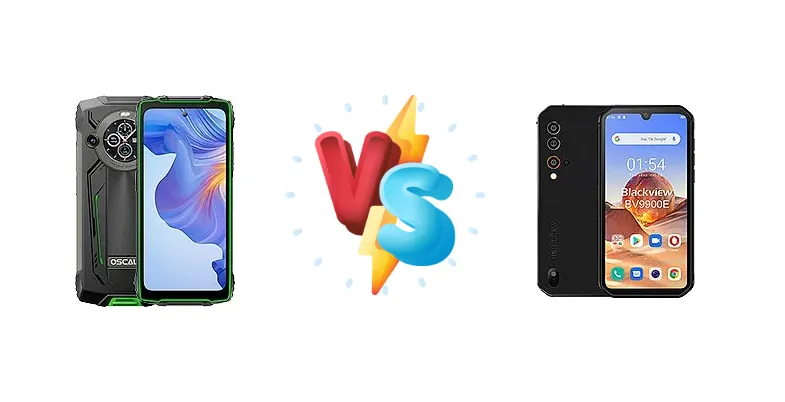
Oscal Pilot 2 vs Blackview BV9900E: A Deep Dive into Rugged Performance
| Phones Images | |||||
|---|---|---|---|---|---|
|
🏆 Quick Verdict
For the average user prioritizing efficiency and faster charging, the Oscal Pilot 2 emerges as the winner. Its Helio G99 chipset, built on a 6nm process, offers a better balance of performance and power consumption compared to the Blackview BV9900E’s 12nm Helio P90. The 45W charging is a significant advantage over the BV9900E’s 15W wired and 18W wireless.
| PHONES | ||
|---|---|---|
| Phone Names | Oscal Pilot 2 | Blackview BV9900E |
| Network | ||
|---|---|---|
| 2G bands | GSM 850 / 900 / 1800 / 1900 | GSM 850 / 900 / 1800 / 1900 |
| 3G bands | HSDPA 850 / 900 / 1700(AWS) / 1900 / 2100 | HSDPA 800 / 850 / 900 / 1700(AWS) / 1900 / 2100 |
| 4G bands | 1, 2, 3, 4, 5, 7, 8, 12, 13, 17, 18, 19, 20, 25, 26, 28, 30, 34, 38, 39, 40, 41, 66 | 1, 2, 3, 4, 5, 7, 8, 12, 13, 17, 18, 19, 20, 25, 26, 28, 34, 38, 39, 40, 41, 66 |
| Speed | HSPA, LTE | HSPA, LTE |
| Technology | GSM / CDMA / HSPA / LTE | GSM / CDMA / HSPA / CDMA2000 / LTE |
| Launch | ||
|---|---|---|
| Announced | 2024, May | 2020, September 10. Released 2020, September |
| Status | Available. Released 2024, May | Discontinued |
| Body | ||
|---|---|---|
| Dimensions | 179.5 x 82.6 x 17 mm (7.07 x 3.25 x 0.67 in) | 156.5 x 78.3 x 14.2 mm (6.16 x 3.08 x 0.56 in) |
| SIM | Nano-SIM + Nano-SIM | Nano-SIM + Nano-SIM |
| Weight | 368 g (12.98 oz) | 273 g (9.63 oz) |
| Display | ||
|---|---|---|
| Protection | Corning Gorilla Glass 5 | Corning Gorilla Glass 5 |
| Resolution | 1080 x 2400 pixels, 20:9 ratio (~405 ppi density) | 1080 x 2280 pixels, 19:9 ratio (~432 ppi density) |
| Size | 6.5 inches, 102.0 cm2 (~68.8% screen-to-body ratio) | 5.84 inches, 85.1 cm2 (~69.5% screen-to-body ratio) |
| Type | IPS LCD, 120Hz, 500 nits | IPS LCD |
| Platform | ||
|---|---|---|
| CPU | Octa-core (2x2.2 GHz Cortex-A76 & 6x2.0 GHz Cortex-A55) | Octa-core (2x2.2 GHz Cortex-A75 & 6x2.0 GHz Cortex-A55) |
| Chipset | Mediatek Helio G99 (6 nm) | Mediatek MT6779V/CE Helio P90 (12 nm) |
| GPU | Mali-G57 MC2 | PowerVR GM9446 |
| OS | Android 14, DokeOS 4.0 | Android 10 |
| Memory | ||
|---|---|---|
| Card slot | microSDXC (uses shared SIM slot) | microSDXC |
| Internal | 256GB 8GB RAM | 128GB 6GB RAM |
| Main Camera | ||
|---|---|---|
| Dual | 50 MP, (wide), 1/1.57", PDAF, OIS 13 MP, 120˚, (ultrawide), AF | - |
| Features | LED flash, HDR, panorama | LED flash, HDR, panorama |
| Quad | - | 48 MP, f/1.8, (wide), PDAF 16 MP, 120˚ (ultrawide) 2 MP (macro) Auxiliary lens |
| Video | 1440p@30fps, 1080p@30fps | 4K@30fps, 1080p@60fps |
| Selfie camera | ||
|---|---|---|
| Single | 32 MP, (wide) | 16 MP, f/2.0, (wide) |
| Video | 1080p@30fps | 1080p@30fps |
| Sound | ||
|---|---|---|
| 35mm jack | No | No |
| Loudspeaker | Yes | Yes |
| Comms | ||
|---|---|---|
| Bluetooth | 5.1, A2DP, LE | 5.0, A2DP, LE |
| NFC | Yes | Yes |
| Positioning | GPS, GLONASS, BDS, GALILEO | GPS, GLONASS, GALILEO, BDS |
| Radio | FM radio | FM radio |
| USB | USB Type-C, OTG | USB Type-C 2.0, OTG |
| WLAN | Wi-Fi 802.11 a/b/g/n/ac, dual-band | Wi-Fi 802.11 a/b/g/n/ac |
| Features | ||
|---|---|---|
| Sensors | Fingerprint (side-mounted), accelerometer, gyro, proximity, compass | Fingerprint (side-mounted), accelerometer, gyro, proximity, compass, barometer |
| Battery | ||
|---|---|---|
| Charging | 45W wired 5W reverse wired | 15W wired 18W wireless |
| Type | 8800 mAh | 4380 mAh |
| Misc | ||
|---|---|---|
| Colors | Black, Green, Orange | Black, Silver |
| Price | - | About 260 EUR |
Oscal Pilot 2
- More efficient Helio G99 chipset
- Significantly faster 45W wired charging
- Potentially better sustained performance
- Lacks wireless charging
- Camera specs unknown
Blackview BV9900E
- Wireless charging convenience
- Potentially higher peak CPU performance (short bursts)
- Established rugged phone brand
- Less efficient Helio P90 chipset
- Slower 15W wired charging
- More prone to thermal throttling
Display Comparison
Neither device’s display specifications are provided, so a direct comparison is limited. However, given the Pilot 2’s focus on efficiency, it’s likely to employ a power-saving panel technology. The BV9900E, being an older model, may have a less efficient display. Real-world brightness and color accuracy will be key differentiators, requiring hands-on testing.
Camera Comparison
Without detailed camera specs, a definitive comparison is difficult. However, the market segment suggests both phones will prioritize practicality over flagship-level photography. The focus will likely be on durable image capture in challenging conditions. The absence of information regarding sensor size and aperture makes it impossible to assess low-light performance or dynamic range. The 2MP macro cameras commonly found on these devices are unlikely to provide significant photographic value.
Performance
The core difference lies in the chipsets. The Oscal Pilot 2’s Mediatek Helio G99 (6nm) boasts a more modern architecture than the Blackview BV9900E’s Helio P90 (12nm). While both CPUs feature a 2x2.2 GHz Cortex-A76 & 6x2.0 GHz Cortex-A55 configuration, the G99’s smaller node translates to improved thermal efficiency and sustained performance. The P90, while capable, is more prone to throttling under prolonged load. This benefits gamers and multi-taskers on the Pilot 2.
Battery Life
Battery capacity isn’t specified for either device, but the charging capabilities reveal a key difference. The Oscal Pilot 2’s 45W wired charging significantly outperforms the Blackview BV9900E’s 15W wired charging. The BV9900E offers 18W wireless charging, a convenience the Pilot 2 lacks. However, the G99’s efficiency means the Pilot 2 may achieve comparable real-world battery life with a smaller battery capacity, and will refill much faster when plugged in.
Buying Guide
Buy the Oscal Pilot 2 if you need a phone that balances performance with battery life, and value fast charging speeds for minimal downtime. It’s ideal for users who frequently use their phones for navigation, media consumption, and light gaming. Buy the Blackview BV9900E if you prioritize wireless charging convenience and potentially slightly higher peak performance in short bursts, accepting the trade-off of lower efficiency and slower wired charging.