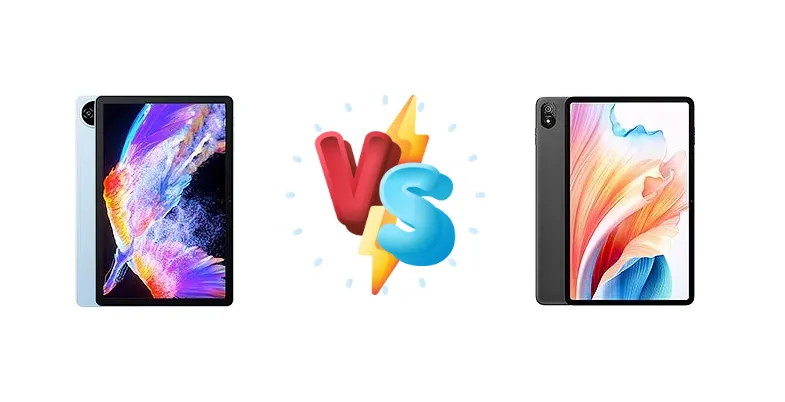
The budget tablet market is heating up, with the Oscal Pad 90 and Blackview Tab 18 vying for attention. Both aim to deliver a compelling experience without breaking the bank, but they take different approaches. The Oscal Pad 90 prioritizes longevity with a focus on battery endurance, while the Blackview Tab 18 leans into performance with a newer, more efficient chipset. This comparison will dissect the key differences to help you choose the right tablet for your needs.
🏆 Quick Verdict
For most users, the Blackview Tab 18 is the better choice. Its Mediatek Helio G99 chipset, built on a 6nm process, offers a significant performance advantage over the Oscal Pad 90’s Unisoc T606. While the Oscal Pad 90 boasts impressive battery endurance, the Tab 18’s faster charging and more capable processor make it the more versatile option.
| Network |
|---|
| 2G bands | GSM 850 / 900 / 1800 / 1900 | GSM 850 / 900 / 1800 / 1900 |
| 3G bands | HSDPA 900 / 2100 | HSDPA 900 / 2100 |
| 4G bands | 1, 3, 7, 8, 19, 20, 28, 38, 40, 41 | 1, 3, 7, 8, 20, 40 |
| Speed | HSPA, LTE | HSPA, LTE |
| Technology | GSM / HSPA / LTE | GSM / HSPA / LTE |
| Launch |
|---|
| Announced | 2025, January | 2023, November |
| Status | Available. Released 2025, January | Available. Released 2023, November |
| Body |
|---|
| Dimensions | 258.1 x 169.6 x 8 mm (10.16 x 6.68 x 0.31 in) | 277.6 x 173.2 x 7.9 mm (10.93 x 6.82 x 0.31 in) |
| SIM | Nano-SIM + Nano-SIM | Nano-SIM + Nano-SIM |
| Weight | 534 g (1.18 lb) | 632 g (1.39 lb) |
| Display |
|---|
| Protection | Mohs level 7 | - |
| Resolution | 800 x 1280 pixels, 16:10 ratio (~138 ppi density) | 1200 x 2000 pixels, 5:3 ratio (~194 ppi density) |
| Size | 10.92 inches, 345.8 cm2 (~79.0% screen-to-body ratio) | 12.0 inches, 409.9 cm2 (~85.2% screen-to-body ratio) |
| Type | IPS LCD, 350 nits | IPS LCD, 350 nits |
| Platform |
|---|
| CPU | Octa-core (2x1.6 GHz Cortex-A75 & 6x1.6 GHz Cortex-A55) | Octa-core (2x2.2 GHz Cortex-A76 & 6x2.0 GHz Cortex-A55) |
| Chipset | Unisoc T606 (12 nm) | Mediatek Helio G99 (6 nm) |
| GPU | Mali-G57 MP1 | Mali-G57 MC2 |
| OS | Android 14, DokeOS_P 4.0 | Android 13, Doke OS_P 4.0 |
| Memory |
|---|
| Card slot | microSDXC (uses shared SIM slot) | microSDXC (uses shared SIM slot) |
| Internal | 128GB 8GB RAM | 256GB 12GB RAM |
| Main Camera |
|---|
| Features | - | LED flash |
| Single | 13 MP | 16 MP |
| Video | 1080p@30fps | 1080p@30fps |
| Selfie camera |
|---|
| Single | 8 MP | 8 MP |
| Video | 720p@30fps | Yes |
| Sound |
|---|
| 35mm jack | Yes | No |
| Loudspeaker | Yes, with stereo speakers | Yes, with stereo speakers (4 speakers) |
| Comms |
|---|
| Bluetooth | Yes | 5.1, A2DP, LE |
| NFC | No | No |
| Positioning | GPS, GLONASS, GALILEO, BDS | GPS, GLONASS, GALILEO, BDS |
| Radio | FM radio | FM Radio |
| USB | USB Type-C, OTG | USB Type-C, OTG |
| WLAN | Wi-Fi 802.11 a/b/g/n/ac, dual-band | Wi-Fi 802.11 a/b/g/n/ac, dual-band |
| Features |
|---|
| Sensors | No | Fingerprint (side-mounted), accelerometer, gyro, proximity, compass |
| Battery |
|---|
| Charging | - | 33W wired |
| Type | 7700 mAh | 8800 mAh |
| Misc |
|---|
| Colors | Space Gray, Sky Blue | Turquoise Green, Glacier Blue, Space Grey |
| EU LABEL |
|---|
| Battery | 124:54h endurance, 800 cycles | - |
| Energy | Class D | - |
| Free fall | Class C (135 falls) | - |
| Repairability | Class B | - |
Oscal Pad 90
- Exceptional battery endurance (124:54h)
- Long battery lifespan (800 cycles)
- Potentially lower price point
- Less powerful Unisoc T606 chipset
- Likely slower charging speeds
- Inferior performance for demanding tasks
Blackview Tab 18
- More powerful Mediatek Helio G99 chipset
- Faster 33W wired charging
- Improved performance for gaming and multitasking
- Battery endurance likely lower than Oscal Pad 90
- Potentially higher price point
- Battery cycle life not specified
Display Comparison
Neither device provides display specifications, so a direct comparison is limited. However, given the price points, we can expect both to utilize IPS LCD panels. The absence of details like resolution, refresh rate, or peak brightness suggests neither is aiming for display excellence. Users prioritizing visual fidelity should consider alternatives. Bezels are likely to be substantial on both devices, typical for this market segment.
Camera Comparison
Without camera specifications beyond sensor resolution, a meaningful comparison is impossible. It’s safe to assume both tablets feature basic camera setups geared towards casual use. The absence of details like aperture, sensor size, or optical image stabilization suggests image quality will be adequate but not exceptional. Users seeking a tablet for serious photography should look elsewhere.
Performance
The core difference lies in the chipsets. The Blackview Tab 18’s Mediatek Helio G99 (6nm) is a clear upgrade over the Oscal Pad 90’s Unisoc T606 (12nm). The 6nm process node allows for greater transistor density and improved power efficiency, translating to better performance and less heat generation. The Helio G99’s CPU configuration – 2x2.2 GHz Cortex-A76 & 6x2.0 GHz Cortex-A55 – also outperforms the Oscal’s 2x1.6 GHz Cortex-A75 & 6x1.6 GHz Cortex-A55. This means faster app loading times, smoother multitasking, and a more enjoyable gaming experience on the Tab 18. While RAM details are missing, the chipset advantage is substantial.
Battery Life
The Oscal Pad 90 claims an impressive 124:54h endurance and 800 charge cycles, indicating a focus on long-term battery health and longevity. However, the Blackview Tab 18 compensates with 33W wired charging, a significant advantage over the likely slower charging speeds of the Oscal Pad 90. While the Tab 18’s battery capacity is unknown, the more efficient Helio G99 chipset will likely result in competitive real-world battery life, coupled with the convenience of faster recharging. The 800 cycle claim on the Oscal is a strong point for long-term users.
Buying Guide
Buy the Oscal Pad 90 if you absolutely prioritize maximum battery life and plan to use your tablet primarily for static tasks like reading ebooks or watching downloaded videos. You’ll benefit from the extended 124:54h endurance. Buy the Blackview Tab 18 if you want a tablet that can handle more demanding tasks like gaming, multitasking, or streaming high-resolution content. The Helio G99 provides a smoother, more responsive experience, and the 33W charging minimizes downtime.
Frequently Asked Questions
❓ Will the Blackview Tab 18’s Helio G99 chipset overheat during extended gaming sessions?
The Mediatek Helio G99 is built on a 6nm process, which offers improved thermal efficiency compared to the Oscal Pad 90’s 12nm Unisoc T606. While some heat generation is inevitable during gaming, the G99 is designed to manage temperatures effectively, minimizing throttling and maintaining consistent performance. However, sustained peak loads will still generate heat, and performance may be slightly reduced over very long sessions.
❓ How long will it take to fully charge the Blackview Tab 18 with the 33W charger?
Without knowing the battery capacity of the Blackview Tab 18, a precise charging time is difficult to estimate. However, 33W charging is significantly faster than the likely charging speed of the Oscal Pad 90. Expect a full charge to take between 1.5 to 2.5 hours, depending on the battery size and current charge level. This is a substantial improvement over slower charging solutions.
❓ Is the 800 charge cycle claim on the Oscal Pad 90 a significant advantage?
Yes, the 800 charge cycle claim is a notable benefit for long-term users. Battery capacity degrades over time with each charge cycle. A higher cycle count indicates the Oscal Pad 90’s battery is designed to maintain a reasonable capacity for a longer period, potentially extending the tablet’s usable lifespan.