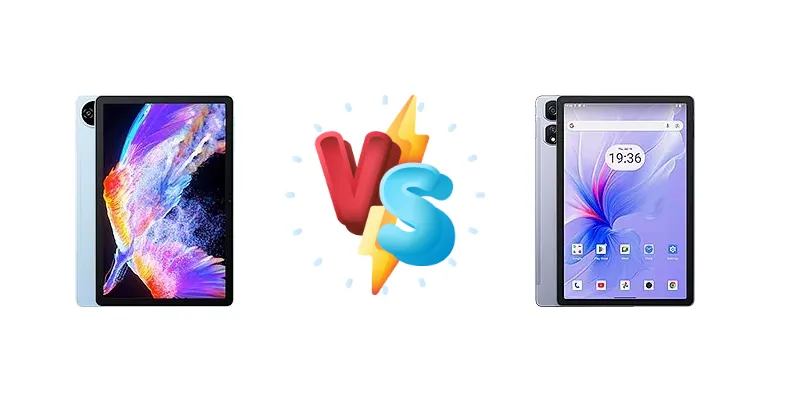
The budget Android tablet space is heating up, with the Oscal Pad 90 and Blackview Tab 16 Pro offering compelling features at attractive price points. Both leverage Unisoc chipsets, but diverge in battery capacity and charging speeds. This comparison dissects these differences to determine which tablet best suits your needs, focusing on real-world performance implications.
🏆 Quick Verdict
For users prioritizing maximum longevity and battery cycle life, the Blackview Tab 16 Pro emerges as the winner. Its 1200 battery cycles significantly outpace the Oscal Pad 90’s 800, offering greater peace of mind over the tablet’s lifespan. However, the Oscal Pad 90 remains a strong contender for those seeking a balance of performance and endurance.
| Network |
|---|
| 2G bands | GSM 850 / 900 / 1800 / 1900 | GSM 850 / 900 / 1800 / 1900 |
| 3G bands | HSDPA 900 / 2100 | HSDPA 900 / 2100 |
| 4G bands | 1, 3, 7, 8, 19, 20, 28, 38, 40, 41 | 1, 3, 7, 8, 19, 20, 40, 41 |
| Speed | HSPA, LTE | HSPA, LTE |
| Technology | GSM / HSPA / LTE | GSM / HSPA / LTE |
| Launch |
|---|
| Announced | 2025, January | 2024, May |
| Status | Available. Released 2025, January | Available. Released 2024, May |
| Body |
|---|
| Dimensions | 258.1 x 169.6 x 8 mm (10.16 x 6.68 x 0.31 in) | 256.8 x 167 x 7.5 mm (10.11 x 6.57 x 0.30 in) |
| SIM | Nano-SIM + Nano-SIM | Nano-SIM + Nano-SIM |
| Weight | 534 g (1.18 lb) | 503 g (1.11 lb) |
| Display |
|---|
| Protection | Mohs level 7 | Mohs level 5 |
| Resolution | 800 x 1280 pixels, 16:10 ratio (~138 ppi density) | 1200 x 1920 pixels, 16:10 ratio (~206 ppi density) |
| Size | 10.92 inches, 345.8 cm2 (~79.0% screen-to-body ratio) | 11.0 inches, 350.9 cm2 (~81.8% screen-to-body ratio) |
| Type | IPS LCD, 350 nits | IPS LCD |
| Platform |
|---|
| CPU | Octa-core (2x1.6 GHz Cortex-A75 & 6x1.6 GHz Cortex-A55) | Octa-core (2x2.0 GHz Cortex-A75 & 6x1.8 GHz Cortex-A55) |
| Chipset | Unisoc T606 (12 nm) | Unisoc Tiger T616 (12 nm) |
| GPU | Mali-G57 MP1 | Mali-G57 MP1 |
| OS | Android 14, DokeOS_P 4.0 | Android 14 |
| Memory |
|---|
| Card slot | microSDXC (uses shared SIM slot) | microSDXC (uses shared SIM slot) |
| Internal | 128GB 8GB RAM | 256GB 8GB RAM |
| Main Camera |
|---|
| Dual | - | 13 MP
2 MP |
| Features | - | LED flash |
| Single | 13 MP | - |
| Video | 1080p@30fps | 1080p@30fps |
| Selfie camera |
|---|
| Single | 8 MP | 8 MP |
| Video | 720p@30fps | Yes |
| Sound |
|---|
| 35mm jack | Yes | No |
| Loudspeaker | Yes, with stereo speakers | Yes, with stereo speakers |
| Comms |
|---|
| Bluetooth | Yes | 5.0, A2DP |
| NFC | No | No |
| Positioning | GPS, GLONASS, GALILEO, BDS | GPS, GLONASS, GALILEO, BDS |
| Radio | FM radio | Unspecified |
| USB | USB Type-C, OTG | USB Type-C, OTG |
| WLAN | Wi-Fi 802.11 a/b/g/n/ac, dual-band | Wi-Fi 802.11 a/b/g/n/ac, dual-band |
| Features |
|---|
| Sensors | No | Accelerometer |
| Battery |
|---|
| Charging | - | 18W wired |
| Type | 7700 mAh | 7700 mAh |
| Misc |
|---|
| Colors | Space Gray, Sky Blue | Gray, Blue, Violet |
| EU LABEL |
|---|
| Battery | 124:54h endurance, 800 cycles | 97:36h endurance, 1200 cycles |
| Energy | Class D | Class E |
| Free fall | Class C (135 falls) | Class B (156 falls) |
| Repairability | Class B | Class B |
Oscal Pad 90
- Longer battery endurance (124:54h)
- Potentially lower price point (depending on retailer)
- Solid performance for everyday tasks
- Lower battery cycle count (800)
- Slightly slower CPU and GPU performance
- Charging speed not specified
Blackview Tab 16 Pro
- Higher battery cycle count (1200)
- Faster CPU and GPU performance
- 18W wired charging
- Shorter battery endurance (97:36h)
- Potentially higher price point
- May require more frequent charging
Display Comparison
Display specifications are not provided, so a direct comparison is limited. However, given the price bracket, both tablets likely utilize IPS LCD panels. The user experience will hinge on resolution and color accuracy, which are currently unknown. Bezels are also a key consideration; smaller bezels contribute to a more immersive viewing experience. Without further data, it's reasonable to assume both offer adequate displays for media consumption, but neither will likely compete with higher-end OLED panels.
Camera Comparison
Camera details are absent, making a meaningful comparison impossible. In this price segment, camera performance is rarely a primary selling point. Expect both tablets to feature basic camera setups suitable for casual snapshots and video calls. Sensor size and aperture are critical factors, but without this information, we can only assume both offer similar image quality. The inclusion of features like Optical Image Stabilization (OIS) would be a significant advantage, but is unlikely at this price point.
Performance
The Blackview Tab 16 Pro’s Unisoc Tiger T616 chipset boasts a slight CPU clock speed advantage (2.0 GHz vs 1.6 GHz on the Oscal Pad 90’s T606). This, coupled with a marginally faster Cortex-A55 core speed (1.8 GHz vs 1.6 GHz), translates to a potentially snappier experience in demanding applications. While both chipsets are 12nm, the T616’s architectural refinements should yield a modest performance boost. This benefits users engaging in multitasking, gaming, or video editing. The core architecture (2x A75, 6x A55) is identical, meaning the performance difference will be incremental, not transformative.
Battery Life
The Blackview Tab 16 Pro’s 97:36h endurance is less than the Oscal Pad 90’s 124:54h, but this is offset by its significantly higher battery cycle count of 1200 versus 800. This means the Blackview Tab 16 Pro is designed to maintain a higher percentage of its original capacity after more charge/discharge cycles. The 18W wired charging on the Blackview Tab 16 Pro is a welcome addition, allowing for faster replenishment, though the exact 0-100% time remains unknown. The Oscal Pad 90 lacks specified charging speed, suggesting it may be slower.
Buying Guide
Buy the Oscal Pad 90 if you need a tablet for everyday tasks like browsing, streaming, and light productivity, and value a solid all-around experience. Buy the Blackview Tab 16 Pro if you prioritize long-term battery health, anticipate heavy usage, and want the reassurance of a higher battery cycle count, even if it means slightly slower charging.
Frequently Asked Questions
❓ How will the difference in battery cycle counts affect the tablet's lifespan?
The Blackview Tab 16 Pro’s 1200 cycles mean it’s designed to retain a higher percentage of its original battery capacity after being charged and discharged 1200 times. The Oscal Pad 90’s 800 cycles mean it will likely experience a more noticeable decline in battery health over the same period, potentially requiring a battery replacement sooner.
❓ Is the performance difference between the Unisoc T606 and T616 noticeable in everyday use?
The performance difference is likely to be subtle in most everyday tasks like browsing, streaming, and social media. However, users who frequently engage in multitasking, gaming, or video editing may notice a smoother experience with the Blackview Tab 16 Pro’s T616 chipset due to its slightly higher clock speeds and architectural refinements.
❓ Does the 18W charging on the Blackview Tab 16 Pro significantly reduce charging times?
While the exact charging time is unknown, 18W charging is faster than many budget tablets that offer 10W or 15W charging. This means you'll be able to replenish the battery more quickly, minimizing downtime. However, the Blackview Tab 16 Pro has a smaller battery capacity, so the charging time difference may not be dramatic.