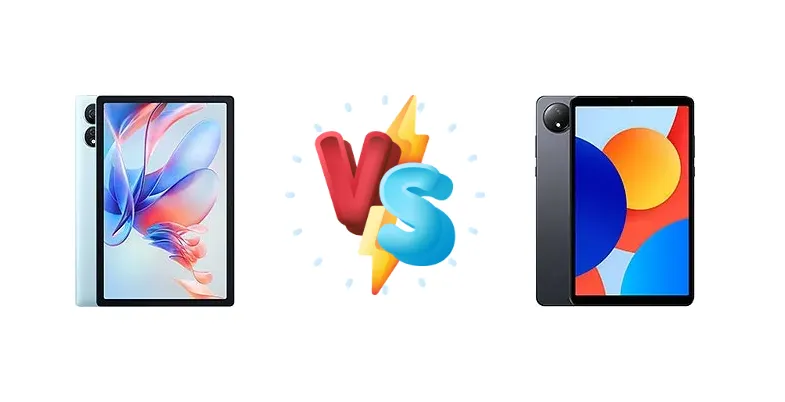
The sub-$200 tablet market is heating up, with the Oscal Pad 80 and Xiaomi Redmi Pad SE 8.7 vying for dominance. Both offer a large-screen experience at an accessible price, but key differences in chipset and charging capabilities dictate which tablet is best suited for your needs. This comparison dissects those differences to provide a clear recommendation.
🏆 Quick Verdict
For most users, the Xiaomi Redmi Pad SE 8.7 is the better choice. While the Oscal Pad 80 offers a functional experience, the Redmi Pad SE’s faster 18W (International) charging and slightly more powerful Helio G85 chipset provide a noticeable advantage in everyday use and light gaming.
| Network |
|---|
| 2G bands | GSM 850 / 900 / 1800 / 1900 N/A | GSM 850 / 900 / 1800 / 1900 |
| 3G bands | N/A | HSDPA 800 / 850 / 900 / 1700(AWS) / 1900 / 2100 |
| 4G bands | N/A | 1, 2, 3, 4, 5, 7, 8, 13, 18, 19, 20, 26, 28, 38, 40, 41, 66 |
| EDGE | No | - |
| GPRS | No | - |
| Speed | - | HSPA, LTE - cellular model only |
| Technology | GSM | GSM / HSPA / LTE |
| Launch |
|---|
| Announced | 2025, January | 2024, July 29 |
| Status | Available. Released 2025, January | Available. Released 2024, August 08 |
| Body |
|---|
| Build | - | Glass front (Gorilla Glass 3) |
| Dimensions | 246.8 x 161.9 x 9.1 mm (9.72 x 6.37 x 0.36 in) | 211.6 x 125.5 x 8.8 mm (8.33 x 4.94 x 0.35 in) |
| SIM | No | Nano-SIM + Nano-SIM (cellular model only) |
| Weight | 495 g (1.09 lb) | 370 / 373 / 375 g (13.05 oz) |
| Display |
|---|
| Protection | - | Corning Gorilla Glass 3 |
| Resolution | 1200 x 1920 pixels, 16:10 ratio (~215 ppi density) | 800 x 1340 pixels, 5:3 ratio (~179 ppi density) |
| Size | 10.51 inches, 320.3 cm2 (~80.2% screen-to-body ratio) | 8.7 inches, 214.9 cm2 (~80.9% screen-to-body ratio) |
| Type | IPS LCD | IPS LCD, 1B colors, 90Hz, 600 nits (HBM) |
| Platform |
|---|
| CPU | Octa-core (2x1.6 GHz Cortex-A75 & 6x1.6 GHz Cortex-A55) | Octa-core (2x2.0 GHz Cortex-A75 & 6x1.8 GHz Cortex-A55) |
| Chipset | Unisoc T606 (12 nm) | Mediatek Helio G85 (12 nm) |
| GPU | Mali-G57 MP1 | Mali-G52 MC2 |
| OS | Android 14, Doke OS_P 4.0 | Android 14, HyperOS |
| Memory |
|---|
| Card slot | microSDXC (dedicated slot) | microSDXC (dedicated slot) |
| Internal | 256GB 6GB RAM | 64GB 4GB RAM, 128GB 4GB RAM, 128GB 6GB RAM |
| Main Camera |
|---|
| Features | LED flash | LED flash |
| Single | 13 MP, f/2.0 | 8 MP, f/2.0, (wide), 1/4.0", 1.12µm |
| Video | 1080p@30fps | 1080p@30fps |
| Selfie camera |
|---|
| Single | 8 MP, f/2.2 | 5 MP, f/2.2, (wide), 1/5.0", 1.12µm |
| Video | 720p@30fps | 1080p@30fps |
| Sound |
|---|
| 35mm jack | Yes | Yes |
| Loudspeaker | Yes, with stereo speakers | Yes, with stereo speakers |
| Comms |
|---|
| Bluetooth | 5.0, A2DP, LE | 5.3, A2DP, LE |
| Infrared port | - | Yes |
| NFC | No | No |
| Positioning | No | GPS, GALILEO, GLONASS, BDS - cellular model only |
| Radio | No | FM radio |
| USB | USB Type-C | USB Type-C 2.0 |
| WLAN | Wi-Fi 802.11 a/b/g/n/ac, dual-band | Wi-Fi 802.11 a/b/g/n/ac, dual-band |
| Features |
|---|
| Sensors | Accelerometer | Accelerometer, proximity (accessories only), compass |
| Battery |
|---|
| Charging | 10W wired | 18W wired (Int'l)
10W wired (India) |
| Type | 8200 mAh | 6650 mAh |
| Misc |
|---|
| Colors | Grey, Blue | Aurora Green (Forest Green), Sky Blue (Ocean Blue), Graphite Gray (Urban Grey) |
| Models | - | 220233L2G |
| Price | - | About 120 EUR |
| SAR | - | 0.90 W/kg (head) 0.65 W/kg (body) |
| SAR EU | - | 0.40 W/kg (head) 0.99 W/kg (body) |
Oscal Pad 80 WiFi
- Potentially lower price point
- Functional for basic tasks
- Compact 8-inch form factor
- Slower Unisoc T606 chipset
- Significantly slower 10W charging
- Likely less responsive user experience
Xiaomi Redmi Pad SE 8.7
- Faster MediaTek Helio G85 chipset
- Faster 18W (International) charging
- Slightly larger 8.7-inch display
- May be slightly more expensive
- Still limited gaming capabilities
- Camera performance likely similar to Oscal Pad 80
Display Comparison
Both tablets feature 8-inch displays, but detailed display specs are unavailable. Given the price point, expect IPS LCD panels. The Redmi Pad SE’s slightly larger screen size (8.7 inches vs 8 inches) offers a marginally more immersive viewing experience. Bezels are likely comparable, and color accuracy will be typical for this segment – adequate for general use but not color-critical work. Without specific brightness data, it’s difficult to assess outdoor visibility, but both will likely struggle in direct sunlight.
Camera Comparison
Camera performance is unlikely to be a deciding factor for either tablet. Both will likely feature basic camera setups geared towards video calls and casual snapshots. Without sensor size or aperture information, it’s difficult to make a meaningful comparison. Expect image quality to be acceptable in good lighting conditions but poor in low light. Focusing on the rear camera specs is less important than the front-facing camera for video conferencing, a common use case for tablets.
Performance
The core difference lies in the chipsets. The Redmi Pad SE’s MediaTek Helio G85, with its 2x2.0 GHz Cortex-A75 cores, offers a clear advantage over the Oscal Pad 80’s Unisoc T606 (2x1.6 GHz Cortex-A75). While both are 12nm chips, the higher clock speeds on the G85 translate to snappier app launches and smoother multitasking. The G85’s GPU is also more capable, providing a better gaming experience, even if limited to lighter titles. The Oscal Pad 80 will handle basic tasks, but the Redmi Pad SE will feel more responsive under load. RAM configurations are not specified, but sufficient RAM is crucial for Android performance.
Battery Life
Battery capacity is not specified for either device. However, the Redmi Pad SE’s 18W (International) charging is a significant advantage over the Oscal Pad 80’s 10W charging. This translates to substantially faster charging times, reducing downtime. While a larger battery capacity is always preferable, faster charging can mitigate the impact of a smaller battery. The 10W charging on the Oscal Pad 80 will require a significantly longer time to reach a full charge, impacting usability for users who need quick top-ups. Note that the Redmi Pad SE has 10W charging in India.
Buying Guide
Buy the Oscal Pad 80 WiFi if you prioritize absolute affordability and are willing to accept slower charging speeds and slightly less responsive performance. It’s a solid option for basic media consumption and light tasks. Buy the Xiaomi Redmi Pad SE 8.7 if you value faster charging, a bit more processing power for smoother multitasking and gaming, and a generally more refined user experience, even if it means spending a little extra.
Frequently Asked Questions
❓ Does the Redmi Pad SE's Helio G85 chipset handle popular games like PUBG Mobile?
The Helio G85 can run PUBG Mobile, but expect to play at lower graphics settings and frame rates for a smooth experience. It's not a gaming powerhouse, but it's capable of handling less demanding titles without issue. The Oscal Pad 80's Unisoc T606 will struggle more with graphically intensive games.
❓ How long does it realistically take to fully charge the Oscal Pad 80 with its 10W charging?
With 10W charging, a full charge from 0% on the Oscal Pad 80 will likely take between 4-6 hours, depending on battery capacity. This is significantly slower than the Redmi Pad SE, making it less convenient for users who need a quick power boost.
❓ Is the difference in charging speed between 10W and 18W (International) really that noticeable?
Yes, the difference is substantial. 18W charging can typically add a significant percentage of battery life in just 30 minutes, while 10W charging will provide a much smaller gain in the same timeframe. This makes the Redmi Pad SE much more practical for users on the go.
❓ Which tablet is better for video conferencing and online classes?
Both tablets are suitable for video conferencing, but the Redmi Pad SE’s slightly more responsive performance may result in a smoother experience with video apps. The front-facing camera quality is likely similar on both, so the chipset advantage is the key differentiator.