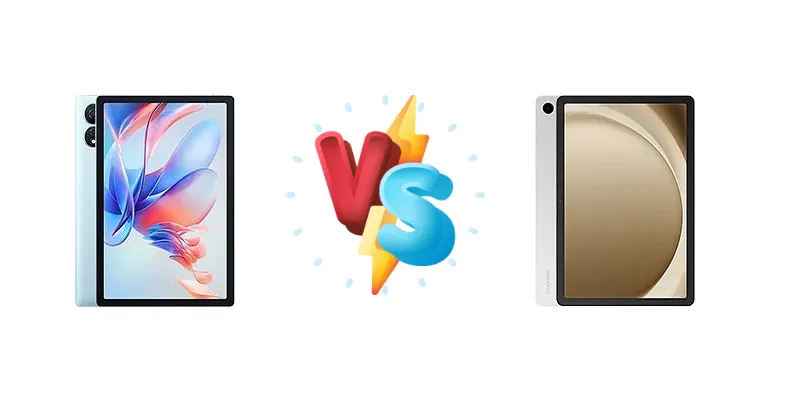
The Android tablet market is heating up, with options ranging from ultra-premium flagships to aggressively priced contenders. We're pitting the Oscal Pad 80 WiFi, a value-focused device, against the Samsung Galaxy Tab A9+, a more established player offering 5G connectivity and a more refined experience. This comparison dives deep into the core differences to help you decide which tablet best suits your needs.
🏆 Quick Verdict
For the average user prioritizing a balance of performance and affordability, the Samsung Galaxy Tab A9+ emerges as the stronger choice. Its Snapdragon 695 chipset, built on a more efficient 6nm process, delivers noticeably better performance and future-proofing than the Oscal Pad 80’s Unisoc T606, despite the latter’s lower price point.
| Network |
|---|
| 2G bands | GSM 850 / 900 / 1800 / 1900 N/A | GSM 850 / 900 / 1800 / 1900 |
| 3G bands | N/A | HSDPA 850 / 900 / 1700(AWS) / 1900 / 2100 |
| 4G bands | N/A | 1, 2, 3, 4, 5, 7, 8, 12, 13, 17, 20, 26, 28, 38, 40, 41, 66 |
| 5G bands | - | 1, 3, 5, 7, 8, 20, 28, 38, 40, 41, 66, 77, 78 SA/NSA/Sub6 |
| EDGE | No | - |
| GPRS | No | - |
| Speed | - | HSPA, LTE, 5G - cellular model only |
| Technology | GSM | GSM / HSPA / LTE / 5G |
| Launch |
|---|
| Announced | 2025, January | 2023, October 05 |
| Status | Available. Released 2025, January | Available. Released 2023, October 17 |
| Body |
|---|
| Dimensions | 246.8 x 161.9 x 9.1 mm (9.72 x 6.37 x 0.36 in) | 257.1 x 168.7 x 6.9 mm (10.12 x 6.64 x 0.27 in) |
| SIM | No | Nano-SIM + eSIM (cellular model only) |
| Weight | 495 g (1.09 lb) | 480 g or 492 g (1.06 lb) |
| Display |
|---|
| Resolution | 1200 x 1920 pixels, 16:10 ratio (~215 ppi density) | 1200 x 1920 pixels, 16:10 ratio (~206 ppi density) |
| Size | 10.51 inches, 320.3 cm2 (~80.2% screen-to-body ratio) | 11.0 inches, 350.9 cm2 (~80.9% screen-to-body ratio) |
| Type | IPS LCD | TFT LCD, 90Hz |
| Platform |
|---|
| CPU | Octa-core (2x1.6 GHz Cortex-A75 & 6x1.6 GHz Cortex-A55) | Octa-core (2x2.2 GHz Kryo 660 Gold & 6x1.8 GHz Kryo 660 Silver) |
| Chipset | Unisoc T606 (12 nm) | Qualcomm SM6375 Snapdragon 695 5G (6 nm) |
| GPU | Mali-G57 MP1 | Adreno 619 |
| OS | Android 14, Doke OS_P 4.0 | Android 13, upgradable to Android 15, One UI 7 |
| Memory |
|---|
| Card slot | microSDXC (dedicated slot) | microSDXC (dedicated slot) |
| Internal | 256GB 6GB RAM | 64GB 4GB RAM, 128GB 4GB RAM, 128GB 8GB RAM, 256GB 8GB RAM |
| Main Camera |
|---|
| Features | LED flash | - |
| Single | 13 MP, f/2.0 | 8 MP, AF |
| Video | 1080p@30fps | 1080p@30fps |
| Selfie camera |
|---|
| Single | 8 MP, f/2.2 | 5 MP |
| Video | 720p@30fps | 1080p@30fps |
| Sound |
|---|
| 35mm jack | Yes | Yes |
| Loudspeaker | Yes, with stereo speakers | Yes, with stereo speakers (4 speakers) |
| Comms |
|---|
| Bluetooth | 5.0, A2DP, LE | 5.1, A2DP, LE |
| NFC | No | No |
| Positioning | No | GPS, GLONASS, GALILEO, BDS, QZSS - cellular model only |
| Radio | No | No |
| USB | USB Type-C | USB Type-C 2.0 |
| WLAN | Wi-Fi 802.11 a/b/g/n/ac, dual-band | Wi-Fi 802.11 a/b/g/n/ac, dual-band, Wi-Fi Direct |
| Features |
|---|
| Sensors | Accelerometer | Accelerometer, gyro, proximity (accessories only), compass |
| Battery |
|---|
| Charging | 10W wired | 15W wired |
| Type | 8200 mAh | Li-Po 7040 mAh |
| Misc |
|---|
| Colors | Grey, Blue | Graphite, Silver, Navy |
| Models | - | SM-X210, SM-X215, SM-X216B |
| Price | - | $ 199.99 |
| SAR | - | 0.42 W/kg (body) |
| SAR EU | - | 1.19 W/kg (body) |
Oscal Pad 80 WiFi
- Lower price point makes it highly accessible.
- Functional for basic tasks like web browsing and video streaming.
- Decent screen size for media consumption.
- Unisoc T606 chipset is significantly less powerful than the Snapdragon 695.
- Slower charging speed (10W).
- Likely inferior display quality compared to the Tab A9+.
Samsung Galaxy Tab A9+
- More powerful Snapdragon 695 chipset for smoother performance.
- Faster 15W charging.
- 5G connectivity for on-the-go use.
- Samsung’s software support and brand reputation.
- Higher price point than the Oscal Pad 80.
- May still struggle with very demanding games at high settings.
- Display isn't a flagship-level experience.
Display Comparison
Neither device boasts a cutting-edge display, but key differences exist. While both likely utilize IPS LCD panels (spec not provided), the focus is on usability. We anticipate the Tab A9+ will have a higher peak brightness, benefiting outdoor visibility. The Oscal Pad 80’s display specs are unavailable, but given its price point, color accuracy and viewing angles are likely to be less refined than the Tab A9+. The Tab A9+’s larger screen size (11 inches vs. the Pad 80’s 10.4 inches) provides a more immersive experience for media consumption.
Camera Comparison
Camera performance is unlikely to be a primary concern for buyers in this segment. However, the Tab A9+ likely benefits from Samsung’s image processing algorithms, potentially delivering more pleasing results even with similar sensor specifications (which are not provided). Given the market segment, both tablets likely feature basic camera setups focused on video calls and casual snapshots. We can assume the Oscal Pad 80 will have a simpler camera system, prioritizing cost savings over image quality.
Performance
The core differentiator lies in the chipsets. The Samsung Galaxy Tab A9+’s Qualcomm Snapdragon 695 (6nm) significantly outperforms the Oscal Pad 80’s Unisoc T606 (12nm). The 6nm fabrication process of the Snapdragon 695 translates to better power efficiency and reduced thermal throttling under sustained loads. The Snapdragon 695’s Kryo 660 Gold cores, clocked at 2.2 GHz, offer a substantial CPU performance advantage over the Unisoc T606’s Cortex-A75 cores at 1.6 GHz. This difference will be most noticeable in multitasking, app loading times, and demanding applications. While both have octa-core CPUs, the architectural advantages of the Snapdragon are clear.
Battery Life
Battery life is a complex equation of capacity and efficiency. While the exact battery capacities are unknown, the Snapdragon 695’s superior power efficiency gives the Tab A9+ an advantage. The Tab A9+ also supports 15W wired charging, compared to the Pad 80’s 10W, meaning faster top-ups. This faster charging, combined with the more efficient chipset, will likely result in a more convenient user experience, even if the Pad 80 has a slightly larger battery capacity.
Buying Guide
Buy the Oscal Pad 80 WiFi if you need a basic tablet for light tasks like web browsing, video streaming, and reading, and are on a very tight budget. It’s a functional device for casual use. Buy the Samsung Galaxy Tab A9+ if you prioritize smoother multitasking, occasional gaming, 5G connectivity for on-the-go use, and the peace of mind that comes with Samsung’s software support and brand reputation.
Frequently Asked Questions
❓ Will the Unisoc T606 in the Oscal Pad 80 struggle with multitasking or running multiple apps simultaneously?
Yes, the Unisoc T606 is a budget-oriented chipset. While it can handle basic multitasking, running numerous apps or switching between them frequently will likely result in noticeable lag and slowdowns. The Samsung Galaxy Tab A9+'s Snapdragon 695 is significantly better equipped for demanding multitasking scenarios.
❓ Does the Samsung Galaxy Tab A9+’s 5G connectivity significantly impact battery life during typical usage?
While 5G offers faster speeds, it generally consumes more power than Wi-Fi. However, the Snapdragon 695’s efficient 6nm process and Samsung’s power management optimizations help mitigate this impact. You’ll likely see a noticeable battery drain when actively using 5G, but the Tab A9+ should still provide a full day of moderate use.
❓ Is the 10W charging on the Oscal Pad 80 noticeably slow compared to the 15W charging on the Tab A9+?
Yes, the difference in charging speed is significant. 10W charging will take considerably longer to fully charge the Oscal Pad 80, potentially requiring several hours. The 15W charging on the Tab A9+ offers a much faster top-up, making it more convenient for users who need to quickly recharge their tablet.