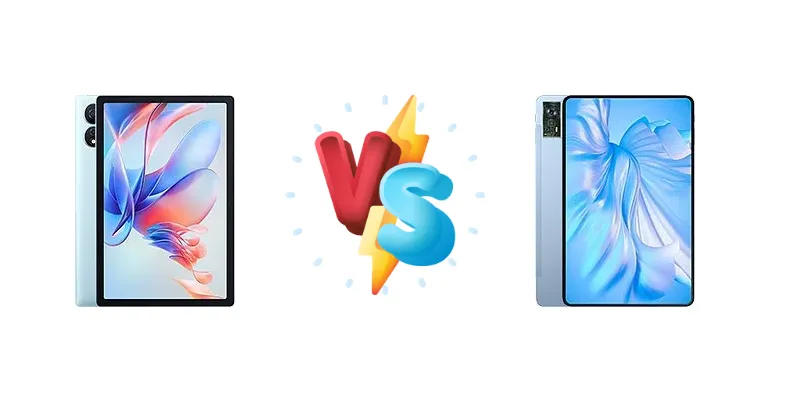
The tablet market is increasingly competitive, offering a range of options at various price points. We're pitting the Oukitel OT5, boasting a modern Mediatek Helio G99 chipset and impressive battery endurance claims, against the Oscal Pad 80 WiFi, powered by the Unisoc T606. This comparison dives deep into the core differences to help you determine which tablet best suits your needs.
🏆 Quick Verdict
For users prioritizing raw performance and faster charging, the Oukitel OT5 is the clear winner. Its Helio G99 chipset and 18W charging offer a noticeable speed advantage. However, the Oscal Pad 80 WiFi remains a viable option for those seeking a more budget-friendly device for basic tasks.
| Network |
|---|
| 2G bands | GSM 850 / 900 / 1800 / 1900 N/A | GSM 850 / 900 / 1800 / 1900 |
| 3G bands | N/A | HSDPA 850 / 900 / 1700(AWS) / 1900 / 2100 |
| 4G bands | N/A | 1, 2, 3, 4, 5, 7, 8, 12, 17, 18, 19, 20, 25, 26, 28, 38, 39, 40, 41, 66 |
| EDGE | No | - |
| GPRS | No | - |
| Speed | - | HSPA, LTE |
| Technology | GSM | GSM / HSPA / LTE |
| Launch |
|---|
| Announced | 2025, January | 2023, October |
| Status | Available. Released 2025, January | Available. Released 2023, November 11 |
| Body |
|---|
| Dimensions | 246.8 x 161.9 x 9.1 mm (9.72 x 6.37 x 0.36 in) | 278.5 x 174 x 7.5 mm (10.96 x 6.85 x 0.30 in) |
| SIM | No | Nano-SIM + Nano-SIM |
| Weight | 495 g (1.09 lb) | 560 g (1.23 lb) |
| Display |
|---|
| Protection | - | Corning Gorilla Glass 5, Mohs level 5 |
| Resolution | 1200 x 1920 pixels, 16:10 ratio (~215 ppi density) | 1200 x 2000 pixels, 5:3 ratio (~194 ppi density) |
| Size | 10.51 inches, 320.3 cm2 (~80.2% screen-to-body ratio) | 12.0 inches, 409.9 cm2 (~84.6% screen-to-body ratio) |
| Type | IPS LCD | IPS LCD, 300 nits |
| Platform |
|---|
| CPU | Octa-core (2x1.6 GHz Cortex-A75 & 6x1.6 GHz Cortex-A55) | Octa-core (2x2.2 GHz Cortex-A76 & 6x2.0 GHz Cortex-A55) |
| Chipset | Unisoc T606 (12 nm) | Mediatek Helio G99 (6 nm) |
| GPU | Mali-G57 MP1 | Mali-G57 MC2 |
| OS | Android 14, Doke OS_P 4.0 | Android 13 |
| Memory |
|---|
| Card slot | microSDXC (dedicated slot) | microSDXC (uses shared SIM slot) |
| Internal | 256GB 6GB RAM | 256GB 12GB RAM |
| Main Camera |
|---|
| Dual | - | 16 MP, f/2.2, (wide), 1/3.1", AF
2 MP (macro) |
| Features | LED flash | LED flash |
| Single | 13 MP, f/2.0 | - |
| Video | 1080p@30fps | 1080p@30fps |
| Selfie camera |
|---|
| Single | 8 MP, f/2.2 | 8 MP, f/2.2, (wide), 1/4.0" |
| Video | 720p@30fps | 1080p@30fps |
| Sound |
|---|
| 35mm jack | Yes | Yes |
| Loudspeaker | Yes, with stereo speakers | Yes, with stereo speakers (4 speakers) |
| Comms |
|---|
| Bluetooth | 5.0, A2DP, LE | 5.2, A2DP, LE |
| NFC | No | No |
| Positioning | No | GPS, GLONASS, GALILEO, BDS |
| Radio | No | FM radio |
| USB | USB Type-C | USB Type-C 2.0, OTG |
| WLAN | Wi-Fi 802.11 a/b/g/n/ac, dual-band | Wi-Fi 802.11 b/g/n/ac, dual-band |
| Features |
|---|
| Sensors | Accelerometer | Accelerometer, gyro, proximity, compass |
| Battery |
|---|
| Charging | 10W wired | 18W wired |
| Type | 8200 mAh | Li-Po 11000 mAh |
| Misc |
|---|
| Colors | Grey, Blue | Gray, Green, Blue |
| Price | - | About 200 EUR |
| EU LABEL |
|---|
| Battery | - | 114:00h endurance, 1000 cycles |
| Energy | - | Class E |
| Free fall | - | Class E (52 falls) |
| Repairability | - | Class B |
Oscal Pad 80 WiFi
- Lower price point makes it accessible.
- Unisoc T606 is power efficient for basic tasks.
- Suitable for light usage and media consumption.
- Slower processor compared to the Helio G99.
- 10W charging is significantly slower.
- Likely limited multitasking capabilities.
Oukitel OT5
- Faster Mediatek Helio G99 processor for smoother performance.
- 18W fast charging reduces downtime.
- Impressive 114-hour endurance claim.
- Likely a higher price tag than the Oscal Pad 80 WiFi.
- May experience some thermal throttling under sustained load.
- Battery capacity not specified.
Display Comparison
Neither device provides display specifications in the provided data. However, given the price points, we can anticipate both utilizing IPS LCD panels. The Oukitel OT5, positioned as a slightly more premium offering, may benefit from a higher resolution or slightly improved color accuracy. Without specific nit brightness or color gamut data, it's difficult to definitively state a display advantage.
Camera Comparison
The provided data lacks camera specifications for both devices. Given the market segment, we can expect basic camera setups focused on casual photography. It's likely both tablets will feature a primary camera and potentially a secondary depth or macro sensor. Without knowing sensor sizes, apertures, or image processing capabilities, a meaningful comparison is impossible. Users should not expect flagship-level camera performance from either device.
Performance
The Oukitel OT5’s Mediatek Helio G99 (6nm) represents a significant leap in processing power compared to the Oscal Pad 80 WiFi’s Unisoc T606 (12nm). The G99 utilizes two Cortex-A76 cores clocked at 2.2 GHz, versus the T606’s Cortex-A75 cores at 1.6 GHz. This architectural difference, combined with the smaller 6nm process node, translates to faster application loading times, smoother multitasking, and improved gaming performance on the OT5. The T606 is adequate for basic tasks, but will struggle with demanding applications. The G99’s integrated GPU will also provide a superior graphical experience.
Battery Life
The Oukitel OT5 claims an impressive 114-hour endurance and 1000 charge cycles, suggesting a focus on longevity. While the actual capacity isn't specified, the endurance claim indicates a well-optimized power management system. The 18W wired charging is a significant advantage over the Oscal Pad 80 WiFi’s 10W charging, allowing for faster top-ups. While a larger battery capacity isn't guaranteed, the OT5’s faster charging and endurance claims suggest it will offer a more convenient user experience, especially for those frequently on the go.
Buying Guide
Buy the Oscal Pad 80 WiFi if you need a basic tablet for media consumption, light web browsing, and occasional productivity tasks, and are on a very tight budget. Buy the Oukitel OT5 if you prioritize smoother multitasking, gaming, and faster charging, and are willing to spend a bit more for a more responsive experience. The OT5 is ideal for users who demand more from their tablet.
Frequently Asked Questions
❓ Does the Mediatek Helio G99 in the Oukitel OT5 get hot during extended gaming sessions?
While the Helio G99 is a powerful chip, its thermal performance will depend on the OT5’s cooling solution. The 6nm process helps with efficiency, but sustained gaming will likely generate heat. Expect some potential throttling to maintain stable performance, but it should still offer a significantly better gaming experience than the Unisoc T606.
❓ Is the 10W charging on the Oscal Pad 80 WiFi noticeably slow in practical use?
Yes, 10W charging is considerably slower than the 18W charging on the Oukitel OT5. Expect a significantly longer time to fully charge the Oscal Pad 80 WiFi, potentially taking several hours from a low battery level. This is a key consideration for users who need quick top-ups.
❓ How does the Unisoc T606 handle multitasking compared to the Helio G99?
The Unisoc T606 is adequate for light multitasking, such as switching between a few apps. However, the Helio G99’s more powerful cores and improved architecture will handle more demanding multitasking scenarios – running multiple apps simultaneously, or switching between resource-intensive applications – with greater ease and responsiveness.