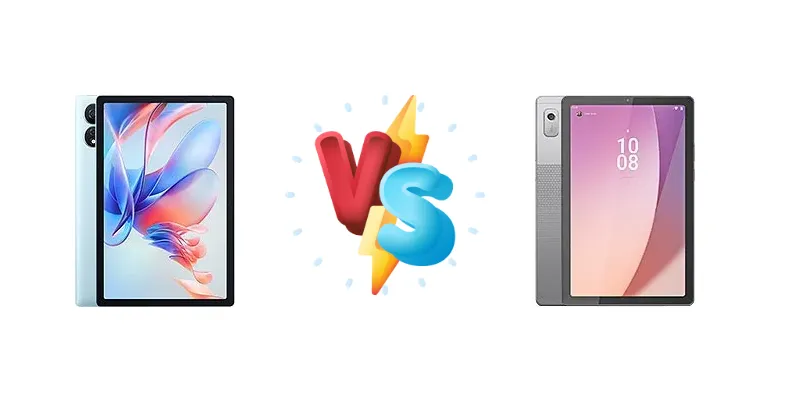
The sub-$150 tablet market is fiercely competitive, and the Oscal Pad 80 and Lenovo Tab M9 are two contenders vying for your attention. Both offer a large-screen experience at an accessible price, but significant differences in their core hardware – specifically the chipsets – dictate their strengths and weaknesses. This comparison dives deep into those differences to help you choose the right tablet for your needs.
🏆 Quick Verdict
For most users, the Lenovo Tab M9 emerges as the better choice. Its Mediatek Helio G80 chipset, with higher clocked Cortex-A75 cores, provides a noticeable performance advantage over the Oscal Pad 80’s Unisoc T606, making it more responsive for everyday tasks and light gaming. While both charge at the same slow 10W rate, the M9’s extra processing power justifies the slightly higher price.
| Network |
|---|
| 2G bands | GSM 850 / 900 / 1800 / 1900 N/A | GSM 850 / 900 / 1800 / 1900 |
| 3G bands | N/A | HSDPA 850 / 900 / 1700(AWS) / 1900 / 2100 |
| 4G bands | N/A | 1, 2, 3, 4, 5, 7, 8, 18, 19, 20, 26, 28, 38, 40, 41, 66 |
| EDGE | No | - |
| GPRS | No | - |
| Speed | - | HSPA, LTE - cellular model only |
| Technology | GSM | GSM / HSPA / LTE |
| Launch |
|---|
| Announced | 2025, January | 2022, December 20 |
| Status | Available. Released 2025, January | Available. Released 2023, March 14 |
| Body |
|---|
| Dimensions | 246.8 x 161.9 x 9.1 mm (9.72 x 6.37 x 0.36 in) | 215.4 x 136.8 x 8 mm (8.48 x 5.39 x 0.31 in) |
| SIM | No | Nano-SIM (cellular model only) |
| Weight | 495 g (1.09 lb) | 344 g (12.13 oz) |
| Display |
|---|
| Resolution | 1200 x 1920 pixels, 16:10 ratio (~215 ppi density) | 800 x 1340 pixels, 5:3 ratio (~173 ppi density) |
| Size | 10.51 inches, 320.3 cm2 (~80.2% screen-to-body ratio) | 9.0 inches, 230.0 cm2 (~78.1% screen-to-body ratio) |
| Type | IPS LCD | IPS LCD, 400 nits (typ) |
| Platform |
|---|
| CPU | Octa-core (2x1.6 GHz Cortex-A75 & 6x1.6 GHz Cortex-A55) | Octa-core (2x2.0 GHz Cortex-A75 & 6x1.8 GHz Cortex-A55) |
| Chipset | Unisoc T606 (12 nm) | Mediatek MT6769V/CU Helio G80 (12 nm) |
| GPU | Mali-G57 MP1 | Mali-G52 MC2 |
| OS | Android 14, Doke OS_P 4.0 | Android 12 |
| Memory |
|---|
| Card slot | microSDXC (dedicated slot) | microSDXC (dedicated slot) |
| Internal | 256GB 6GB RAM | 32GB 3GB RAM, 64GB 4GB RAM, 128GB 4GB RAM |
| | - | eMMC 5.1 |
| Main Camera |
|---|
| Features | LED flash | - |
| Single | 13 MP, f/2.0 | 8 MP, AF |
| Video | 1080p@30fps | 1080p |
| Selfie camera |
|---|
| Single | 8 MP, f/2.2 | 2 MP |
| Video | 720p@30fps | 720p |
| Sound |
|---|
| 3.5mm jack | - | Yes |
| 35mm jack | Yes | Yes |
| Loudspeaker | Yes, with stereo speakers | Yes, with dual speakers |
| Comms |
|---|
| Bluetooth | 5.0, A2DP, LE | 5.1, A2DP, LE |
| NFC | No | No |
| Positioning | No | GPS, GLONASS, GALILEO - cellular model only |
| Radio | No | Unspecified |
| USB | USB Type-C | USB Type-C 2.0 |
| WLAN | Wi-Fi 802.11 a/b/g/n/ac, dual-band | Wi-Fi 802.11 a/b/g/n/ac, dual-band, Wi-Fi Direct |
| Features |
|---|
| Sensors | Accelerometer | Accelerometer, proximity |
| Battery |
|---|
| Charging | 10W wired | 10W wired |
| Type | 8200 mAh | Li-Po 5100 mAh |
| Misc |
|---|
| Colors | Grey, Blue | Arctic Grey, Frost Blue |
| Models | - | TB310FU |
| Price | - | About 180 EUR |
Oscal Pad 80 WiFi
- Lowest possible price point
- Acceptable for basic tasks
- Large screen for media consumption
- Unisoc T606 chipset is underpowered
- Slow 10W charging
- Likely limited software updates
Lenovo Tab M9
- More powerful Mediatek Helio G80 chipset
- Smoother multitasking experience
- Better performance for light gaming
- Still uses slow 10W charging
- Slightly higher price than Oscal Pad 80
- May still lack advanced features
Display Comparison
Neither Oscal nor Lenovo provide detailed display specifications beyond screen size. Assuming both utilize IPS LCD panels – typical for this price bracket – the visual experience will likely be similar in terms of color reproduction and viewing angles. The absence of high refresh rates or advanced features like LTPO is expected. Bezels are likely to be substantial on both devices, maximizing screen real estate within a budget-friendly design. Without specific brightness data, it's difficult to assess which tablet offers better outdoor visibility.
Camera Comparison
Given the price point, camera performance is unlikely to be a deciding factor. Both tablets likely feature basic camera setups focused on video calls rather than photography. Detailed sensor information is unavailable, but it’s safe to assume both will utilize low-resolution sensors. Image quality will be adequate for casual use, but don’t expect flagship-level results. Focusing on the chipset difference, the Helio G80’s integrated image signal processor (ISP) *may* offer slightly better image processing capabilities, but the impact will be minimal given the likely sensor limitations.
Performance
The core difference lies in the chipsets. The Lenovo Tab M9’s Mediatek Helio G80 (12nm) features two Cortex-A75 cores clocked at 2.0 GHz, paired with six Cortex-A55 cores at 1.8 GHz. This contrasts with the Oscal Pad 80’s Unisoc T606 (12nm), which has two Cortex-A75 cores at 1.6 GHz and six Cortex-A55 cores at 1.6 GHz. The higher clock speeds on the Helio G80 translate to faster processing, particularly in single-core tasks and burst performance. While both use the same 12nm process, the Helio G80’s architecture is more efficient, offering a tangible performance advantage in demanding applications. The M9 will handle multitasking and app switching more smoothly.
Battery Life
Both the Oscal Pad 80 and Lenovo Tab M9 are equipped with 10W wired charging, indicating a similar charging experience – slow by modern standards. Expect a full charge to take several hours. Without knowing the battery capacity of either device, it’s difficult to predict which will offer longer runtime. However, the Helio G80’s more efficient architecture in the Tab M9 could potentially offset a slightly smaller battery capacity, resulting in comparable real-world battery life. The slow charging speed is a significant drawback for both tablets.
Buying Guide
Buy the Oscal Pad 80 WiFi if you prioritize absolute affordability and your usage is limited to basic tasks like web browsing, e-reading, and video playback. It’s a solid option for those on a very tight budget. Buy the Lenovo Tab M9 if you value a smoother, more responsive user experience, plan to do any light gaming, or anticipate multitasking. The performance uplift from the Helio G80 is worth the small price premium for most users.
Frequently Asked Questions
❓ Will the Lenovo Tab M9 handle popular mobile games like PUBG Mobile or Call of Duty?
The Helio G80 is capable of running PUBG Mobile and Call of Duty, but you’ll likely need to lower the graphics settings to medium or low to achieve a playable frame rate. Don't expect a flagship gaming experience, but it's significantly better than the Oscal Pad 80, which will struggle with these titles.
❓ How long will it take to fully charge either the Oscal Pad 80 or Lenovo Tab M9?
With both tablets limited to 10W charging, expect a full charge to take approximately 3-4 hours, potentially longer if the tablet is being used during charging. This is a significant drawback for both devices, as it requires overnight charging for optimal use.
❓ What Android version do these tablets ship with, and will they receive updates?
Both tablets likely ship with Android 13 (Go Edition) to optimize performance on their respective chipsets. However, software update support is typically limited on budget tablets. Expect at most one major Android version update, and security patches may be infrequent.
❓ Is the Unisoc T606 chipset in the Oscal Pad 80 a reliable performer for everyday tasks?
The Unisoc T606 is adequate for basic tasks like web browsing, email, and video playback. However, it will exhibit noticeable lag when multitasking or running demanding applications. It's best suited for users with very light usage patterns.