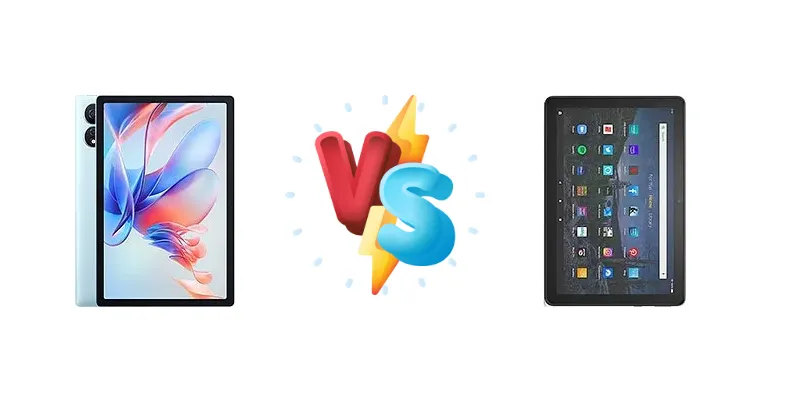
The sub-$200 tablet market is fiercely competitive, offering a surprising amount of functionality for the price. We pit the Oscal Pad 80 WiFi, powered by a Unisoc T606, against the Amazon Fire HD 10 Plus (2021) with its MediaTek Helio P60T to determine which device provides the best balance of performance, features, and value for everyday users.
🏆 Quick Verdict
For users prioritizing raw processing power and a more open Android experience, the Oscal Pad 80 WiFi emerges as the winner. While the Fire HD 10 Plus offers the convenience of wireless charging and Amazon’s ecosystem integration, the Unisoc T606’s Cortex-A75 cores provide a noticeable performance edge in demanding tasks.
| Network |
|---|
| 2G bands | GSM 850 / 900 / 1800 / 1900 N/A | N/A |
| 3G bands | N/A | - |
| 4G bands | N/A | - |
| EDGE | No | No |
| GPRS | No | No |
| Technology | GSM | No cellular connectivity |
| Launch |
|---|
| Announced | 2025, January | 2021, April 27. Released 2021, May 26 |
| Status | Available. Released 2025, January | Discontinued |
| Body |
|---|
| Dimensions | 246.8 x 161.9 x 9.1 mm (9.72 x 6.37 x 0.36 in) | 247 x 166 x 9.2 mm (9.72 x 6.54 x 0.36 in) |
| SIM | No | No |
| Weight | 495 g (1.09 lb) | 468 g (1.03 lb) |
| Display |
|---|
| Protection | - | Aluminosilicate glass |
| Resolution | 1200 x 1920 pixels, 16:10 ratio (~215 ppi density) | 1920 x 1200 pixels, 16:10 ratio (~224 ppi density) |
| Size | 10.51 inches, 320.3 cm2 (~80.2% screen-to-body ratio) | 10.1 inches, 295.8 cm2 (~72.1% screen-to-body ratio) |
| Type | IPS LCD | IPS LCD |
| Platform |
|---|
| CPU | Octa-core (2x1.6 GHz Cortex-A75 & 6x1.6 GHz Cortex-A55) | Octa-core (4x2.0 GHz Cortex-A73 & 4x2.0 GHz Cortex-A53) |
| Chipset | Unisoc T606 (12 nm) | Mediatek MT8183 Helio P60T (12 nm) |
| GPU | Mali-G57 MP1 | Mali-G72 MP3 |
| OS | Android 14, Doke OS_P 4.0 | Android 9.0 (Pie), Fire OS 7 |
| Memory |
|---|
| Card slot | microSDXC (dedicated slot) | microSDXC (dedicated slot) |
| Internal | 256GB 6GB RAM | 32GB 4GB RAM, 64GB 4GB RAM |
| | - | eMMC 5.1 |
| Main Camera |
|---|
| Features | LED flash | - |
| Single | 13 MP, f/2.0 | 5 MP |
| Video | 1080p@30fps | 720p |
| Selfie camera |
|---|
| Single | 8 MP, f/2.2 | 2 MP |
| Video | 720p@30fps | 720p |
| Sound |
|---|
| 3.5mm jack | - | Yes |
| 35mm jack | Yes | Yes |
| Loudspeaker | Yes, with stereo speakers | Yes, with stereo speakers |
| Comms |
|---|
| Bluetooth | 5.0, A2DP, LE | 5.0, A2DP, LE |
| NFC | No | No |
| Positioning | No | No |
| Radio | No | No |
| USB | USB Type-C | USB Type-C 2.0, OTG |
| WLAN | Wi-Fi 802.11 a/b/g/n/ac, dual-band | Wi-Fi 802.11 a/b/g/n/ac, dual-band |
| Features |
|---|
| Sensors | Accelerometer | Accelerometer |
| | - | Text-to-Speech English-language content reader |
| Battery |
|---|
| Charging | 10W wired | Wireless |
| Type | 8200 mAh | Li-Ion |
| Misc |
|---|
| Colors | Grey, Blue | Slate |
| Models | - | T76N2P |
| Price | - | About 150 EUR |
Oscal Pad 80 WiFi
- More powerful CPU for smoother multitasking.
- Standard Android experience without Amazon’s Fire OS.
- Potentially better value for performance.
- Limited to 10W wired charging.
- Lack of wireless charging convenience.
Amazon Fire HD 10 Plus (2021)
- Wireless charging for added convenience.
- Seamless integration with Amazon’s ecosystem.
- Established app store and content library.
- Less powerful CPU compared to the Oscal Pad 80.
- Fire OS can feel restrictive for some users.
Display Comparison
Neither device boasts a cutting-edge display. Both utilize 12nm chipsets, suggesting a focus on cost optimization over premium display features. While specific display specs (resolution, brightness) are missing for the Oscal Pad 80, the Fire HD 10 Plus’s 10.1-inch IPS LCD is known for adequate, but not exceptional, color reproduction. The absence of high refresh rates or LTPO technology on either tablet indicates they are geared towards content consumption rather than visually intensive applications. Bezels are likely comparable, reflecting the budget nature of both devices.
Camera Comparison
Camera performance is unlikely to be a deciding factor for either tablet. Both are positioned as budget devices, and camera quality typically takes a backseat. Details on the Oscal Pad 80’s camera are unavailable, but the Fire HD 10 Plus features a 5MP front and rear camera. Given the limited sensor size and lack of optical image stabilization (OIS) on both, image quality will be acceptable for basic video calls and casual snapshots, but not for serious photography. Focusing on megapixel counts alone would be misleading; image processing and sensor size are far more important.
Performance
The core difference lies in the chipsets. The Amazon Fire HD 10 Plus’s MediaTek Helio P60T features four Cortex-A73 cores clocked at 2.0 GHz, paired with four Cortex-A53 cores. The Oscal Pad 80 WiFi, however, utilizes the Unisoc T606 with two higher-performance Cortex-A75 cores at 1.6 GHz and six Cortex-A55 cores, also at 1.6 GHz. This architectural difference is crucial; the A75 cores, despite a slightly lower clock speed, offer significantly better single-core performance than the A73, translating to snappier app launches and smoother multitasking. While both are 12nm chips, the Unisoc T606’s core configuration gives it an advantage in CPU-bound tasks. The Fire HD 10 Plus relies on Mali-G72 MP3 GPU, while the Oscal Pad 80 uses Mali-G52 MC2. The Helio P60T's GPU is slightly more powerful, but the CPU difference will be more noticeable in general use.
Battery Life
Battery life will depend heavily on usage patterns. While specific battery capacities are not provided, the Fire HD 10 Plus benefits from wireless charging, offering added convenience. The Oscal Pad 80 WiFi is limited to 10W wired charging, which will likely result in slower charging times. The efficiency of the Unisoc T606 versus the Helio P60T will play a role in overall battery endurance, but both tablets should provide sufficient power for a full day of moderate use (web browsing, video streaming). The wireless charging on the Fire HD 10 Plus is a significant convenience feature, but doesn't necessarily translate to longer overall runtime.
Buying Guide
Buy the Oscal Pad 80 WiFi if you need a tablet for multitasking, light gaming, and prefer a standard Android experience without Amazon’s Fire OS limitations. Buy the Amazon Fire HD 10 Plus (2021) if you are heavily invested in the Amazon ecosystem, prioritize wireless charging, and primarily intend to consume media like streaming video and reading ebooks.
Frequently Asked Questions
❓ Will the Unisoc T606 in the Oscal Pad 80 handle demanding games like PUBG Mobile?
While the Unisoc T606 isn't a gaming powerhouse, it should be capable of running PUBG Mobile at medium settings with reasonable frame rates. The Cortex-A75 cores provide a performance boost over the Helio P60T, but don't expect a flagship gaming experience. Lowering graphics settings will be necessary for smoother gameplay.
❓ How restrictive is Amazon’s Fire OS compared to standard Android on the Oscal Pad 80?
Fire OS is heavily customized by Amazon and lacks full access to the Google Play Store. While you can sideload apps, it's not a seamless process. The Oscal Pad 80 runs a standard Android version, providing access to the full Google Play Store and a more open ecosystem. This makes it a better choice for users who prefer a familiar Android experience.
❓ Does the Amazon Fire HD 10 Plus support expandable storage via microSD card?
Yes, the Amazon Fire HD 10 Plus (2021) supports microSD card expansion up to 1TB, allowing you to increase storage for media files and apps. The Oscal Pad 80's microSD support is currently unknown, but is a common feature in this price range.