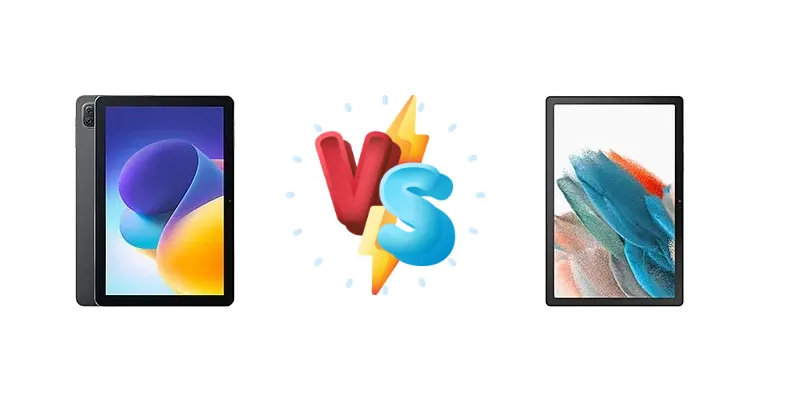
The sub-$200 tablet market is fiercely competitive. The Oscal Pad 70, powered by a Rockchip RK3562, enters the arena to challenge Samsung’s established Galaxy Tab A8 10.5 (2021) and its Unisoc Tiger T618 chipset. This comparison dissects the key differences to determine which tablet delivers the best experience for everyday tasks and light entertainment.
🏆 Quick Verdict
For most users, the Samsung Galaxy Tab A8 10.5 (2021) is the better choice. Its octa-core Unisoc Tiger T618 processor provides a significantly smoother experience for multitasking and demanding applications, offsetting the Oscal Pad 70’s lower price point. However, the Oscal Pad 70 represents a compelling option for extremely budget-conscious users.
| Network |
|---|
| 2G bands | GSM 850 / 900 / 1800 / 1900 N/A | GSM 850 / 900 / 1800 / 1900 |
| 3G bands | N/A | HSDPA 850 / 900 / 1700(AWS) / 1900 / 2100 |
| 4G bands | N/A | 1, 2, 3, 4, 5, 7, 8, 12, 17, 20, 28, 38, 40, 41, 66 |
| EDGE | No | - |
| GPRS | No | - |
| Speed | - | HSPA, LTE - cellular model only |
| Technology | GSM | GSM / HSPA / LTE |
| Launch |
|---|
| Announced | 2025, January | 2021, December 15 |
| Status | Available. Released 2025, January | Available. Released 2022, January 17 |
| Body |
|---|
| Dimensions | 246.5 x 163 x 9.9 mm (9.70 x 6.42 x 0.39 in) | 246.8 x 161.9 x 6.9 mm (9.72 x 6.37 x 0.27 in) |
| SIM | No | Nano-SIM (cellular model only) |
| Weight | 520.5 g (1.15 lb) | 508 g (1.12 lb) |
| Display |
|---|
| Protection | Asahi glass | - |
| Resolution | 800 x 1280 pixels, 16:10 ratio (~149 ppi density) | 1200 x 1920 pixels, 16:10 ratio (~216 ppi density) |
| Size | 10.1 inches, 295.8 cm2 (~73.6% screen-to-body ratio) | 10.5 inches, 319.7 cm2 (~80.0% screen-to-body ratio) |
| Type | IPS LCD | TFT LCD |
| Platform |
|---|
| CPU | Quad-core 2.0 GHz Cortex-A53 | Octa-core (2x2.0 GHz Cortex-A75 & 6x2.0 GHz Cortex-A55) |
| Chipset | Rockchip RK3562 | Unisoc Tiger T618 (12 nm) |
| GPU | Mali-G52 | Mali G52 MP2 |
| OS | Android 14, Doke OS_P 4.0 | Android 11, upgradable to Android 14, One UI 6 |
| Memory |
|---|
| Card slot | microSDXC (dedicated slot) | microSDXC (dedicated slot) |
| Internal | 128GB 4GB RAM | 32GB 2GB RAM, 32GB 3GB RAM, 64GB 2GB RAM, 64GB 3GB RAM, 64GB 4GB RAM, 128GB 3GB RAM, 128GB 4GB RAM |
| Main Camera |
|---|
| Features | LED flash | - |
| Single | 13 MP, f/2.0, AF | 8 MP, AF |
| Video | 720p@30fps | 1080p@30fps |
| Selfie camera |
|---|
| Single | 8 MP | 5 MP |
| Video | 480p@30fps | 1080p@30fps |
| Sound |
|---|
| 3.5mm jack | - | Yes |
| 35mm jack | Yes | Yes |
| Loudspeaker | Yes, with stereo speakers | Yes, with stereo speakers (4 speakers) |
| Comms |
|---|
| Bluetooth | 5.0, A2DP, LE | 5.0, A2DP, LE |
| NFC | No | No |
| Positioning | No | GPS, GLONASS, BDS, GALILEO, QZSS - cellular model only |
| Radio | No | No |
| USB | USB Type-C, OTG | USB Type-C 2.0 |
| WLAN | Wi-Fi 802.11 a/b/g/n/ac/6, dual-band | Wi-Fi 802.11 a/b/g/n/ac, dual-band, Wi-Fi Direct |
| Features |
|---|
| Sensors | Accelerometer | Accelerometer, gyro, proximity, compass |
| Battery |
|---|
| Charging | 10W wired | 15W wired |
| Type | 6580 mAh | Li-Po 7040 mAh |
| Misc |
|---|
| Colors | Grey, Blue | Gray, Silver, Pink Gold |
| Models | - | SM-X200, SM-X205 |
| Price | - | About 230 EUR |
| SAR EU | - | 0.92 W/kg (body) |
Oscal Pad 70 WiFi
- Lower price point makes it accessible.
- Rockchip RK3562 is sufficient for basic tasks.
- Potentially lighter weight due to simpler hardware.
- Quad-core CPU struggles with multitasking.
- Slower performance compared to the Tab A8.
- 10W charging is relatively slow.
Samsung Galaxy Tab A8 10.5 (2021)
- Octa-core Unisoc T618 delivers smoother performance.
- Faster 15W charging.
- Samsung’s brand reputation and software support.
- Higher price compared to the Oscal Pad 70.
- May not be significantly better for extremely light tasks.
- Unisoc chipset may not receive as many software updates as a Snapdragon.
Display Comparison
Neither device boasts a particularly impressive display. Both are likely to utilize IPS LCD panels, common in this price bracket. However, the lack of detailed display specs (resolution, brightness) necessitates a focus on performance. The Tab A8’s larger brand recognition suggests a potentially better-calibrated panel, though this is speculative. Bezels are likely comparable, reflecting the budget nature of both tablets. The absence of high refresh rates or advanced features like LTPO on either device is expected.
Camera Comparison
Camera performance is unlikely to be a deciding factor for either tablet. Both are likely equipped with basic camera sensors suitable for video calls and occasional snapshots. Given the context data, detailed analysis is limited. It’s safe to assume both tablets will struggle in low-light conditions. Focusing on camera specs in this segment is often misleading, as image processing and software optimization play a larger role than sensor size.
Performance
The core difference lies in the chipsets. The Samsung Galaxy Tab A8’s Unisoc Tiger T618, fabricated on a 12nm process, features an octa-core configuration (2x2.0 GHz Cortex-A75 & 6x2.0 GHz Cortex-A55). This architecture provides a substantial advantage over the Oscal Pad 70’s Rockchip RK3562, which utilizes a quad-core 2.0 GHz Cortex-A53 setup. The A75 cores in the Tab A8 are significantly more powerful than the A53 cores in the Oscal Pad 70, resulting in faster app loading times and smoother multitasking. While both CPUs peak at 2.0 GHz, the architectural differences translate to a noticeable performance gap, particularly in graphically intensive tasks. The Tab A8 will handle more demanding games and applications with greater ease.
Battery Life
Battery life will depend heavily on usage patterns. The Oscal Pad 70 supports 10W wired charging, while the Samsung Galaxy Tab A8 steps up to 15W. While the difference in charging wattage isn’t massive, the 15W charging on the Tab A8 will likely result in faster top-ups. Without knowing the battery capacity of either device, it’s difficult to predict real-world endurance. However, the more efficient Unisoc T618 in the Tab A8 may contribute to slightly longer battery life during moderate use.
Buying Guide
Buy the Oscal Pad 70 WiFi if you need a basic tablet for simple tasks like web browsing, reading ebooks, and light video playback, and your budget is extremely limited. Buy the Samsung Galaxy Tab A8 10.5 (2021) if you prioritize smoother performance for multitasking, streaming, and occasional gaming, and are willing to spend a bit more for a more refined user experience.
Frequently Asked Questions
❓ Will the Oscal Pad 70 struggle with multiple apps open simultaneously?
Yes, the Oscal Pad 70’s quad-core Rockchip RK3562 processor and Cortex-A53 cores are less efficient at multitasking compared to the Tab A8’s octa-core Unisoc T618. Expect noticeable slowdowns and app reloading when switching between several applications.
❓ Is the Unisoc Tiger T618 in the Tab A8 capable of playing modern mobile games?
The Unisoc Tiger T618 can handle many modern mobile games, but likely at medium settings. Demanding titles like Genshin Impact may require lower graphics settings to maintain a playable frame rate. The Tab A8’s processor provides a better gaming experience than the Oscal Pad 70.
❓ How long will it take to fully charge the Oscal Pad 70 with the 10W charger?
With a 10W charger, expect the Oscal Pad 70 to take approximately 3-4 hours to fully charge from 0% to 100%, depending on battery capacity. The Samsung Tab A8’s 15W charging will be noticeably faster.
❓ Does the Samsung Galaxy Tab A8 support expandable storage via microSD card?
Yes, the Samsung Galaxy Tab A8 10.5 (2021) does support expandable storage via a microSD card, allowing you to increase the internal storage capacity. The Oscal Pad 70's microSD support is unconfirmed, but likely present given the target market.