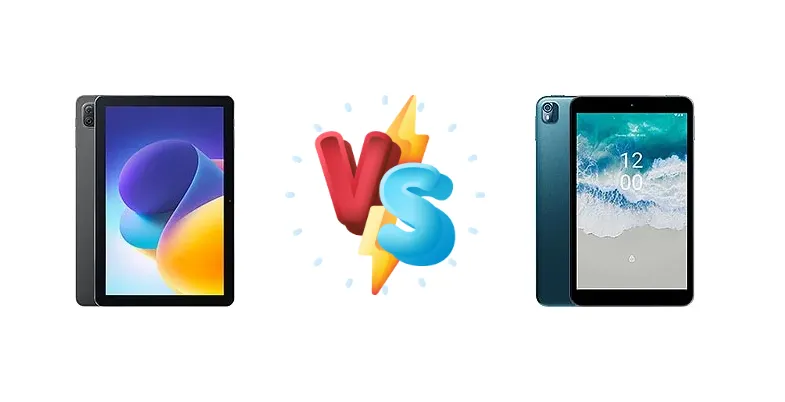
The sub-$200 tablet market is fiercely competitive, with options like the Oscal Pad 70 WiFi and Nokia T10 vying for attention. Both aim to deliver an affordable Android experience, but they take different approaches to achieving that goal, primarily through their chipset choices. This comparison dissects the key differences to determine which tablet best suits your needs.
🏆 Quick Verdict
For most users, the Nokia T10 emerges as the better choice. Its Unisoc T606, with its octa-core configuration and Cortex-A75 performance cores, provides a noticeably smoother experience than the Oscal Pad 70’s quad-core RK3562, especially for multitasking and demanding apps. While both charge at the same slow 10W rate, the T10’s more efficient processor offers a slight edge in overall battery life.
| Network |
|---|
| 2G bands | GSM 850 / 900 / 1800 / 1900 N/A | GSM 850 / 900 / 1800 / 1900 |
| 3G bands | N/A | HSDPA 850 / 900 / 2100 |
| 4G bands | N/A | 1, 3, 5, 7, 8, 20, 28, 38, 40, 41 |
| EDGE | No | - |
| GPRS | No | - |
| Speed | - | HSPA 42.2/5.76 Mbps, LTE Cat4 150/50 Mbps |
| Technology | GSM | GSM / HSPA / LTE |
| Launch |
|---|
| Announced | 2025, January | 2022, July 12 |
| Status | Available. Released 2025, January | Available. Released 2022, August 20 |
| Body |
|---|
| Build | - | Glass front, plastic back, plastic frame |
| Dimensions | 246.5 x 163 x 9.9 mm (9.70 x 6.42 x 0.39 in) | 208 x 123.2 x 9 mm (8.19 x 4.85 x 0.35 in) |
| SIM | No | Nano-SIM |
| Weight | 520.5 g (1.15 lb) | 375 g (13.23 oz) |
| | - | Splash resistant |
| Display |
|---|
| Protection | Asahi glass | - |
| Resolution | 800 x 1280 pixels, 16:10 ratio (~149 ppi density) | 800 x 1280 pixels, 16:10 ratio (~189 ppi density) |
| Size | 10.1 inches, 295.8 cm2 (~73.6% screen-to-body ratio) | 8.0 inches, 185.6 cm2 (~72.4% screen-to-body ratio) |
| Type | IPS LCD | IPS LCD, 360 nits (typ), 450 nits (peak) |
| Platform |
|---|
| CPU | Quad-core 2.0 GHz Cortex-A53 | Octa-core (2x1.6 GHz Cortex-A75 & 6x1.6 GHz Cortex-A55) |
| Chipset | Rockchip RK3562 | Unisoc T606 (12 nm) |
| GPU | Mali-G52 | Mali-G57 MP1 |
| OS | Android 14, Doke OS_P 4.0 | Android 12, upgradable to Android 13 |
| Memory |
|---|
| Card slot | microSDXC (dedicated slot) | microSDXC |
| Internal | 128GB 4GB RAM | 32GB 3GB RAM, 64GB 4GB RAM |
| Main Camera |
|---|
| Features | LED flash | LED flash |
| Single | 13 MP, f/2.0, AF | 8 MP, 1/4.0", 1.12µm, AF |
| Video | 720p@30fps | 1080p |
| Selfie camera |
|---|
| Single | 8 MP | 2 MP, 1/5.0", 1.65µm |
| Video | 480p@30fps | 720p |
| Sound |
|---|
| 3.5mm jack | - | Yes |
| 35mm jack | Yes | Yes |
| Loudspeaker | Yes, with stereo speakers | Yes, with stereo speakers |
| Comms |
|---|
| Bluetooth | 5.0, A2DP, LE | 5.0, A2DP, LE |
| NFC | No | No |
| Positioning | No | GPS, GLONASS, GALILEO |
| Radio | No | No |
| USB | USB Type-C, OTG | USB Type-C 2.0, OTG |
| WLAN | Wi-Fi 802.11 a/b/g/n/ac/6, dual-band | Wi-Fi 802.11 a/b/g/n/ac, dual-band |
| Features |
|---|
| Sensors | Accelerometer | Accelerometer, proximity |
| Battery |
|---|
| Charging | 10W wired | 10W wired |
| Type | 6580 mAh | Li-Po 5250 mAh |
| Misc |
|---|
| Colors | Grey, Blue | Ocean Blue |
| Models | - | TA-1503, TA-1472, TA-1462, TA-1457 |
| Price | - | About 160 EUR |
| SAR | - | 1.19 W/kg (body) |
| SAR EU | - | 0.27 W/kg (head) 1.57 W/kg (body) |
Oscal Pad 70 WiFi
- Potentially lower price point.
- Rockchip RK3562 offers adequate performance for basic tasks.
- Simple and straightforward Android experience.
- Quad-core CPU limits multitasking capabilities.
- RK3562 chipset is less efficient than Unisoc T606.
- 10W charging is slow.
Nokia T10
- Octa-core Unisoc T606 provides smoother performance.
- Cortex-A75 cores offer a noticeable performance boost.
- More efficient chipset potentially extends battery life.
- 10W charging is slow.
- May be slightly more expensive than the Oscal Pad 70.
- Limited camera capabilities.
Display Comparison
Neither Oscal nor Nokia provide detailed display specifications in the provided data. However, given the price bracket, we can assume both utilize IPS LCD panels. The lack of information regarding resolution, peak brightness, or color gamut makes a direct comparison impossible. Users should expect typical budget tablet display quality – adequate for media consumption but not exceptional. Bezels are likely to be substantial on both devices, maximizing screen real estate within a compact form factor.
Camera Comparison
Neither device is positioned as a photography powerhouse, and the provided data doesn’t offer specifics beyond the presence of cameras. It’s safe to assume both feature basic camera setups suitable for casual snapshots and video calls. Without sensor size or aperture information, a meaningful comparison is impossible. Users shouldn’t expect high-quality images from either tablet.
Performance
The core difference lies in the chipsets. The Nokia T10’s Unisoc T606 (12nm) boasts an octa-core CPU configuration – two Cortex-A75 cores clocked at 1.6 GHz and six Cortex-A55 cores, also at 1.6 GHz. This architecture provides a significant advantage over the Oscal Pad 70’s Rockchip RK3562, which features a quad-core Cortex-A53 CPU clocked at 2.0 GHz. While the RK3562 has a higher clock speed, the A53 cores are less efficient and less powerful than the A75 cores in the T10. The T10 will exhibit superior performance in multi-threaded tasks and applications optimized for the A75 architecture. The 12nm process node of the Unisoc T606 also contributes to better power efficiency, potentially extending battery life.
Battery Life
Both the Oscal Pad 70 WiFi and Nokia T10 utilize 10W wired charging, indicating a similar charging experience – slow. The actual battery capacity isn’t specified, but the Unisoc T606’s greater power efficiency in the Nokia T10 likely translates to slightly longer real-world battery life despite potentially similar capacity. Expect several hours of usage for basic tasks, but demanding applications will drain the battery more quickly on both devices.
Buying Guide
Buy the Oscal Pad 70 WiFi if you prioritize a potentially lower price point and your usage is limited to very basic tasks like web browsing and light video playback. Buy the Nokia T10 if you value a more responsive user experience, better multitasking capabilities, and a chipset capable of handling a wider range of applications without significant slowdowns. The T10 is the better all-rounder.
Frequently Asked Questions
❓ Will the Nokia T10 handle multiple apps running simultaneously without lagging?
The Nokia T10’s octa-core Unisoc T606 chipset, with its Cortex-A75 performance cores, is significantly better equipped for multitasking than the Oscal Pad 70’s quad-core RK3562. You should experience smoother app switching and less lag when running multiple applications concurrently on the T10.
❓ Is the 10W charging speed on either tablet acceptable for daily use?
10W charging is slow by modern standards for both the Oscal Pad 70 and Nokia T10. Expect a full charge to take several hours. It’s best to charge these tablets overnight or during periods of inactivity. The more efficient processor in the Nokia T10 may mitigate the impact of slow charging slightly by requiring less frequent top-ups.
❓ Can either tablet handle light gaming?
Both tablets can handle light gaming, but performance will be limited. The Nokia T10’s Unisoc T606 will provide a better experience for less demanding titles due to its more capable GPU and CPU. Expect lower frame rates and graphical settings on both devices for more graphically intensive games.