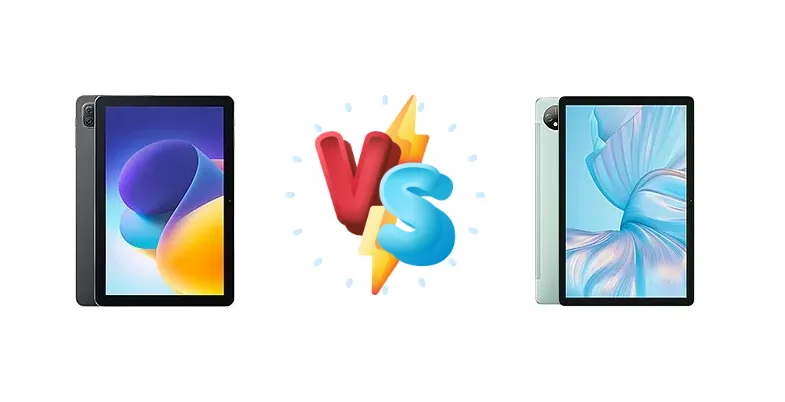
The budget tablet market is fiercely competitive, with brands like Blackview and Oscal offering compelling options under $200. Both the Blackview Tab 80 and Oscal Pad 70 aim to deliver a functional Android experience without breaking the bank. However, they take different approaches to achieving this, primarily through their choice of system-on-chip (SoC). This comparison will dissect the key differences between the Rockchip RK3562 in the Oscal Pad 70 and the Unisoc T606 in the Blackview Tab 80, revealing which tablet offers the better overall experience.
🏆 Quick Verdict
For most users, the Blackview Tab 80 emerges as the stronger choice. Its Unisoc T606 chipset, featuring an octa-core configuration with Cortex-A75 performance cores, provides a noticeable performance advantage over the Oscal Pad 70’s quad-core RK3562. While both tablets share the same 10W charging, the Tab 80’s superior processing power makes it better suited for multitasking and demanding applications.
| Network |
|---|
| 2G bands | GSM 850 / 900 / 1800 / 1900 N/A | GSM 850 / 900 / 1800 / 1900 |
| 3G bands | N/A | HSDPA 900 / 2100 |
| 4G bands | N/A | 1, 3, 7, 8, 20, 40 |
| EDGE | No | - |
| GPRS | No | - |
| Speed | - | HSPA, LTE |
| Technology | GSM | GSM / HSPA / LTE |
| Launch |
|---|
| Announced | 2025, January | 2023, September |
| Status | Available. Released 2025, January | Available. Released 2023, September |
| Body |
|---|
| Dimensions | 246.5 x 163 x 9.9 mm (9.70 x 6.42 x 0.39 in) | 241 x 156 x 7.5 mm (9.49 x 6.14 x 0.30 in) |
| SIM | No | Nano-SIM + Nano-SIM |
| Weight | 520.5 g (1.15 lb) | 484 g (1.07 lb) |
| Display |
|---|
| Protection | Asahi glass | - |
| Resolution | 800 x 1280 pixels, 16:10 ratio (~149 ppi density) | 800 x 1280 pixels, 16:10 ratio (~149 ppi density) |
| Size | 10.1 inches, 295.8 cm2 (~73.6% screen-to-body ratio) | 10.1 inches, 295.8 cm2 (~78.7% screen-to-body ratio) |
| Type | IPS LCD | IPS LCD |
| Platform |
|---|
| CPU | Quad-core 2.0 GHz Cortex-A53 | Octa-core (2x1.6 GHz Cortex-A75 & 6x1.6 GHz Cortex-A55) |
| Chipset | Rockchip RK3562 | Unisoc T606 (12 nm) |
| GPU | Mali-G52 | Mali-G57 MP1 |
| OS | Android 14, Doke OS_P 4.0 | Android 13, Doke OS_P 3.0 |
| Memory |
|---|
| Card slot | microSDXC (dedicated slot) | microSDXC (uses shared SIM slot) |
| Internal | 128GB 4GB RAM | 64GB 4GB RAM, 128GB 4GB RAM, 128GB 8GB RAM |
| Main Camera |
|---|
| Dual | - | 13 MP
secondary unspecified camera |
| Features | LED flash | LED flash |
| Single | 13 MP, f/2.0, AF | - |
| Video | 720p@30fps | 1080p@30fps |
| Selfie camera |
|---|
| Single | 8 MP | 8 MP |
| Video | 480p@30fps | 1080p@30fps |
| Sound |
|---|
| 35mm jack | Yes | Yes |
| Loudspeaker | Yes, with stereo speakers | Yes, with stereo speakers |
| Comms |
|---|
| Bluetooth | 5.0, A2DP, LE | 5.0, A2DP |
| NFC | No | No |
| Positioning | No | GPS, GLONASS, GALILEO, BDS |
| Radio | No | FM Radio |
| USB | USB Type-C, OTG | USB Type-C, OTG |
| WLAN | Wi-Fi 802.11 a/b/g/n/ac/6, dual-band | Wi-Fi 802.11 a/b/g/n/ac, dual-band |
| Features |
|---|
| Sensors | Accelerometer | Accelerometer |
| Battery |
|---|
| Charging | 10W wired | 10W wired |
| Type | 6580 mAh | 7680 mAh |
| Misc |
|---|
| Colors | Grey, Blue | Grey, Blue, Green |
Oscal Pad 70 WiFi
- Potentially lower price point (depending on retailer)
- Simple and straightforward Android experience
- Sufficient for basic tasks like reading and web browsing
- Significantly weaker processor performance
- Less responsive user interface
- Struggles with multitasking and demanding apps
Blackview Tab 80
- Superior processor performance with Cortex-A75 cores
- Smoother multitasking and app responsiveness
- More efficient processor for potentially longer battery life
- May be slightly more expensive than the Oscal Pad 70
- 10W charging is relatively slow
- Camera performance is likely basic
Display Comparison
Neither Oscal nor Blackview provide detailed display specifications beyond the screen size. However, given the price point, both tablets likely utilize IPS LCD panels. The key differentiator lies in the processing power driving the display. The Unisoc T606 in the Tab 80 has a more capable GPU, potentially leading to smoother scrolling and video playback compared to the RK3562 in the Pad 70. Without knowing the panel’s brightness or color gamut, it’s difficult to assess image quality, but the Tab 80’s chipset offers a better foundation for a responsive visual experience.
Camera Comparison
Both tablets are unlikely to excel in photography. Given the target price range, camera sensors are likely to be basic. Without specific sensor details, it’s difficult to make a meaningful comparison. Focusing on the chipset, the Unisoc T606’s image signal processor (ISP) is likely more advanced than the RK3562’s, potentially resulting in slightly better image processing and noise reduction. However, users should temper expectations; these tablets are not designed for serious photography.
Performance
The performance gap is the most significant difference between these two tablets. The Blackview Tab 80’s Unisoc T606 is an octa-core processor built on a 12nm process, featuring two Cortex-A75 cores clocked at 1.6 GHz and six Cortex-A55 cores, also at 1.6 GHz. This configuration provides a substantial advantage over the Oscal Pad 70’s Rockchip RK3562, which is a quad-core processor with Cortex-A53 cores clocked at 2.0 GHz. While the RK3562 has a higher clock speed, the Cortex-A53 architecture is significantly less efficient than the Cortex-A75 found in the T606. The T606’s architecture translates to better performance in multi-threaded tasks and a more responsive overall user experience. The 12nm process node of the T606 also contributes to improved power efficiency compared to the likely larger node process of the RK3562.
Battery Life
Both the Oscal Pad 70 and Blackview Tab 80 support 10W wired charging. While the charging speed is identical, the Unisoc T606’s improved power efficiency in the Tab 80 could translate to slightly longer battery life during typical usage. The actual battery capacity isn’t specified, but the Tab 80’s more efficient processor will likely extract more usage time from a similarly sized battery. The 10W charging speed will result in relatively slow charging times for both devices, likely taking several hours to reach a full charge.
Buying Guide
Buy the Oscal Pad 70 WiFi if you prioritize simplicity and basic functionality, primarily needing a tablet for light web browsing, e-reading, and occasional video playback. Buy the Blackview Tab 80 if you value smoother multitasking, a more responsive user interface, and the ability to handle slightly more demanding apps and games. The Tab 80 is the better option for users who anticipate using their tablet for more than just casual tasks.
Frequently Asked Questions
❓ Will the Blackview Tab 80 handle popular games like PUBG Mobile?
While the Unisoc T606 is capable, don't expect high frame rates or ultra settings in demanding games like PUBG Mobile. You'll likely need to play on medium settings with moderate frame rates for a playable experience. The Oscal Pad 70’s RK3562 would struggle significantly with this title.
❓ Is the 10W charging speed a major drawback on either tablet?
Yes, 10W charging is relatively slow. Expect several hours to fully charge both the Oscal Pad 70 and Blackview Tab 80. It’s best to charge these tablets overnight or during periods of inactivity. Neither device offers fast charging capabilities.
❓ Can I expect regular software updates on either the Oscal Pad 70 or Blackview Tab 80?
Software update support is often limited on budget tablets. While both brands may provide occasional security patches, major Android version updates are unlikely. Don't purchase these tablets expecting long-term software support.