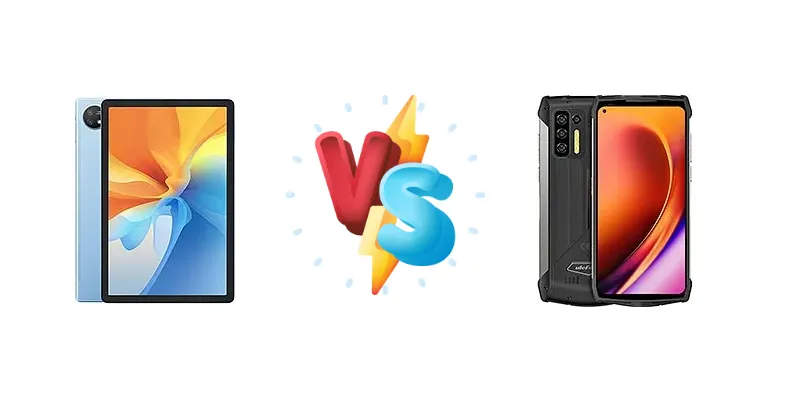
The Ulefone Power Armor 13 and Oscal Pad 16 represent distinct approaches to mobile computing. The Power Armor 13 prioritizes extreme durability and extended battery life, catering to users in demanding environments. Conversely, the Oscal Pad 16 focuses on providing a larger-screen experience at a competitive price point, making it ideal for media consumption and productivity tasks. This comparison dissects their core components to determine which device best suits your needs.
🏆 Quick Verdict
For the average user prioritizing a large screen for entertainment and light productivity, the Oscal Pad 16 offers a compelling value. However, if you require a device capable of withstanding harsh conditions and providing multi-day battery life, the Ulefone Power Armor 13 is the clear winner, despite its less powerful chipset.
| Network |
|---|
| 2G bands | GSM 850 / 900 / 1800 / 1900 | GSM 850 / 900 / 1800 / 1900 |
| 3G bands | HSDPA 900 / 2100 | HSDPA 850 / 900 / 1700(AWS) / 1900 / 2100 |
| 4G bands | 1, 3, 7, 8, 19, 20, 40 | 1, 2, 3, 4, 5, 7, 8, 12, 13, 17, 18, 19, 20, 25, 26, 28, 38, 40, 66 |
| Speed | HSPA, LTE | HSPA 42.2/11.5 Mbps, LTE Cat12 600/150 Mbps |
| Technology | GSM / HSPA / LTE | GSM / HSPA / LTE |
| Launch |
|---|
| Announced | 2024, January | 2021, July 22 |
| Status | Available. Released 2024, January | Available. Released 2021, July 26 |
| Body |
|---|
| Dimensions | 246.6 x 160.8 x 7.4 mm (9.71 x 6.33 x 0.29 in) | 183.7 x 85.4 x 20.8 mm (7.23 x 3.36 x 0.82 in) |
| SIM | Nano-SIM + Nano-SIM | Nano-SIM + Nano-SIM |
| Weight | 515 g (1.14 lb) | 492 g (1.08 lb) |
| | - | IP68 dust/water resistant (up to 1.5m for 30 min)
Drop-to-concrete resistance from up to 1.2m
MIL-STD-810G compliant |
| Display |
|---|
| Protection | - | Corning Gorilla Glass 3 |
| Resolution | 1200 x 1920 pixels, 16:10 ratio (~216 ppi density) | 1080 x 2400 pixels, 20:9 ratio (~386 ppi density) |
| Size | 10.5 inches, 319.7 cm2 (~80.6% screen-to-body ratio) | 6.81 inches, 112.0 cm2 (~71.4% screen-to-body ratio) |
| Type | IPS LCD | IPS LCD |
| Platform |
|---|
| CPU | Octa-core (2x1.6 GHz Cortex-A75 & 6x1.6 GHz Cortex-A55) | Octa-core (2x2.05 GHz Cortex-A76 & 6x2.0 GHz Cortex-A55) |
| Chipset | Unisoc T606 (12 nm) | Mediatek MT6785V/CD Helio G95 (12 nm) |
| GPU | Mali-G57 MP1 | Mali-G76 MC4 |
| OS | Android 13, DokeOS_P 3.0 | Android 11 |
| Memory |
|---|
| Card slot | microSDXC (uses shared SIM slot) | microSDXC (uses shared SIM slot) |
| Internal | 256GB 8GB RAM | 256GB 8GB RAM |
| Main Camera |
|---|
| Features | LED flash | Quad-LED flash, HDR, panorama |
| Penta | - | 48 MP, f/1.8, 26mm (wide), 1/2.0", 0.8µm, PDAF
8 MP, f/2.2, (ultrawide)
2 MP (macro)
Auxiliary lens |
| Single | 13 MP
Auxiliary lens | - |
| Video | 1080p@30fps | 4K@30fps, 1080p@30fps |
| Selfie camera |
|---|
| Features | - | HDR, panorama |
| Single | 13 MP | 16 MP, f/2.2 |
| Video | Yes | 1080p@30fps |
| Sound |
|---|
| 3.5mm jack | - | Yes |
| 35mm jack | No | Yes |
| Loudspeaker | Yes, with stereo speakers (4 speakers) | Yes |
| Comms |
|---|
| Bluetooth | 5.0, A2DP, LE | 5.0, A2DP, LE |
| NFC | No | Yes |
| Positioning | GPS, GLONASS, GALILEO, BDS | GPS, GLONASS, GALILEO, BDS |
| Radio | FM radio | FM radio, RDS, recording |
| USB | USB Type-C, OTG | - |
| WLAN | Wi-Fi 802.11 a/b/g/n/ac, dual-band | Wi-Fi 802.11 a/b/g/n/ac, dual-band |
| Features |
|---|
| Sensors | Accelerometer, proximity (accessories only) | Fingerprint (side-mounted), accelerometer, gyro, proximity, compass, baroceptor, coulombmeter |
| | - | Infrared distance measure (error range: 1~20m, ±10mm; 20~40m, ±25mm) |
| Battery |
|---|
| Charging | - | 33W wired
15W wireless
5W reverse wireless |
| Type | 8200 mAh | Li-Po 13200 mAh |
| Misc |
|---|
| Colors | Space Gray, Sierra Blue | Black |
| Price | - | About 300 EUR |
| Tests |
|---|
| Battery life | - |
Endurance rating 296h
|
| Camera | - |
Photo / Video |
| Display | - |
Contrast ratio: 1306:1 (nominal) |
| Loudspeaker | - |
-28.3 LUFS (Average)
|
| Performance | - |
AnTuTu: 294194 (v8), 351678 (v9)
GeekBench: 1610 (v5.1)
GFXBench: 18fps (ES 3.1 onscreen) |
Oscal Pad 16
- Larger screen for immersive media consumption
- Potentially more affordable price point
- Lighter and more portable than a ruggedized tablet
- Lacks ruggedization and water resistance
- Less powerful processor than the Ulefone
- Battery life likely significantly shorter
Ulefone Power Armor 13
- Exceptional durability and water resistance (IP68/IP69K)
- Long-lasting battery with versatile charging options
- More powerful processor for demanding tasks
- Bulkier and heavier design
- Potentially lower display quality compared to tablets
- Higher price point
Display Comparison
The Ulefone Power Armor 13 boasts a measured peak brightness of 401 nits and a 1306:1 contrast ratio, providing a reasonably viewable experience, though not exceptional. The Oscal Pad 16’s display specifications are currently unavailable, but given its market positioning, it likely prioritizes screen size over peak brightness and contrast. The Power Armor 13’s ruggedized construction inherently adds thickness and potentially impacts viewing angles, while the Pad 16 will likely offer slimmer bezels and a more immersive viewing experience. The contrast ratio, while identical on paper, may translate to different real-world visibility depending on panel technology.
Camera Comparison
Both devices list 'Photo / Video' capabilities, but lack specific details. Given the Power Armor 13’s focus on durability, its camera system is likely geared towards capturing functional images in challenging conditions. The Oscal Pad 16, being a tablet, may prioritize a higher-resolution main sensor for video conferencing and casual photography. Without sensor size or aperture information, it’s difficult to assess image quality, but the Power Armor 13’s ruggedization may include protective measures for the camera module. The absence of detail suggests neither device will excel in photography.
Performance
The Ulefone Power Armor 13’s MediaTek Helio G95 chipset, featuring a 2x2.05 GHz Cortex-A76 and 6x2.0 GHz Cortex-A55 configuration, offers a significant performance advantage over the Oscal Pad 16’s Unisoc T606 (2x1.6 GHz Cortex-A75 & 6x1.6 GHz Cortex-A55). The G95’s Cortex-A76 cores provide a noticeable boost in single-core performance, crucial for responsive app launching and general navigation. While both chipsets are fabricated on a 12nm process, the G95’s architecture is more modern, resulting in better overall efficiency and gaming capabilities. The Pad 16 will be suitable for basic tasks, but the Power Armor 13 will handle more demanding applications and games with greater ease.
Battery Life
The Ulefone Power Armor 13 stands out with an impressive endurance rating of 296 hours, coupled with 33W wired charging, 15W wireless charging, and even 5W reverse wireless charging. This indicates a substantial battery capacity optimized for extended use. The Oscal Pad 16’s battery specifications are unknown, but tablets generally benefit from larger batteries due to their size. However, the Power Armor 13’s charging versatility – including wireless options – provides a significant convenience factor. The 33W charging on the Power Armor 13 will replenish the battery much faster than a typical tablet charging solution.
Buying Guide
Buy the Oscal Pad 16 if you need a larger display for streaming video, browsing the web, or light office work, and don't anticipate needing extreme durability. Buy the Ulefone Power Armor 13 if you work in construction, outdoor professions, or frequently find yourself in environments where a rugged, waterproof, and long-lasting device is essential. The Power Armor 13 is also ideal for those who prioritize battery life above all else.
Frequently Asked Questions
❓ Does the Ulefone Power Armor 13’s Helio G95 chipset get excessively hot during prolonged gaming sessions?
While the Helio G95 is a capable processor, its thermal performance within the ruggedized chassis of the Power Armor 13 is a key consideration. The device’s design likely incorporates heat dissipation measures, but extended gaming may still result in noticeable warming. However, the robust build quality should prevent throttling issues that plague less well-cooled devices.
❓ How effective is the Ulefone Power Armor 13’s reverse wireless charging for topping up accessories like earbuds?
The 5W reverse wireless charging on the Power Armor 13 is primarily intended for emergency charging of small accessories like earbuds or smartwatches. It’s not designed for quickly charging larger devices like smartphones. Expect a slow but convenient trickle charge for compatible accessories.
❓ What type of storage does the Oscal Pad 16 use, and is it expandable via microSD card?
Storage specifications for the Oscal Pad 16 are currently unavailable. However, many tablets in this price range utilize eMMC storage for cost-effectiveness. MicroSD card expansion is a common feature in tablets, but its presence on the Pad 16 remains unconfirmed.
❓ Is the Ulefone Power Armor 13 compatible with 5G networks?
The Ulefone Power Armor 13 utilizes the MediaTek Helio G95 chipset, which does *not* include integrated 5G modem. Therefore, the device is limited to 4G LTE connectivity.