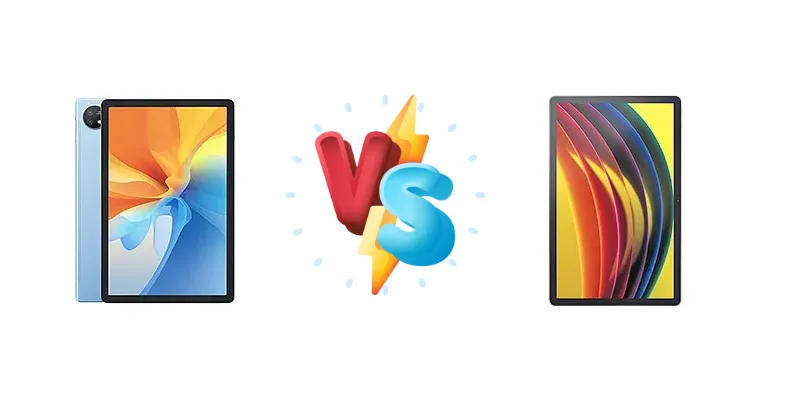
The sub-$200 Android tablet market is fiercely competitive. The Oscal Pad 16 and Lenovo Tab P11 Plus both aim to deliver a compelling experience without breaking the bank, but they take different approaches. The Oscal Pad 16 focuses on a newer, if less powerful, chipset, while the Lenovo Tab P11 Plus leverages the older, but more capable, Helio G90T. This comparison dives deep into the hardware to determine which tablet offers the best balance of performance, features, and value.
🏆 Quick Verdict
For most users, the Lenovo Tab P11 Plus is the better choice. Its Helio G90T chipset provides a noticeable performance advantage over the Oscal Pad 16’s Unisoc T606, making it more suitable for gaming and demanding applications. The 20W charging is also a welcome addition, offsetting the slightly higher price.
| Network |
|---|
| 2G bands | GSM 850 / 900 / 1800 / 1900 | GSM 850 / 900 / 1800 / 1900 |
| 3G bands | HSDPA 900 / 2100 | HSDPA 850 / 900 / 1900 / 2100 |
| 4G bands | 1, 3, 7, 8, 19, 20, 40 | 1, 2, 3, 4, 5, 7, 8, 20, 28, 38, 40, 41 |
| Speed | HSPA, LTE | HSPA, LTE - cellular model only |
| Technology | GSM / HSPA / LTE | GSM / HSPA / LTE |
| Launch |
|---|
| Announced | 2024, January | 2021, June 28 |
| Status | Available. Released 2024, January | Available. Released 2021, July 29 |
| Body |
|---|
| Dimensions | 246.6 x 160.8 x 7.4 mm (9.71 x 6.33 x 0.29 in) | 258.4 x 163 x 7.5 mm (10.17 x 6.42 x 0.30 in) |
| SIM | Nano-SIM + Nano-SIM | Nano-SIM (cellular model only) |
| Weight | 515 g (1.14 lb) | 490 g (1.08 lb) |
| | - | Stylus support |
| Display |
|---|
| Resolution | 1200 x 1920 pixels, 16:10 ratio (~216 ppi density) | 1200 x 2000 pixels, 5:3 ratio (~212 ppi density) |
| Size | 10.5 inches, 319.7 cm2 (~80.6% screen-to-body ratio) | 11.0 inches, 344.4 cm2 (~81.8% screen-to-body ratio) |
| Type | IPS LCD | IPS LCD, 400 nits (typ) |
| Platform |
|---|
| CPU | Octa-core (2x1.6 GHz Cortex-A75 & 6x1.6 GHz Cortex-A55) | Octa-core (2x2.05 GHz Cortex-A76 & 6x2.0 GHz Cortex-A55) |
| Chipset | Unisoc T606 (12 nm) | Mediatek MT6785 Helio G90T (12 nm) |
| GPU | Mali-G57 MP1 | Mali-G76 MC4 |
| OS | Android 13, DokeOS_P 3.0 | Android 11 |
| Memory |
|---|
| Card slot | microSDXC (uses shared SIM slot) | microSDXC (dedicated slot) |
| Internal | 256GB 8GB RAM | 64GB 4GB RAM, 128GB 4GB RAM, 128GB 6GB RAM |
| Main Camera |
|---|
| Features | LED flash | LED flash |
| Single | 13 MP
Auxiliary lens | 13 MP, (wide), AF |
| Video | 1080p@30fps | 1080p@30fps |
| Selfie camera |
|---|
| Single | 13 MP | 8 MP, (wide) |
| Video | Yes | 1080p@30fps |
| Sound |
|---|
| 3.5mm jack | - | No |
| 35mm jack | No | No |
| Loudspeaker | Yes, with stereo speakers (4 speakers) | Yes, with stereo speakers (4 speakers) |
| Comms |
|---|
| Bluetooth | 5.0, A2DP, LE | 5.1, A2DP, LE |
| NFC | No | No |
| Positioning | GPS, GLONASS, GALILEO, BDS | GPS, GLONASS, BDS - cellular model only |
| Radio | FM radio | FM radio |
| USB | USB Type-C, OTG | USB Type-C 2.0 |
| WLAN | Wi-Fi 802.11 a/b/g/n/ac, dual-band | Wi-Fi 802.11 a/b/g/n/ac, dual-band, Wi-Fi Direct |
| Features |
|---|
| Sensors | Accelerometer, proximity (accessories only) | Accelerometer, gyro, proximity |
| Battery |
|---|
| Charging | - | 20W wired |
| Type | 8200 mAh | Li-Po 7700 mAh |
| Misc |
|---|
| Colors | Space Gray, Sierra Blue | Slate Grey, Platinum Grey, Modernist teal |
| Models | - | ZA940124SE |
| Price | - | About 300 EUR |
Oscal Pad 16
- Potentially lower price point
- Unisoc T606 is relatively power efficient for basic tasks
- May offer a longer software support lifecycle (depending on Oscal's commitment)
- Significantly weaker performance compared to the Helio G90T
- Likely slower charging speeds
- Less capable GPU for gaming
Lenovo Tab P11 Plus
- Superior performance with the Helio G90T chipset
- Faster 20W wired charging
- More responsive user experience
- Slightly higher price
- Helio G90T is an older chipset
- May receive fewer software updates compared to newer chipsets
Display Comparison
Neither Oscal nor Lenovo provide detailed display specs beyond resolution. However, the core performance difference impacts the user experience. While both likely utilize IPS LCD panels, the more powerful GPU in the Lenovo Tab P11 Plus can drive higher frame rates and potentially better visual fidelity in games. Bezels are likely comparable given the price bracket, and color accuracy is expected to be standard for this segment – adequate for general use but not color-critical work.
Camera Comparison
Camera performance is unlikely to be a deciding factor for either tablet. Both will likely feature basic camera setups geared towards casual snapshots. Without detailed sensor information, it’s difficult to make a direct comparison. However, the more powerful ISP (Image Signal Processor) within the Helio G90T may offer slightly better image processing, resulting in marginally improved photos and videos. Focusing on megapixel counts alone would be misleading; image quality is more dependent on sensor size and software optimization.
Performance
The core difference lies in the chipsets. The Lenovo Tab P11 Plus’s MediaTek Helio G90T (12nm) boasts Cortex-A76 cores clocked at 2.05 GHz, a significant step up from the Oscal Pad 16’s Unisoc T606 (12nm) with its 1.6 GHz Cortex-A75 cores. The A76 architecture offers superior single-core performance, crucial for app responsiveness and smoother multitasking. While both are 12nm, the G90T’s more advanced core design and higher clock speeds translate to a tangible performance advantage. The G90T also features a more capable Mali-G76 MC4 GPU, providing a better gaming experience than the T606’s Mali-G52 MC2. The Lenovo’s likely use of faster LPDDR4X RAM further enhances performance.
Battery Life
Battery life will depend heavily on usage patterns. While the Oscal Pad 16’s battery capacity is not specified, tablets in this price range typically range from 6000-7000mAh. The Lenovo Tab P11 Plus benefits from 20W wired charging, allowing for significantly faster top-ups compared to the likely 10W or 15W charging on the Oscal Pad 16. This faster charging is a practical advantage, reducing downtime and ensuring the tablet is ready when you need it. The more efficient Helio G90T may also contribute to slightly better battery life under heavy load.
Buying Guide
Buy the Oscal Pad 16 if you prioritize a very low price point and primarily need a tablet for basic tasks like web browsing, video playback, and light productivity. It’s a good option for users who aren’t demanding gamers or power users. Buy the Lenovo Tab P11 Plus if you value smoother performance, faster charging, and a more responsive user experience, even if it means spending a bit more. This tablet is ideal for students, casual gamers, and anyone who wants a tablet that can handle a wider range of tasks.
Frequently Asked Questions
❓ Will the Oscal Pad 16 struggle with multitasking or running multiple apps simultaneously?
Yes, the Unisoc T606 chipset in the Oscal Pad 16 is less capable at handling multitasking compared to the Helio G90T. Expect noticeable slowdowns and app reloading when switching between several applications. It's best suited for running one or two apps at a time.
❓ Is the Helio G90T in the Lenovo Tab P11 Plus still a good chipset in 2024, or is it outdated?
While the Helio G90T isn't the newest chipset, it remains a capable performer for everyday tasks and even some moderate gaming. It offers a significant performance boost over newer, lower-end chipsets like the Unisoc T606, making it a solid choice for a budget tablet in 2024.
❓ Can the Lenovo Tab P11 Plus handle popular mobile games like PUBG Mobile or Call of Duty Mobile?
The Lenovo Tab P11 Plus can run PUBG Mobile and Call of Duty Mobile, but you'll likely need to lower the graphics settings to medium or low to achieve a smooth frame rate. The Helio G90T's Mali-G76 MC4 GPU is capable, but it's not a high-end gaming chipset.
❓ What type of storage does each tablet use, and is it expandable?
While not explicitly stated, both tablets likely use eMMC storage, common in this price range. Expandability via microSD card is highly probable on both devices, but confirm the maximum supported capacity before purchasing.