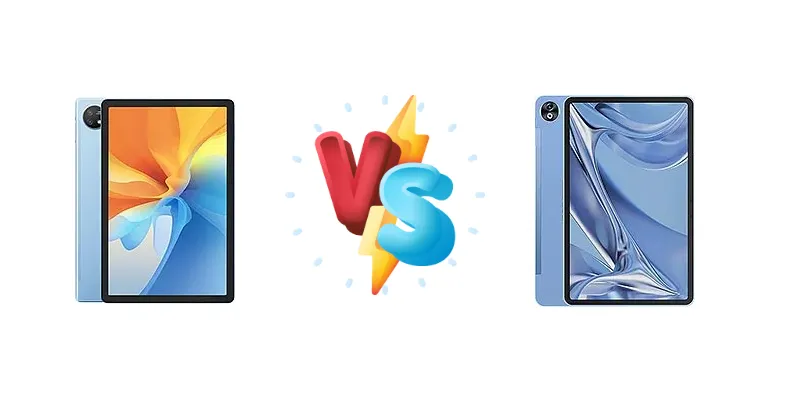
The budget tablet market is heating up, with the Oscal Pad 16 and Doogee T20 Ultra vying for attention. Both aim to deliver a functional tablet experience without breaking the bank, but they take different approaches to achieving this. The key differentiator lies in their chipsets: Unisoc T606 in the Oscal versus the MediaTek Helio G99 in the Doogee. This comparison will dissect those differences and determine which tablet offers the best value.
🏆 Quick Verdict
For most users, the Doogee T20 Ultra is the better choice. Its MediaTek Helio G99 chipset, built on a more efficient 6nm process, provides a noticeable performance boost over the Oscal Pad 16’s Unisoc T606. While the Oscal is a capable device, the T20 Ultra’s superior processing power translates to a smoother user experience and better multitasking capabilities.
| Network |
|---|
| 2G bands | GSM 850 / 900 / 1800 / 1900 | GSM 850 / 900 / 1800 / 1900 |
| 3G bands | HSDPA 900 / 2100 | HSDPA 800 / 850 / 900 / 1700(AWS) / 1900 / 2100 |
| 4G bands | 1, 3, 7, 8, 19, 20, 40 | 1, 2, 3, 4, 5, 7, 8, 12, 17, 18, 19, 20, 25, 26, 28, 34, 38, 39, 40, 41, 66 |
| Speed | HSPA, LTE | HSPA, LTE |
| Technology | GSM / HSPA / LTE | GSM / HSPA / LTE |
| Launch |
|---|
| Announced | 2024, January | 2023, October |
| Status | Available. Released 2024, January | Available. Released 2023, November |
| Body |
|---|
| Build | - | Glass front, aluminum frame, aluminum back |
| Dimensions | 246.6 x 160.8 x 7.4 mm (9.71 x 6.33 x 0.29 in) | 278.8 x 174.3 x 7.6 mm (10.98 x 6.86 x 0.30 in) |
| SIM | Nano-SIM + Nano-SIM | Nano-SIM + Nano-SIM |
| Weight | 515 g (1.14 lb) | 568 g (1.25 lb) |
| Display |
|---|
| Resolution | 1200 x 1920 pixels, 16:10 ratio (~216 ppi density) | 1200 x 2000 pixels, 5:3 ratio (~194 ppi density) |
| Size | 10.5 inches, 319.7 cm2 (~80.6% screen-to-body ratio) | 12.0 inches, 409.9 cm2 (~84.3% screen-to-body ratio) |
| Type | IPS LCD | IPS LCD, 350 nits |
| Platform |
|---|
| CPU | Octa-core (2x1.6 GHz Cortex-A75 & 6x1.6 GHz Cortex-A55) | Octa-core (2x2.2 GHz Cortex-A76 & 6x2.0 GHz Cortex-A55) |
| Chipset | Unisoc T606 (12 nm) | Mediatek Helio G99 (6 nm) |
| GPU | Mali-G57 MP1 | Mali-G57 MC2 |
| OS | Android 13, DokeOS_P 3.0 | Android 13 |
| Memory |
|---|
| Card slot | microSDXC (uses shared SIM slot) | microSDXC (uses shared SIM slot) |
| Internal | 256GB 8GB RAM | 256GB 12GB RAM |
| Main Camera |
|---|
| Features | LED flash | LED flash |
| Single | 13 MP
Auxiliary lens | 16 MP |
| Video | 1080p@30fps | 1440p@30fps, 1080p@30fps |
| Selfie camera |
|---|
| Single | 13 MP | 8 MP |
| Video | Yes | Yes |
| Sound |
|---|
| 35mm jack | No | Yes |
| Loudspeaker | Yes, with stereo speakers (4 speakers) | Yes, with stereo speakers (4 speakers) |
| Comms |
|---|
| Bluetooth | 5.0, A2DP, LE | 5.2, A2DP, LE |
| NFC | No | No |
| Positioning | GPS, GLONASS, GALILEO, BDS | GPS, GALILEO, GLONASS, BDS |
| Radio | FM radio | FM radio |
| USB | USB Type-C, OTG | USB Type-C 2.0, OTG, magnetic accessory connector pins |
| WLAN | Wi-Fi 802.11 a/b/g/n/ac, dual-band | Wi-Fi 802.11 a/b/g/n/ac, dual-band |
| Features |
|---|
| Sensors | Accelerometer, proximity (accessories only) | Accelerometer, gyro, proximity, compass |
| Battery |
|---|
| Charging | - | 18W wired
Reverse wired |
| Type | 8200 mAh | 10800 mAh |
| Misc |
|---|
| Colors | Space Gray, Sierra Blue | Blue, Gray, Black |
| Price | - | About 230 EUR |
Oscal Pad 16
- Potentially lower price point
- Functional for basic tasks
- Acceptable for casual users
- Less powerful Unisoc T606 chipset
- Likely limited multitasking capabilities
- May struggle with demanding apps
Doogee T20 Ultra
- More powerful MediaTek Helio G99 chipset
- Improved performance and multitasking
- 18W charging with reverse wired charging
- Potentially higher price
- Battery life dependent on usage
- Camera quality likely still modest
Display Comparison
Neither Oscal nor Doogee provide detailed display specifications beyond the basic panel size. However, the chipset difference hints at potential display capabilities. The Helio G99 in the T20 Ultra is often paired with displays supporting higher refresh rates (though not confirmed here), suggesting a potentially smoother visual experience. The Unisoc T606 is generally found on more basic panels. Without specific nit brightness or color gamut data, it’s difficult to definitively declare a winner, but the T20 Ultra’s chipset suggests a more modern display implementation.
Camera Comparison
Both tablets likely feature modest camera setups typical of their price range. Without detailed sensor information, it’s difficult to make a meaningful comparison. However, the T20 Ultra’s more powerful ISP (Image Signal Processor) within the Helio G99 chipset will likely result in better image processing, particularly in low-light conditions. Expect both tablets to struggle with complex scenes or demanding photography tasks. Focusing on the chipset advantage, the T20 Ultra will likely produce more usable images.
Performance
The performance gap is the most significant difference. The Doogee T20 Ultra’s MediaTek Helio G99 (6nm) boasts a clear advantage over the Oscal Pad 16’s Unisoc T606 (12nm). The G99’s Cortex-A76 cores, clocked at 2.2 GHz, are significantly more powerful than the T606’s Cortex-A75 cores at 1.6 GHz. The 6nm fabrication process also contributes to better power efficiency and sustained performance, reducing the likelihood of thermal throttling during extended use. This translates to faster app loading times, smoother multitasking, and a more enjoyable gaming experience on the T20 Ultra.
Battery Life
Battery life will depend heavily on usage patterns. While the exact battery capacities aren’t specified, the Doogee T20 Ultra’s 18W charging and reverse wired charging capability offer a convenience the Oscal Pad 16 likely lacks. The more efficient Helio G99 chipset should also contribute to longer battery life under similar workloads. The 18W charging, while not exceptionally fast, is a welcome addition for quickly topping up the battery.
Buying Guide
Buy the Oscal Pad 16 if you prioritize absolute affordability and need a tablet for basic tasks like web browsing, video streaming, and light document editing. It’s a solid option for casual users on a tight budget. Buy the Doogee T20 Ultra if you want a more responsive tablet capable of handling more demanding applications, moderate gaming, and smoother multitasking. The T20 Ultra is ideal for students, professionals, or anyone who needs a bit more power from their tablet.
Frequently Asked Questions
❓ Will the Doogee T20 Ultra handle graphically intensive games like PUBG Mobile?
The MediaTek Helio G99 is capable of running PUBG Mobile, but you’ll likely need to lower the graphics settings to achieve a smooth frame rate. The T606 in the Oscal Pad 16 will struggle with PUBG, even on the lowest settings.
❓ Does the Doogee T20 Ultra support fast charging, and how long does it take to fully charge?
The Doogee T20 Ultra supports 18W wired charging. While not the fastest charging available, it should take approximately 2.5 to 3.5 hours for a full charge from 0%, depending on the charger used and background processes.
❓ Is the Unisoc T606 in the Oscal Pad 16 sufficient for everyday tasks like browsing and video streaming?
Yes, the Unisoc T606 is adequate for basic tasks like web browsing, video streaming, and light document editing. However, expect some lag when multitasking or running more demanding applications.
❓ What type of storage does each tablet use, and is it expandable?
Specific storage details (eMMC vs. UFS) aren't provided. However, tablets in this price range typically use eMMC storage. Expandability via microSD card is common, but needs to be verified for each model.