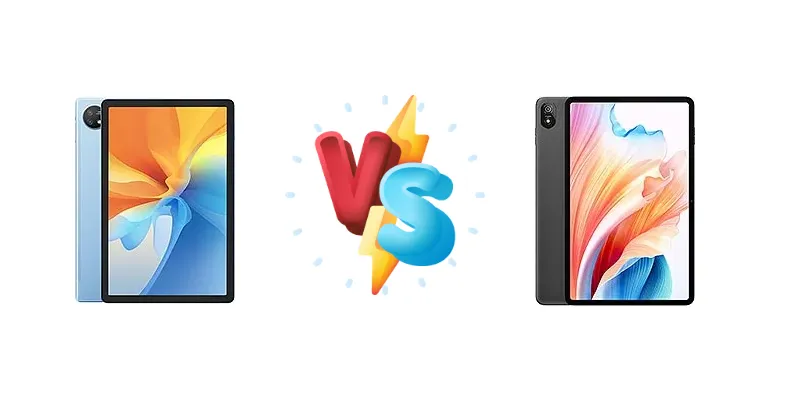
The budget tablet market is heating up, with the Oscal Pad 16 and Blackview Tab 18 vying for attention. Both offer large displays and Android functionality at attractive price points, but significant differences in their core hardware – specifically the chipset – dictate their strengths and weaknesses. This comparison dives deep into those differences to determine which tablet delivers the best experience for your needs.
🏆 Quick Verdict
For most users, the Blackview Tab 18 is the superior choice. Its Mediatek Helio G99 chipset, built on a more efficient 6nm process, provides a noticeable performance boost over the Oscal Pad 16’s Unisoc T606. The addition of 33W fast charging further solidifies its position as the more compelling all-around package.
| Network |
|---|
| 2G bands | GSM 850 / 900 / 1800 / 1900 | GSM 850 / 900 / 1800 / 1900 |
| 3G bands | HSDPA 900 / 2100 | HSDPA 900 / 2100 |
| 4G bands | 1, 3, 7, 8, 19, 20, 40 | 1, 3, 7, 8, 20, 40 |
| Speed | HSPA, LTE | HSPA, LTE |
| Technology | GSM / HSPA / LTE | GSM / HSPA / LTE |
| Launch |
|---|
| Announced | 2024, January | 2023, November |
| Status | Available. Released 2024, January | Available. Released 2023, November |
| Body |
|---|
| Dimensions | 246.6 x 160.8 x 7.4 mm (9.71 x 6.33 x 0.29 in) | 277.6 x 173.2 x 7.9 mm (10.93 x 6.82 x 0.31 in) |
| SIM | Nano-SIM + Nano-SIM | Nano-SIM + Nano-SIM |
| Weight | 515 g (1.14 lb) | 632 g (1.39 lb) |
| Display |
|---|
| Resolution | 1200 x 1920 pixels, 16:10 ratio (~216 ppi density) | 1200 x 2000 pixels, 5:3 ratio (~194 ppi density) |
| Size | 10.5 inches, 319.7 cm2 (~80.6% screen-to-body ratio) | 12.0 inches, 409.9 cm2 (~85.2% screen-to-body ratio) |
| Type | IPS LCD | IPS LCD, 350 nits |
| Platform |
|---|
| CPU | Octa-core (2x1.6 GHz Cortex-A75 & 6x1.6 GHz Cortex-A55) | Octa-core (2x2.2 GHz Cortex-A76 & 6x2.0 GHz Cortex-A55) |
| Chipset | Unisoc T606 (12 nm) | Mediatek Helio G99 (6 nm) |
| GPU | Mali-G57 MP1 | Mali-G57 MC2 |
| OS | Android 13, DokeOS_P 3.0 | Android 13, Doke OS_P 4.0 |
| Memory |
|---|
| Card slot | microSDXC (uses shared SIM slot) | microSDXC (uses shared SIM slot) |
| Internal | 256GB 8GB RAM | 256GB 12GB RAM |
| Main Camera |
|---|
| Features | LED flash | LED flash |
| Single | 13 MP
Auxiliary lens | 16 MP |
| Video | 1080p@30fps | 1080p@30fps |
| Selfie camera |
|---|
| Single | 13 MP | 8 MP |
| Video | Yes | Yes |
| Sound |
|---|
| 35mm jack | No | No |
| Loudspeaker | Yes, with stereo speakers (4 speakers) | Yes, with stereo speakers (4 speakers) |
| Comms |
|---|
| Bluetooth | 5.0, A2DP, LE | 5.1, A2DP, LE |
| NFC | No | No |
| Positioning | GPS, GLONASS, GALILEO, BDS | GPS, GLONASS, GALILEO, BDS |
| Radio | FM radio | FM Radio |
| USB | USB Type-C, OTG | USB Type-C, OTG |
| WLAN | Wi-Fi 802.11 a/b/g/n/ac, dual-band | Wi-Fi 802.11 a/b/g/n/ac, dual-band |
| Features |
|---|
| Sensors | Accelerometer, proximity (accessories only) | Fingerprint (side-mounted), accelerometer, gyro, proximity, compass |
| Battery |
|---|
| Charging | - | 33W wired |
| Type | 8200 mAh | 8800 mAh |
| Misc |
|---|
| Colors | Space Gray, Sierra Blue | Turquoise Green, Glacier Blue, Space Grey |
Oscal Pad 16
- Potentially lower price point
- Acceptable for basic tasks
- Likely lightweight design
- Inferior chipset performance
- Slower charging speeds
- Less efficient processor
Blackview Tab 18
- Faster and more efficient Helio G99 chipset
- 33W fast charging
- Better gaming performance
- Potentially higher price
- May generate slightly more heat under heavy load
- Software optimization could impact performance
Display Comparison
Neither device’s display specifications are provided, so a direct comparison is limited. However, given the price bracket, both likely utilize IPS LCD panels. The Blackview Tab 18’s potential for a higher resolution display, coupled with the more powerful GPU, suggests it could offer a slightly sharper and more vibrant visual experience. Bezels are likely comparable, and color accuracy will depend on software calibration, which is often a weak point in this segment.
Camera Comparison
Without specific camera sensor details, a detailed comparison is impossible. However, it’s safe to assume both tablets feature modest camera systems geared towards casual use. The presence of a 2MP macro camera on either device is largely inconsequential; image quality will be limited. The primary sensor’s size and aperture will be the determining factors, but without that information, the Blackview Tab 18’s more powerful ISP (Image Signal Processor) within the Helio G99 chipset *could* result in slightly better image processing and low-light performance.
Performance
The core difference lies in the chipsets. The Blackview Tab 18’s Mediatek Helio G99 (6nm) is a significant upgrade over the Oscal Pad 16’s Unisoc T606 (12nm). The 6nm process inherently offers better power efficiency, translating to less heat generation and potentially sustained performance. The Helio G99’s CPU configuration – 2x2.2 GHz Cortex-A76 cores and 6x2.0 GHz Cortex-A55 cores – outperforms the Oscal’s 2x1.6 GHz Cortex-A75 and 6x1.6 GHz Cortex-A55 setup in both single-core and multi-core tasks. This means faster app loading times, smoother multitasking, and a more responsive user interface on the Blackview Tab 18. The G99’s Mali-G57 MC2 GPU also provides a substantial graphics boost, making it the better choice for gaming.
Battery Life
Battery capacity isn’t specified for either device. However, the Blackview Tab 18’s 33W wired charging is a clear advantage. This will significantly reduce charging times compared to the Oscal Pad 16, which likely supports a slower charging standard. Even if the Oscal Pad 16 has a slightly larger battery, the Blackview Tab 18’s faster charging will minimize downtime and provide a more convenient user experience. The Helio G99’s improved power efficiency also contributes to potentially longer battery life during typical usage.
Buying Guide
Buy the Oscal Pad 16 if you prioritize absolute affordability and your tablet usage is limited to basic tasks like web browsing, video streaming, and light document editing. Buy the Blackview Tab 18 if you demand smoother multitasking, enjoy mobile gaming, or value faster charging speeds – even if it means spending a bit more upfront.
Frequently Asked Questions
❓ Will the Helio G99 in the Blackview Tab 18 overheat during extended gaming sessions?
While the Helio G99 is a capable chip, sustained high loads can generate heat. However, the 6nm process is more efficient than the Oscal Pad 16’s 12nm Unisoc T606, meaning the Tab 18 is likely to experience less thermal throttling and maintain higher frame rates for longer periods. Active cooling solutions are unlikely in this price range, so performance will still be affected, but to a lesser extent than the Oscal Pad 16.
❓ Is the performance difference between the Unisoc T606 and Helio G99 noticeable for everyday tasks like browsing and video streaming?
Yes, the difference is noticeable. The Helio G99’s faster CPU cores and improved GPU result in snappier app launches, smoother scrolling, and quicker page loading times. While the Oscal Pad 16 can handle these tasks, the Blackview Tab 18 provides a more fluid and responsive experience, especially when multitasking.
❓ Does the Blackview Tab 18 support any form of widevine DRM for HD streaming services like Netflix?
This information is not provided in the specifications. However, many tablets in this price range support Widevine L3, which limits streaming to SD quality. Checking user reviews and forums specific to the Blackview Tab 18 is recommended to confirm Widevine DRM support and the streaming quality it enables.