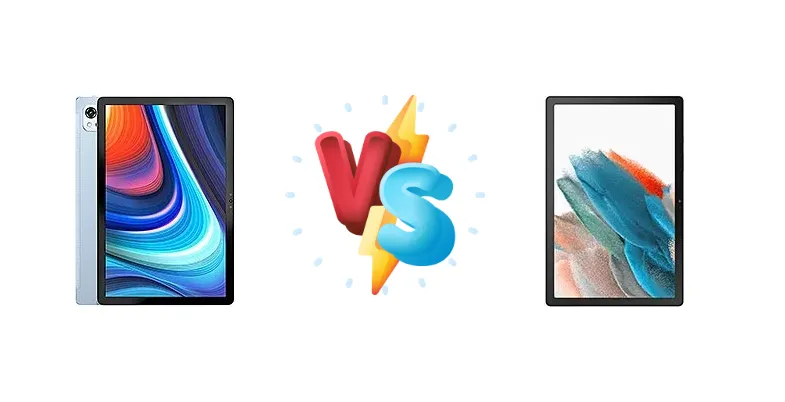
The sub-$200 Android tablet market is fiercely competitive. Both the Oscal Pad 13 and the Samsung Galaxy Tab A8 10.5 (2021) aim to deliver a functional tablet experience without breaking the bank. However, subtle differences in their chipsets and features can significantly impact performance and usability. This comparison dissects these nuances to determine which tablet offers the best value.
🏆 Quick Verdict
For most users, the Samsung Galaxy Tab A8 10.5 (2021) is the better choice. While the Oscal Pad 13 offers a compelling price, the Tab A8’s slightly faster Unisoc Tiger T618 chipset and Samsung’s software optimizations provide a smoother, more responsive user experience. The 15W charging is also a benefit over the Oscal's unknown charging speed.
| Network |
|---|
| 2G bands | GSM 850 / 900 / 1800 / 1900 | GSM 850 / 900 / 1800 / 1900 |
| 3G bands | HSDPA 900 / 2100 | HSDPA 850 / 900 / 1700(AWS) / 1900 / 2100 |
| 4G bands | 1, 3, 7, 8, 20, 40 | 1, 2, 3, 4, 5, 7, 8, 12, 17, 20, 28, 38, 40, 41, 66 |
| Speed | HSPA, LTE | HSPA, LTE - cellular model only |
| Technology | GSM / HSPA / LTE | GSM / HSPA / LTE |
| Launch |
|---|
| Announced | 2023, April 12 | 2021, December 15 |
| Status | Available. Released 2023, April 17 | Available. Released 2022, January 17 |
| Body |
|---|
| Dimensions | 239.2 x 158 x 7.6 mm (9.42 x 6.22 x 0.30 in) | 246.8 x 161.9 x 6.9 mm (9.72 x 6.37 x 0.27 in) |
| SIM | Nano-SIM + Nano-SIM | Nano-SIM (cellular model only) |
| Weight | 435 g (15.34 oz) | 508 g (1.12 lb) |
| Display |
|---|
| Resolution | 1200 x 1920 pixels, 16:10 ratio (~224 ppi density) | 1200 x 1920 pixels, 16:10 ratio (~216 ppi density) |
| Size | 10.1 inches, 295.8 cm2 (~78.3% screen-to-body ratio) | 10.5 inches, 319.7 cm2 (~80.0% screen-to-body ratio) |
| Type | IPS LCD | TFT LCD |
| Platform |
|---|
| CPU | Octa-core (2x1.6 GHz Cortex-A75 & 6x1.6 GHz Cortex-A55) | Octa-core (2x2.0 GHz Cortex-A75 & 6x2.0 GHz Cortex-A55) |
| Chipset | Unisoc T606 (12 nm) | Unisoc Tiger T618 (12 nm) |
| GPU | Mali-G57 MP1 | Mali G52 MP2 |
| OS | Android 12, Doke-OS 3.0 | Android 11, upgradable to Android 14, One UI 6 |
| Memory |
|---|
| Card slot | microSDXC (uses shared SIM slot) | microSDXC (dedicated slot) |
| Internal | 256GB 8GB RAM | 32GB 2GB RAM, 32GB 3GB RAM, 64GB 2GB RAM, 64GB 3GB RAM, 64GB 4GB RAM, 128GB 3GB RAM, 128GB 4GB RAM |
| Main Camera |
|---|
| Features | LED flash | - |
| Single | 13 MP | 8 MP, AF |
| Video | 1080p@30fps | 1080p@30fps |
| Selfie camera |
|---|
| Single | 8 MP, 1/4.0", 1.12µm | 5 MP |
| Video | Yes | 1080p@30fps |
| Sound |
|---|
| 3.5mm jack | - | Yes |
| 35mm jack | No | Yes |
| Loudspeaker | Yes, with dual speakers | Yes, with stereo speakers (4 speakers) |
| Comms |
|---|
| Bluetooth | 5.0, A2DP, LE | 5.0, A2DP, LE |
| NFC | No | No |
| Positioning | GPS, GLONASS, GALILEO, BDS | GPS, GLONASS, BDS, GALILEO, QZSS - cellular model only |
| Radio | FM radio | No |
| USB | USB Type-C, OTG | USB Type-C 2.0 |
| WLAN | Wi-Fi 802.11 a/b/g/n/ac, dual-band | Wi-Fi 802.11 a/b/g/n/ac, dual-band, Wi-Fi Direct |
| Features |
|---|
| Sensors | Unspecified | Accelerometer, gyro, proximity, compass |
| Battery |
|---|
| Charging | - | 15W wired |
| Type | 7680 mAh | Li-Po 7040 mAh |
| Misc |
|---|
| Colors | Glacier Blue, Space Grey | Gray, Silver, Pink Gold |
| Models | - | SM-X200, SM-X205 |
| Price | About 130 EUR | About 230 EUR |
| SAR EU | - | 0.92 W/kg (body) |
Oscal Pad 13
- Potentially lower price point
- Unisoc T606 chipset offers adequate performance for basic tasks
- Likely lightweight design
- Unknown display specifications
- Performance likely lags behind the Tab A8
- Charging speed and battery capacity unknown
Samsung Galaxy Tab A8 10.5 (2021)
- Faster Unisoc Tiger T618 chipset
- 7,040 mAh battery provides all-day battery life
- 15W wired charging
- TFT LCD display isn't the most vibrant
- 2MP front camera offers limited quality
- Higher price compared to the Oscal Pad 13
Display Comparison
Both tablets utilize 12nm process technology, suggesting similar power efficiency considerations in display design. While specific display specs like resolution and panel type are missing for the Oscal Pad 13, the Samsung Galaxy Tab A8 10.5 features a 10.5-inch TFT LCD. The absence of details on the Oscal Pad 13’s display makes a direct comparison difficult, but given the price point, it’s likely to be a similar TFT LCD panel. Bezels are expected to be relatively substantial on both devices, typical for this price bracket. Color accuracy is likely to be standard for both, prioritizing cost over color calibration.
Camera Comparison
Camera performance is unlikely to be a key differentiator for either tablet. Details on the Oscal Pad 13’s camera are unavailable, but the Samsung Galaxy Tab A8 10.5 features an 8MP rear camera and a 2MP front camera. The 2MP front camera is largely for video calls and offers limited image quality. The 8MP rear camera is adequate for basic snapshots in good lighting conditions, but don’t expect flagship-level image processing or low-light performance. Given the likely cost-cutting measures on the Oscal Pad 13, its camera system is likely comparable or slightly inferior.
Performance
The core difference lies in the chipsets. The Samsung Galaxy Tab A8 10.5 is powered by the Unisoc Tiger T618, featuring a CPU clocked at 2.0 GHz on its Cortex-A75 cores. The Oscal Pad 13 uses the Unisoc T606, with Cortex-A75 cores clocked slightly lower at 1.6 GHz. This 0.4 GHz difference, coupled with the 'Tiger' variant’s potential optimizations, translates to a noticeable performance edge for the Tab A8 in CPU-intensive tasks. Both utilize the same Cortex-A55 efficiency cores, but the higher clock speed on the A75 cores of the T618 will benefit multitasking and app responsiveness. RAM configurations are unknown for the Oscal Pad 13, but the Tab A8’s RAM speed (likely LPDDR4X) will contribute to overall system fluidity. Thermal management is unlikely to be a major concern on either device given the relatively low-power chipsets.
Battery Life
Battery capacity is unknown for the Oscal Pad 13. The Samsung Galaxy Tab A8 10.5 packs a 7,040 mAh battery and supports 15W wired charging. While the battery capacity is substantial, the 15W charging isn’t particularly fast. Expect a full charge to take around 3-4 hours. Without knowing the Oscal Pad 13’s battery capacity and charging speed, it’s difficult to make a direct comparison. However, the Tab A8’s 15W charging provides a known benchmark for recharge times.
Buying Guide
Buy the Oscal Pad 13 if you prioritize absolute affordability and are willing to accept minor performance compromises for basic tasks like web browsing and video playback. Buy the Samsung Galaxy Tab A8 10.5 (2021) if you value a more fluid user experience, slightly faster app loading times, and the reliability of the Samsung brand, even if it means spending a bit more.
Frequently Asked Questions
❓ Is the Unisoc Tiger T618 in the Samsung Galaxy Tab A8 powerful enough for light gaming?
Yes, the Unisoc Tiger T618 can handle light gaming titles and casual games without significant issues. However, demanding 3D games may require lower graphics settings to maintain a playable frame rate. It's not a gaming powerhouse, but it's sufficient for entertainment on the go.
❓ Does the Samsung Galaxy Tab A8 support expandable storage via microSD card?
Yes, the Samsung Galaxy Tab A8 10.5 (2021) includes a microSD card slot, allowing you to expand the internal storage up to 1TB. This is a crucial feature for users who plan to store a large number of files, photos, or videos on their tablet.
❓ What kind of software experience can I expect on the Oscal Pad 13?
Given Oscal's brand positioning, the Pad 13 likely runs a near-stock version of Android. While this can be a benefit for users who prefer a clean interface, it may also mean fewer software features and potentially less frequent software updates compared to Samsung's One UI.
❓ How long will the Samsung Galaxy Tab A8's 7,040 mAh battery last on a single charge?
The 7,040 mAh battery in the Samsung Galaxy Tab A8 typically provides around 8-10 hours of mixed usage, including web browsing, video playback, and social media. Battery life will vary depending on screen brightness, app usage, and network conditions.