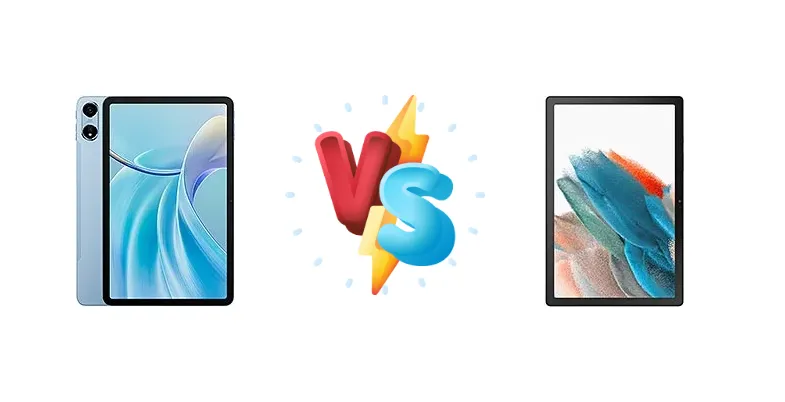
The budget tablet market is fiercely competitive, with options like the Oscal Pad 100 and Samsung Galaxy Tab A8 10.5 (2021) vying for attention. Both tablets utilize Unisoc chipsets, but diverge significantly in battery endurance and subtle performance characteristics. This comparison dissects these differences to determine which tablet delivers the best value for your needs.
🏆 Quick Verdict
For the average user prioritizing longevity and all-day use, the Oscal Pad 100 emerges as the winner. Its exceptional 108:47h battery endurance significantly surpasses the Tab A8, making it ideal for travel or extended use away from a charger. While the Tab A8 offers the Samsung brand recognition, the Oscal Pad 100 provides superior battery performance.
| Network |
|---|
| 2G bands | GSM 850 / 900 / 1800 / 1900 | GSM 850 / 900 / 1800 / 1900 |
| 3G bands | HSDPA 900 / 2100 | HSDPA 850 / 900 / 1700(AWS) / 1900 / 2100 |
| 4G bands | 1, 3, 7, 8, 19, 20, 28, 38, 40, 41 | 1, 2, 3, 4, 5, 7, 8, 12, 17, 20, 28, 38, 40, 41, 66 |
| Speed | HSPA, LTE | HSPA, LTE - cellular model only |
| Technology | GSM / HSPA / LTE | GSM / HSPA / LTE |
| Launch |
|---|
| Announced | 2025, February | 2021, December 15 |
| Status | Available. Released 2025, February | Available. Released 2022, January 17 |
| Body |
|---|
| Dimensions | 281.7 x 177.2 x 8 mm (11.09 x 6.98 x 0.31 in) | 246.8 x 161.9 x 6.9 mm (9.72 x 6.37 x 0.27 in) |
| SIM | Nano-SIM + Nano-SIM | Nano-SIM (cellular model only) |
| Weight | 610 g (1.34 lb) | 508 g (1.12 lb) |
| Display |
|---|
| Protection | Mohs level 5 | - |
| Resolution | 1200 x 2000 pixels, 5:3 ratio (~194 ppi density) | 1200 x 1920 pixels, 16:10 ratio (~216 ppi density) |
| Size | 12.0 inches, 409.9 cm2 (~82.1% screen-to-body ratio) | 10.5 inches, 319.7 cm2 (~80.0% screen-to-body ratio) |
| Type | IPS LCD, 360 nits | TFT LCD |
| Platform |
|---|
| CPU | Octa-core (2x1.8 GHz Cortex-A75 & 6x1.6 GHz Cortex-A55) | Octa-core (2x2.0 GHz Cortex-A75 & 6x2.0 GHz Cortex-A55) |
| Chipset | Unisoc T615 (12 nm) | Unisoc Tiger T618 (12 nm) |
| GPU | Mali-G57 MP1 | Mali G52 MP2 |
| OS | Android 15 | Android 11, upgradable to Android 14, One UI 6 |
| Memory |
|---|
| Card slot | microSDXC (uses shared SIM slot) | microSDXC (dedicated slot) |
| Internal | 256GB 8GB RAM, 256GB 12GB RAM | 32GB 2GB RAM, 32GB 3GB RAM, 64GB 2GB RAM, 64GB 3GB RAM, 64GB 4GB RAM, 128GB 3GB RAM, 128GB 4GB RAM |
| Main Camera |
|---|
| Features | LED flash, panorama | - |
| Single | 16 MP | 8 MP, AF |
| Video | 1080p@30fps | 1080p@30fps |
| Selfie camera |
|---|
| Single | 8 MP | 5 MP |
| Video | 1080p@30fps | 1080p@30fps |
| Sound |
|---|
| 3.5mm jack | - | Yes |
| 35mm jack | Yes | Yes |
| Loudspeaker | Yes, with stereo speakers | Yes, with stereo speakers (4 speakers) |
| Comms |
|---|
| Bluetooth | 5.0 | 5.0, A2DP, LE |
| NFC | No | No |
| Positioning | GPS, GLONASS, GALILEO, BDS | GPS, GLONASS, BDS, GALILEO, QZSS - cellular model only |
| Radio | FM radio | No |
| USB | USB Type-C, OTG | USB Type-C 2.0 |
| WLAN | Wi-Fi 802.11 a/b/g/n/ac, dual-band | Wi-Fi 802.11 a/b/g/n/ac, dual-band, Wi-Fi Direct |
| Features |
|---|
| Sensors | Accelerometer | Accelerometer, gyro, proximity, compass |
| Battery |
|---|
| Charging | - | 15W wired |
| Type | Li-Ion 9000 mAh | Li-Po 7040 mAh |
| Misc |
|---|
| Colors | Gray, Blue | Gray, Silver, Pink Gold |
| Models | - | SM-X200, SM-X205 |
| Price | - | About 230 EUR |
| SAR EU | - | 0.92 W/kg (body) |
| EU LABEL |
|---|
| Battery | 108:47h endurance, 800 cycles | - |
| Energy | Class D | - |
| Free fall | Class B (156 falls) | - |
| Repairability | Class B | - |
Oscal Pad 100
- Exceptional battery life (108:47h endurance)
- Long battery lifespan (800 charge cycles)
- Competitive performance for the price
- Slightly slower CPU clock speed compared to Tab A8
- Charging speed not specified (likely slower than Tab A8)
Samsung Galaxy Tab A8 10.5 (2021)
- Faster CPU clock speed (2.0 GHz Cortex-A75)
- 15W wired charging for quicker top-ups
- Samsung brand recognition and ecosystem
- Significantly lower battery endurance
- Potentially shorter battery lifespan
- Higher price point for similar overall performance
Display Comparison
Neither device boasts a particularly standout display. Both are likely utilizing IPS LCD panels, common in this price bracket. While specific details like peak brightness and color accuracy are unavailable, the focus here is on functionality rather than visual fidelity. Bezels are expected to be moderate on both, prioritizing affordability over an edge-to-edge design. The Tab A8's 10.5-inch size is marginally larger, potentially offering a slightly more immersive viewing experience, but the difference is unlikely to be substantial.
Camera Comparison
Camera performance is unlikely to be a deciding factor for either tablet. Both are positioned as budget devices, and camera quality typically takes a backseat. Details regarding sensor sizes and apertures are unavailable, but it's safe to assume both feature basic camera setups suitable for casual snapshots. Focusing on the main sensor is key; any secondary sensors (often 2MP macro or depth sensors) are unlikely to deliver meaningful image quality.
Performance
The core of the performance difference lies in the chipsets: the Oscal Pad 100 features the Unisoc T615, while the Samsung Galaxy Tab A8 utilizes the Unisoc Tiger T618. Both are 12nm chips with an octa-core configuration (2x Cortex-A75 and 6x Cortex-A55). However, the Tab A8’s Cortex-A75 cores are clocked slightly higher at 2.0 GHz versus 1.8 GHz on the Oscal Pad 100. This translates to a marginal performance advantage in CPU-intensive tasks for the Tab A8, but the difference is unlikely to be noticeable in everyday use. The GPU performance is also expected to be similar, sufficient for light gaming and video playback. Neither device is expected to excel in demanding graphical applications.
Battery Life
This is where the Oscal Pad 100 truly shines. Its reported 108:47h endurance is exceptional for a tablet in this price range. This longevity is likely achieved through a combination of efficient chipset utilization and a larger battery capacity (specific mAh not provided, but implied to be larger than the Tab A8). The Samsung Galaxy Tab A8, while offering the convenience of 15W wired charging, will require more frequent charging due to its lower endurance. The Oscal Pad 100’s 800 charge cycles also suggest a longer lifespan before battery degradation becomes noticeable.
Buying Guide
Buy the Oscal Pad 100 if you need a tablet that can genuinely last through multiple days of moderate use, prioritizing battery life above all else. This is the ideal choice for students, travelers, or anyone who frequently uses their tablet on the go. Buy the Samsung Galaxy Tab A8 10.5 (2021) if you prefer the Samsung ecosystem, a slightly faster CPU clock speed, and the convenience of 15W wired charging, accepting that you'll need to charge it more frequently.
Frequently Asked Questions
❓ How much faster is the Samsung Galaxy Tab A8's CPU in real-world use?
While the Tab A8's CPU cores are clocked 0.2 GHz higher, the difference in performance will be minimal in most everyday tasks like browsing, video streaming, and social media. You're unlikely to notice a significant speed boost unless performing consistently demanding tasks.
❓ Does the Oscal Pad 100's long battery life come at the cost of performance?
Not necessarily. The Unisoc T615 is a capable chipset, and the Oscal Pad 100's endurance is achieved through efficient power management rather than throttling performance. You can expect a smooth user experience for typical tablet activities.
❓ Is the lack of fast charging on the Oscal Pad 100 a major drawback?
Given the exceptional battery life, the slower charging speed is less of a concern. You'll likely only need to charge the Oscal Pad 100 every few days, minimizing the impact of slower charging.
❓ What type of storage does the Oscal Pad 100 use, and is it expandable?
Specific storage details are not provided. However, budget tablets often utilize eMMC storage. Expandability via microSD card is highly probable, given the target market, but confirmation is needed.