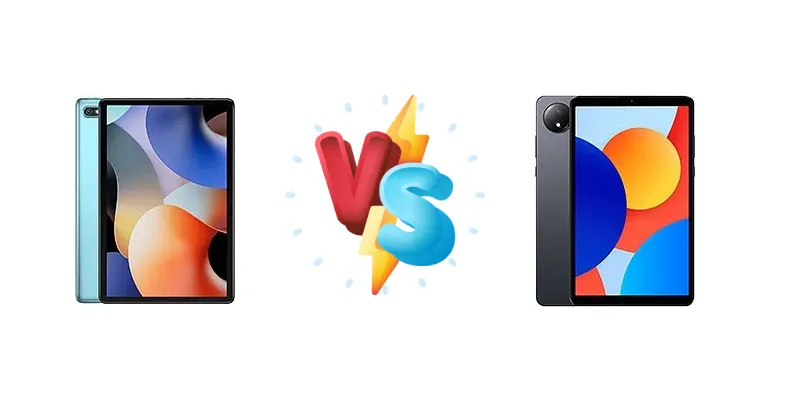
The sub-$200 tablet market is heating up, with the Oscal Pad 10 and Xiaomi Redmi Pad SE 8.7 vying for dominance. Both offer large screens and Android functionality at incredibly accessible price points, but significant differences in chipset and charging capabilities dictate which tablet is best suited for different users. This comparison dives deep into the specs to reveal the true winner.
🏆 Quick Verdict
For most users, the Xiaomi Redmi Pad SE 8.7 is the better choice. Its Mediatek Helio G85 chipset provides a noticeable performance edge over the Oscal Pad 10’s Unisoc T606, and the availability of 18W charging (depending on region) significantly reduces charging times. While the Oscal Pad 10 offers a larger screen, the performance and charging advantages of the Redmi Pad SE outweigh this difference.
| Network |
|---|
| 2G bands | GSM 850 / 900 / 1800 / 1900 | GSM 850 / 900 / 1800 / 1900 |
| 3G bands | HSDPA 900 / 2100 | HSDPA 800 / 850 / 900 / 1700(AWS) / 1900 / 2100 |
| 4G bands | 1, 3, 7, 8, 19, 20, 28, 40 | 1, 2, 3, 4, 5, 7, 8, 13, 18, 19, 20, 26, 28, 38, 40, 41, 66 |
| Speed | HSPA, LTE | HSPA, LTE - cellular model only |
| Technology | GSM / HSPA / LTE | GSM / HSPA / LTE |
| Launch |
|---|
| Announced | 2022, December 29 | 2024, July 29 |
| Status | Available. Released 2023, January 09 | Available. Released 2024, August 08 |
| Body |
|---|
| Build | - | Glass front (Gorilla Glass 3) |
| Dimensions | 241.3 x 160 x 8.9 mm (9.50 x 6.30 x 0.35 in) | 211.6 x 125.5 x 8.8 mm (8.33 x 4.94 x 0.35 in) |
| SIM | Nano-SIM + Nano-SIM | Nano-SIM + Nano-SIM (cellular model only) |
| Weight | 536 g (1.18 lb) | 370 / 373 / 375 g (13.05 oz) |
| Display |
|---|
| Protection | - | Corning Gorilla Glass 3 |
| Resolution | 1200 x 1920 pixels, 16:10 ratio (~224 ppi density) | 800 x 1340 pixels, 5:3 ratio (~179 ppi density) |
| Size | 10.1 inches, 295.8 cm2 (~76.6% screen-to-body ratio) | 8.7 inches, 214.9 cm2 (~80.9% screen-to-body ratio) |
| Type | IPS LCD | IPS LCD, 1B colors, 90Hz, 600 nits (HBM) |
| Platform |
|---|
| CPU | Octa-core (2x1.6 GHz Cortex-A75 & 6x1.6 GHz Cortex-A55) | Octa-core (2x2.0 GHz Cortex-A75 & 6x1.8 GHz Cortex-A55) |
| Chipset | Unisoc T606 (12 nm) | Mediatek Helio G85 (12 nm) |
| GPU | Mali-G57 MP1 | Mali-G52 MC2 |
| OS | Android 12, Doke-OS 3.0 | Android 14, HyperOS |
| Memory |
|---|
| Card slot | microSDXC (uses shared SIM slot) | microSDXC (dedicated slot) |
| Internal | 128GB 8GB RAM | 64GB 4GB RAM, 128GB 4GB RAM, 128GB 6GB RAM |
| Main Camera |
|---|
| Features | LED flash | LED flash |
| Single | 13 MP | 8 MP, f/2.0, (wide), 1/4.0", 1.12µm |
| Video | 1080p@30fps | 1080p@30fps |
| Selfie camera |
|---|
| Single | 8 MP, 1/4.0", 1.12µm | 5 MP, f/2.2, (wide), 1/5.0", 1.12µm |
| Video | Yes | 1080p@30fps |
| Sound |
|---|
| 35mm jack | Yes | Yes |
| Loudspeaker | Yes, with dual speakers | Yes, with stereo speakers |
| Comms |
|---|
| Bluetooth | 5.0, A2DP, LE | 5.3, A2DP, LE |
| Infrared port | - | Yes |
| NFC | No | No |
| Positioning | GPS, GLONASS, GALILEO, BDS | GPS, GALILEO, GLONASS, BDS - cellular model only |
| Radio | FM radio | FM radio |
| USB | USB Type-C, OTG | USB Type-C 2.0 |
| WLAN | Wi-Fi 802.11 a/b/g/n/ac, dual-band | Wi-Fi 802.11 a/b/g/n/ac, dual-band |
| Features |
|---|
| Sensors | Unspecified | Accelerometer, proximity (accessories only), compass |
| Battery |
|---|
| Charging | 10W wired | 18W wired (Int'l)
10W wired (India) |
| Type | 6580 mAh | 6650 mAh |
| Misc |
|---|
| Colors | Mint Green, Moonlight Silver, Diamond Grey | Aurora Green (Forest Green), Sky Blue (Ocean Blue), Graphite Gray (Urban Grey) |
| Models | - | 220233L2G |
| Price | About 130 EUR | About 120 EUR |
| SAR | - | 0.90 W/kg (head) 0.65 W/kg (body) |
| SAR EU | - | 0.40 W/kg (head) 0.99 W/kg (body) |
Oscal Pad 10
- Larger 10.1-inch display for immersive viewing.
- Potentially lower price point (depending on retailer).
- Acceptable performance for basic tasks.
- Slower Unisoc T606 chipset.
- Slow 10W charging.
- Likely lower GPU performance.
Xiaomi Redmi Pad SE 8.7
- Faster Mediatek Helio G85 chipset for smoother performance.
- Faster 18W charging (International) for quicker top-ups.
- More compact and portable 8.7-inch form factor.
- Smaller screen size may not suit all users.
- 10W charging in India market.
- Potentially slightly higher price.
Display Comparison
Both tablets utilize 12nm process technology, but the display differences are notable. The Oscal Pad 10 boasts a 10.1-inch screen, offering more screen real estate for multitasking and media viewing. The Redmi Pad SE 8.7, however, features a smaller 8.7-inch display. While specific brightness nits aren't provided, the Redmi Pad SE’s smaller screen may concentrate light more effectively. Neither manufacturer details panel technology (IPS, VA, etc.) or color accuracy, suggesting both are targeting the budget segment with standard displays. The smaller size of the Redmi Pad SE contributes to a more portable experience.
Camera Comparison
Camera performance is unlikely to be a deciding factor for either tablet. Both are equipped with basic camera setups geared towards video calls rather than photography. Without specific sensor details, it’s safe to assume both feature modest image quality. Focusing on the processors, the Helio G85’s ISP (Image Signal Processor) may offer slightly better image processing capabilities, but the difference will be minimal. The absence of OIS (Optical Image Stabilization) on either device further reinforces their limitations as photography tools.
Performance
The core difference lies in the chipsets. The Xiaomi Redmi Pad SE 8.7’s Mediatek Helio G85 features a slightly higher clocked CPU (2.0 GHz vs 1.6 GHz on the Oscal Pad 10’s Unisoc T606). While both utilize the same Cortex-A75 and A55 core configuration, the higher clock speed translates to faster processing in everyday tasks and gaming. The Helio G85 also has a more capable GPU, offering a smoother gaming experience. Both tablets likely utilize LPDDR4X RAM, a common choice in this price bracket. Thermal management is a question mark, but the Helio G85’s efficiency gains from the clock speed difference should result in comparable or slightly better thermal performance.
Battery Life
Battery capacity isn’t specified, but the Redmi Pad SE 8.7’s charging capabilities are a clear advantage. Offering 18W wired charging (in international markets, 10W in India), it significantly reduces charging times compared to the Oscal Pad 10’s fixed 10W charging. While a larger battery capacity on the Oscal Pad 10 might offset this, the faster charging speed of the Redmi Pad SE provides a more convenient user experience. A full charge on the Oscal Pad 10 will likely take considerably longer, impacting usability for users who need quick top-ups.
Buying Guide
Buy the Oscal Pad 10 if you prioritize a larger 10-inch display for media consumption and don't mind slightly slower performance and longer charging times. It's ideal for casual users who primarily browse the web, stream videos, and read ebooks. Buy the Xiaomi Redmi Pad SE 8.7 if you value responsiveness, faster charging, and a more compact form factor. This tablet is better suited for students, gamers, and anyone who needs a tablet that can keep up with a more demanding workload.
Frequently Asked Questions
❓ Does the Redmi Pad SE 8.7 support fast charging in India?
Unfortunately, the Redmi Pad SE 8.7 ships with 10W charging in India, mirroring the Oscal Pad 10. This significantly reduces the charging speed advantage it holds in international markets. If fast charging is a priority, you may need to consider importing a version with 18W support.
❓ Will the Unisoc T606 in the Oscal Pad 10 struggle with demanding games?
Yes, the Unisoc T606 is a budget-focused chipset. While it can handle casual gaming, you'll likely experience frame drops and reduced graphical settings in more demanding titles like PUBG Mobile or Genshin Impact. The Redmi Pad SE 8.7’s Helio G85 offers a noticeably smoother gaming experience.
❓ Is the 8.7-inch screen of the Redmi Pad SE 8.7 too small for comfortable video watching?
The 8.7-inch screen is a trade-off. While smaller than the Oscal Pad 10’s 10.1-inch display, it’s still perfectly adequate for watching videos, especially given its portability. The higher pixel density on the smaller screen may also result in a sharper image. It depends on your personal preference and viewing habits.
❓ What type of storage does each tablet use, and is it expandable?
Neither specification explicitly states the storage type (eMMC or UFS). However, given the price point, it's highly probable both utilize eMMC storage. Expandability via microSD card is also not confirmed, but is a common feature in tablets of this class and should be verified before purchase.