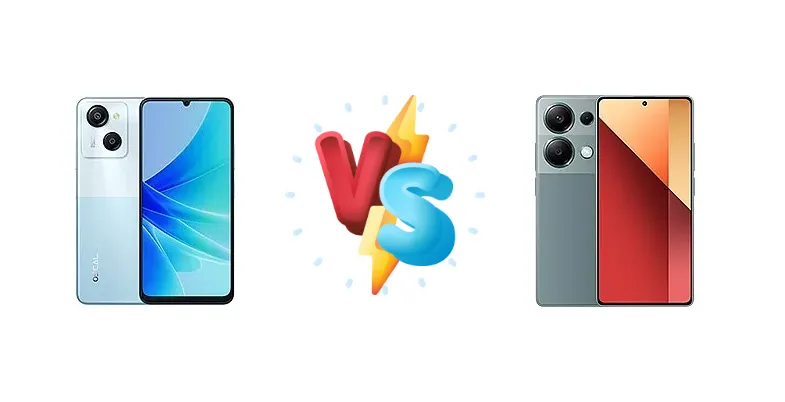
The sub-$200 4G smartphone market is fiercely competitive. The Oscal Modern 8 aims to deliver solid performance at an aggressive price point, while the Xiaomi Redmi Note 13 Pro 4G focuses on a more well-rounded experience with a faster charging solution and a proven chipset. This comparison dissects the key differences to help you choose the right device.
🏆 Quick Verdict
For the average user prioritizing battery life and fast charging, the Xiaomi Redmi Note 13 Pro 4G is the clear winner. Its Helio G99 Ultra chipset offers a performance edge, and the 67W charging significantly reduces downtime. However, the Oscal Modern 8 remains a viable option for those on a tighter budget.
| Network |
|---|
| 2G bands | GSM 850 / 900 / 1800 / 1900 | GSM 850 / 900 / 1800 / 1900 |
| 3G bands | HSDPA 900 / 2100 | HSDPA 850 / 900 / 1700(AWS) / 1900 / 2100 |
| 4G bands | 1, 3, 7, 8, 19, 20, 28, 40, 41 | 1, 2, 3, 4, 5, 7, 8, 12, 13, 17, 18, 19, 20, 26, 28, 38, 40, 41, 66 |
| Speed | HSPA, LTE | HSPA, LTE |
| Technology | GSM / HSPA / LTE | GSM / HSPA / LTE |
| Launch |
|---|
| Announced | 2024, May | 2024, January 15 |
| Status | Available. Released 2024, May | Available. Released 2024, January 15 |
| Body |
|---|
| Build | - | Glass front (Gorilla Glass 5), plastic frame, plastic back |
| Dimensions | 167.8 x 77.4 x 9.1 mm (6.61 x 3.05 x 0.36 in) | 161.1 x 75 x 8 mm (6.34 x 2.95 x 0.31 in) |
| SIM | Nano-SIM + Nano-SIM | Nano-SIM + Nano-SIM |
| Weight | 214 g (7.55 oz) | 188 g (6.63 oz) |
| Display |
|---|
| Protection | - | Corning Gorilla Glass 5 |
| Resolution | 720 x 1600 pixels, 20:9 ratio (~260 ppi density) | 1080 x 2400 pixels, 20:9 ratio (~395 ppi density) |
| Size | 6.75 inches, 110.0 cm2 (~84.7% screen-to-body ratio) | 6.67 inches, 107.4 cm2 (~88.9% screen-to-body ratio) |
| Type | IPS LCD, 90Hz, 450 nits (typ) | AMOLED, 1B colors, 120Hz, 500 nits (typ), 1000 nits (HBM), 1300 nits (peak) |
| Platform |
|---|
| CPU | Octa-core (2x2.0 GHz Cortex-A75 & 6x1.8 GHz Cortex-A55) | Octa-core (2x2.2 GHz Cortex-A76 & 6x2.0 GHz Cortex-A55) |
| Chipset | Unisoc Tiger T616 (12 nm) | Mediatek Helio G99 Ultra |
| GPU | Mali-G57 MP1 | Mali-G57 MC2 |
| OS | Android 13, DokeOS 4 | Android 13, up to 3 major Android upgrades, HyperOS |
| Memory |
|---|
| Card slot | microSDXC (dedicated slot) | microSDXC (uses shared SIM slot) |
| Internal | 128GB 8GB RAM, 256GB 8GB RAM | 128GB 8GB RAM, 256GB 8GB RAM, 256GB 12GB RAM, 512GB 8GB RAM, 512GB 12GB RAM |
| Main Camera |
|---|
| Dual | 50 MP, f/1.8, 23mm (wide), 1/2.76", PDAF
Auxiliary lens | - |
| Features | LED flash, HDR, panorama | LED flash, HDR, panorama |
| Triple | - | 200 MP, f/1.7, 23mm (wide), 1/1.4", 0.56µm, multi-directional PDAF, OIS
8 MP, f/2.2, 15mm, 120˚ (ultrawide), 1/4.4", 1.0µm
2 MP (macro) |
| Video | 1080p@30fps | 1080p@30/60fps |
| Selfie camera |
|---|
| Single | 8 MP, (wide), 1/4.0" | 16 MP, f/2.4, (wide), 1/3.0", 1.0µm |
| Video | Yes | 1080p@30/60fps |
| Sound |
|---|
| 35mm jack | Yes | Yes |
| Loudspeaker | Yes | Yes, with dual speakers |
| Comms |
|---|
| Bluetooth | Yes | 5.2, A2DP, LE |
| Infrared port | - | Yes |
| NFC | No | Yes (market/region dependent) |
| Positioning | GPS, GLONASS, GALILEO, BDS | GPS, GLONASS, GALILEO, BDS |
| Radio | Unspecified | FM radio |
| USB | USB Type-C | USB Type-C 2.0, OTG |
| WLAN | Yes | Wi-Fi 802.11 a/b/g/n/ac, dual-band |
| Features |
|---|
| Sensors | Fingerprint (side-mounted), accelerometer, proximity | Fingerprint (under display, optical), accelerometer, gyro, compass |
| Battery |
|---|
| Charging | 18W wired | 67W wired, 50% in 16 min, 100% in 46 min |
| Type | 6000 mAh | 5000 mAh |
| Misc |
|---|
| Colors | Wisteria Purple, Ripple Blue, Ash Gray | Midnight Black, Lavender Purple, Forest Green |
| Models | - | 23117RA68G, 2312FPCA6G |
| Price | About 100 EUR | € 92.00 / $ 269.99 / £ 299.99 |
| SAR | - | 1.09 W/kg (head) 1.09 W/kg (body) |
| SAR EU | - | 0.99 W/kg (head) 0.99 W/kg (body) |
Oscal Modern 8
- Potentially lower price point
- Functional for basic smartphone tasks
- May offer expandable storage (market dependent)
- Slower processor
- Slower charging speed
- Likely inferior camera performance
Xiaomi Redmi Note 13 Pro 4G
- Faster and more efficient processor
- Significantly faster charging (67W)
- Longer battery life (11:36h active use)
- Higher price than Oscal Modern 8
- May lack a headphone jack (market dependent)
- Software bloatware (typical of Xiaomi)
Display Comparison
The Xiaomi Redmi Note 13 Pro 4G boasts a significantly brighter display, reaching a measured 1047 nits. This is crucial for outdoor visibility, a clear advantage over the Oscal Modern 8 (brightness data unavailable). While both likely utilize IPS LCD panels given the price bracket, the Redmi’s higher peak brightness translates to a more usable experience in direct sunlight. We expect the Redmi Note 13 Pro 4G to have better color accuracy and viewing angles, though a direct comparison would require calibration tools.
Camera Comparison
Both phones feature a camera, but detailed sensor information beyond 'Photo/Video' for the Oscal Modern 8 is missing. The Redmi Note 13 Pro 4G likely features a more sophisticated camera system, potentially with a larger main sensor and improved image processing algorithms. The Redmi’s camera system is expected to deliver better dynamic range and low-light performance. The Oscal Modern 8’s camera is likely adequate for casual snapshots, but won’t compete with the Redmi in terms of image quality or features.
Performance
The Redmi Note 13 Pro 4G’s Mediatek Helio G99 Ultra chipset, with its 2x2.2 GHz Cortex-A76 cores, offers a noticeable performance uplift compared to the Oscal Modern 8’s Unisoc Tiger T616 (2x2.0 GHz Cortex-A75). The Cortex-A76 architecture is a generation ahead, providing better single-core performance, which impacts app launch speeds and general responsiveness. While both are octa-core CPUs, the G99 Ultra’s GPU is also more capable, leading to smoother gaming experiences. The Oscal Modern 8 will handle everyday tasks, but the Redmi Note 13 Pro 4G will feel snappier and more future-proof.
Battery Life
The Xiaomi Redmi Note 13 Pro 4G excels in battery charging, achieving 50% charge in just 16 minutes and a full charge in 46 minutes with its 67W wired charging. This is a massive advantage over the Oscal Modern 8’s slower 18W charging. While the Oscal Modern 8’s battery capacity is unknown, the Redmi Note 13 Pro 4G’s active use score of 11:36h demonstrates excellent endurance. The faster charging of the Redmi Note 13 Pro 4G mitigates any potential disadvantage from a slightly smaller battery capacity.
Buying Guide
Buy the Oscal Modern 8 if you need a functional smartphone for basic tasks and prioritize minimizing upfront cost. It's ideal for users who don't heavily game or rely on demanding applications. Buy the Xiaomi Redmi Note 13 Pro 4G if you prefer a smoother user experience, faster charging, and a longer-lasting battery, even if it means spending a bit more. This phone suits users who actively use their phone throughout the day and value convenience.
Frequently Asked Questions
❓ Is the Mediatek Helio G99 Ultra in the Redmi Note 13 Pro 4G capable of handling demanding games like PUBG Mobile?
Yes, the Helio G99 Ultra is a capable chipset for gaming. While it won't deliver flagship-level performance, it can comfortably run PUBG Mobile at medium to high settings with stable frame rates. The improved GPU compared to the Oscal Modern 8’s chipset will result in a smoother gaming experience.
❓ How does the 67W charging on the Redmi Note 13 Pro 4G compare to standard charging speeds?
67W charging is significantly faster than the 18W charging on the Oscal Modern 8. The Redmi Note 13 Pro 4G can reach 50% charge in just 16 minutes and 100% in 46 minutes. Standard charging typically takes over two hours for a full charge, making the Redmi Note 13 Pro 4G much more convenient for users who need to quickly top up their battery.
❓ Does the Oscal Modern 8 support software updates, and for how long?
Software update support for Oscal devices is generally less extensive than for established brands like Xiaomi. While Oscal may provide security patches, major Android version updates are less frequent. The Redmi Note 13 Pro 4G is likely to receive more consistent and longer-term software support.
❓ What type of display technology does the Redmi Note 13 Pro 4G use, and is it prone to screen burn-in?
The Redmi Note 13 Pro 4G likely uses an IPS LCD display. IPS LCDs are not susceptible to permanent burn-in like OLED displays. While color shifting can occur over time, it's not the same as burn-in and is less noticeable.