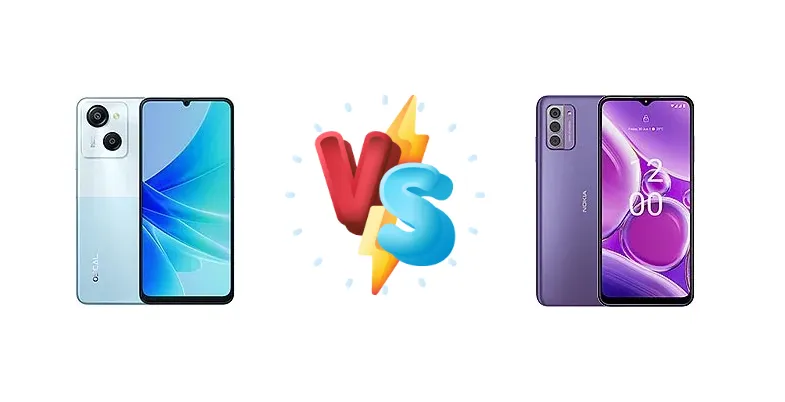
The sub-$200 5G smartphone market is heating up, with the Oscal Modern 8 and Nokia G42 vying for attention. While both aim to deliver affordable connectivity, they take different approaches to achieving it. The Oscal leverages a newer Unisoc chipset, while the Nokia opts for Qualcomm’s Snapdragon 480+. This comparison dissects the key differences to determine which phone offers the best overall experience.
🏆 Quick Verdict
For the average user prioritizing consistent performance and future-proofing, the Nokia G42 emerges as the better choice. Its Snapdragon 480+ chipset, built on a more efficient 8nm process, provides a noticeable performance edge and 5G connectivity, despite the Oscal Modern 8’s slightly faster CPU clock speeds.
| Network |
|---|
| 2G bands | GSM 850 / 900 / 1800 / 1900 | GSM 850 / 900 / 1800 / 1900 |
| 3G bands | HSDPA 900 / 2100 | HSDPA 850 / 900 / 1700(AWS) / 1900 / 2100 |
| 4G bands | 1, 3, 7, 8, 19, 20, 28, 40, 41 | 1, 2, 3, 4, 5, 7, 8, 12, 17, 13, 20, 28, 38, 39, 40, 41, 66 |
| 5G bands | - | 1, 2, 3, 5, 7, 8, 28, 40, 41, 66, 77, 78 SA/NSA |
| Speed | HSPA, LTE | HSPA, LTE, 5G |
| Technology | GSM / HSPA / LTE | GSM / HSPA / LTE / 5G |
| Launch |
|---|
| Announced | 2024, May | 2023, June 28 |
| Status | Available. Released 2024, May | Available. Released 2023, June 28 |
| Body |
|---|
| Build | - | Glass front, plastic back, plastic frame |
| Dimensions | 167.8 x 77.4 x 9.1 mm (6.61 x 3.05 x 0.36 in) | 165 x 75.8 x 8.6 mm (6.50 x 2.98 x 0.34 in) |
| SIM | Nano-SIM + Nano-SIM | · Nano-SIM· Nano-SIM + Nano-SIM |
| Weight | 214 g (7.55 oz) | 193.8 g (6.84 oz) |
| Display |
|---|
| Protection | - | Corning Gorilla Glass 3 |
| Resolution | 720 x 1600 pixels, 20:9 ratio (~260 ppi density) | 720 x 1612 pixels, 20:9 ratio (~269 ppi density) |
| Size | 6.75 inches, 110.0 cm2 (~84.7% screen-to-body ratio) | 6.56 inches, 103.4 cm2 (~82.7% screen-to-body ratio) |
| Type | IPS LCD, 90Hz, 450 nits (typ) | IPS LCD, 90Hz, 450 nits (typ), 560 nits (peak) |
| Platform |
|---|
| CPU | Octa-core (2x2.0 GHz Cortex-A75 & 6x1.8 GHz Cortex-A55) | Octa-core (2x2.2 GHz Kryo 460 & 6x1.8 GHz Kryo 460) |
| Chipset | Unisoc Tiger T616 (12 nm) | Qualcomm SM4350-AC Snapdragon 480+ 5G (8 nm) |
| GPU | Mali-G57 MP1 | Adreno 619 |
| OS | Android 13, DokeOS 4 | Android 13, upgradable to Android 14 |
| Memory |
|---|
| Card slot | microSDXC (dedicated slot) | microSDXC |
| Internal | 128GB 8GB RAM, 256GB 8GB RAM | 128GB 4GB RAM, 128GB 6GB RAM, 256GB 8GB RAM |
| Main Camera |
|---|
| Dual | 50 MP, f/1.8, 23mm (wide), 1/2.76", PDAF
Auxiliary lens | - |
| Features | LED flash, HDR, panorama | LED flash, HDR, panorama |
| Triple | - | 50 MP, f/1.8, (wide), AF
2 MP (macro)
Auxiliary lens |
| Video | 1080p@30fps | 1080p@30fps |
| Selfie camera |
|---|
| Single | 8 MP, (wide), 1/4.0" | 8 MP |
| Video | Yes | Yes |
| Sound |
|---|
| 35mm jack | Yes | Yes |
| Loudspeaker | Yes | Yes |
| Comms |
|---|
| Bluetooth | Yes | 5.1, A2DP, LE |
| NFC | No | Yes (market/region dependent) |
| Positioning | GPS, GLONASS, GALILEO, BDS | GPS, GLONASS, GALILEO, BDS |
| Radio | Unspecified | FM radio |
| USB | USB Type-C | USB Type-C 2.0, OTG |
| WLAN | Yes | Wi-Fi 802.11 a/b/g/n/ac/6, dual-band |
| Features |
|---|
| Sensors | Fingerprint (side-mounted), accelerometer, proximity | Fingerprint (side-mounted), accelerometer, proximity, compass |
| Battery |
|---|
| Charging | 18W wired | 20W wired, PD3.0, QC3 |
| Type | 6000 mAh | Li-Po 5000 mAh |
| Misc |
|---|
| Colors | Wisteria Purple, Ripple Blue, Ash Gray | Gray, Purple, Red |
| Price | About 100 EUR | $ 545.00 / £ 124.99 |
Oscal Modern 8
- Potentially higher CPU clock speeds for basic tasks.
- Competitive price point.
- May offer a larger battery capacity (unconfirmed).
- Less efficient 12nm Unisoc chipset.
- Lacks integrated 5G modem.
- Uncertain software support and updates.
Nokia G42
- More efficient 8nm Snapdragon 480+ chipset.
- Integrated 5G connectivity.
- Faster 20W charging with PD3.0 and QC3.
- Slightly lower CPU clock speeds.
- May be marginally more expensive.
- Software bloatware is a potential concern with Nokia.
Display Comparison
Neither device boasts a standout display. Given the context data focuses on processing power, we can infer both likely utilize standard LCD panels. The Nokia G42’s advantage lies in potential software optimizations for color accuracy, a common strength of Nokia devices. The Oscal Modern 8, lacking specific display details, likely targets cost savings in this area, potentially resulting in lower peak brightness and narrower viewing angles. Bezels are likely comparable, given the price bracket.
Camera Comparison
Without detailed camera specifications, a direct comparison is difficult. However, given the price point, both phones likely feature a primary sensor paired with auxiliary lenses of limited utility. The Nokia G42 benefits from Qualcomm’s image signal processor (ISP), known for its efficient noise reduction and color processing. The Oscal Modern 8’s image quality will heavily rely on the capabilities of its primary sensor and Unisoc’s image processing algorithms. We anticipate the Nokia G42 to deliver more consistent and reliable image quality across various lighting conditions.
Performance
The core difference lies in the chipsets. The Nokia G42’s Qualcomm Snapdragon 480+ (8nm) offers a significant architectural advantage over the Oscal Modern 8’s Unisoc Tiger T616 (12nm). While the Oscal’s Cortex-A75 cores reach 2.0 GHz versus the Nokia’s 2.2 GHz Kryo 460 cores, the 8nm fabrication process of the Snapdragon provides superior power efficiency and sustained performance. This translates to less thermal throttling during prolonged tasks like gaming or video editing. The Snapdragon 480+ also includes an integrated 5G modem, a feature absent in the Oscal Modern 8 based on available data. This impacts real-world download and upload speeds for users in 5G areas.
Battery Life
The Oscal Modern 8’s 18W charging is slower than the Nokia G42’s 20W charging with PD3.0 and QC3 support. While battery capacity isn’t specified, the more efficient Snapdragon 480+ in the Nokia G42 will likely result in comparable or better battery life despite potentially having a similar capacity. The Nokia’s faster charging standards will also reduce the time spent tethered to a wall outlet, offering a more convenient user experience. The inclusion of Quick Charge 3.0 is a significant advantage for users already invested in that ecosystem.
Buying Guide
Buy the Oscal Modern 8 if you prioritize maximizing CPU performance for basic tasks and are comfortable with a less established brand. Its Unisoc Tiger T616 offers competitive multi-core scores for everyday use. Buy the Nokia G42 if you value a more refined software experience, reliable 5G connectivity, and a chipset from a well-known manufacturer, even if it means a slight trade-off in raw CPU power.
Frequently Asked Questions
❓ Will the Unisoc Tiger T616 in the Oscal Modern 8 struggle with demanding games like PUBG Mobile?
The Unisoc Tiger T616 can run PUBG Mobile, but expect to lower graphics settings and potentially experience frame drops during intense firefights. The 12nm process and less powerful GPU compared to the Snapdragon 480+ will limit sustained performance, leading to thermal throttling and reduced frame rates.
❓ Does the Nokia G42 support carrier aggregation for improved 5G speeds?
The Snapdragon 480+ generally supports carrier aggregation, but the specific bands and configurations supported by the Nokia G42 will vary depending on the region and carrier. Check with your mobile carrier to confirm compatibility for optimal 5G performance.
❓ How long will software updates be provided for the Nokia G42?
Nokia typically provides at least 3 years of security updates for its smartphones. While major Android version updates are less frequent, the G42 is likely to receive at least one major update (Android 13 or 14) during its lifespan. The Oscal Modern 8’s software update policy is less clear.
❓ Is the 18W charging on the Oscal Modern 8 significantly slower in real-world use?
Yes, 18W charging is noticeably slower than the 20W charging with Quick Charge 3.0 on the Nokia G42. Expect a longer time to fully charge the Oscal Modern 8, potentially taking over 2 hours from 0% to 100% depending on battery capacity.