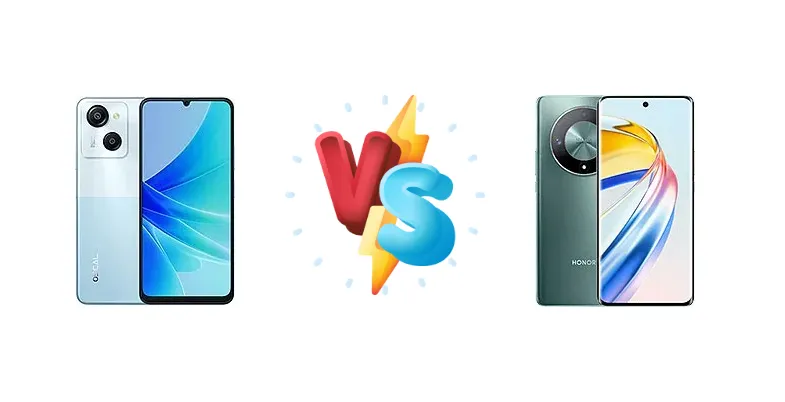
The sub-$250 smartphone market is fiercely competitive. The Oscal Modern 8 and Honor X9b both aim to deliver a compelling experience without breaking the bank, but they take drastically different approaches to achieving that goal. The Oscal relies on a more established, if less efficient, Unisoc chipset, while the Honor leverages Qualcomm’s newer, 4nm Snapdragon 6 Gen 1. This comparison will dissect the key differences to determine which device offers the best overall package.
🏆 Quick Verdict
For the average user prioritizing performance and future-proofing, the Honor X9b is the clear winner. Its Snapdragon 6 Gen 1 chipset, built on a 4nm process, provides a significant performance advantage and superior power efficiency compared to the Oscal Modern 8’s Unisoc Tiger T616. However, the Oscal remains a viable option for those on a very tight budget.
| Network |
|---|
| 2G bands | GSM 850 / 900 / 1800 / 1900 | GSM 850 / 900 / 1800 / 1900 |
| 3G bands | HSDPA 900 / 2100 | HSDPA 850 / 900 / 1900 / 2100 |
| 4G bands | 1, 3, 7, 8, 19, 20, 28, 40, 41 | 1, 2, 3, 4, 5, 7, 8, 20, 28, 32, 38, 40, 41 |
| 5G bands | - | 1, 3, 7, 8, 20, 28, 38, 40, 41, 77, 78 SA/NSA |
| Speed | HSPA, LTE | HSPA, LTE, 5G |
| Technology | GSM / HSPA / LTE | GSM / HSPA / LTE / 5G |
| Launch |
|---|
| Announced | 2024, May | 2023, October 18 |
| Status | Available. Released 2024, May | Available. Released 2023, October |
| Body |
|---|
| Dimensions | 167.8 x 77.4 x 9.1 mm (6.61 x 3.05 x 0.36 in) | 163.6 x 75.5 x 8 mm (6.44 x 2.97 x 0.31 in) |
| SIM | Nano-SIM + Nano-SIM | Nano-SIM + Nano-SIM |
| Weight | 214 g (7.55 oz) | 185 g (6.53 oz) |
| Display |
|---|
| Resolution | 720 x 1600 pixels, 20:9 ratio (~260 ppi density) | 1220 x 2652 pixels, 19.5:9 ratio (~431 ppi density) |
| Size | 6.75 inches, 110.0 cm2 (~84.7% screen-to-body ratio) | 6.78 inches, 112.6 cm2 (~91.2% screen-to-body ratio) |
| Type | IPS LCD, 90Hz, 450 nits (typ) | AMOLED, 1B colors, 120Hz, 1200 nits (peak) |
| Platform |
|---|
| CPU | Octa-core (2x2.0 GHz Cortex-A75 & 6x1.8 GHz Cortex-A55) | Octa-core (4x2.2 GHz Cortex-A78 & 4x1.8 GHz Cortex-A55) |
| Chipset | Unisoc Tiger T616 (12 nm) | Qualcomm SM6450 Snapdragon 6 Gen 1 (4 nm) |
| GPU | Mali-G57 MP1 | Adreno 710 |
| OS | Android 13, DokeOS 4 | Android 13, Magic OS 7.2 |
| Memory |
|---|
| Card slot | microSDXC (dedicated slot) | No |
| Internal | 128GB 8GB RAM, 256GB 8GB RAM | 256GB 8GB RAM, 256GB 12GB RAM, 512GB 8GB RAM, 512GB 12GB RAM |
| Main Camera |
|---|
| Dual | 50 MP, f/1.8, 23mm (wide), 1/2.76", PDAF
Auxiliary lens | - |
| Features | LED flash, HDR, panorama | LED flash, panorama, HDR |
| Triple | - | 108 MP, f/1.8, (wide), 1/1.67", PDAF
5 MP, f/2.2, (ultrawide)
2 MP (macro) |
| Video | 1080p@30fps | 4K@30fps, 1080p@30fps |
| Selfie camera |
|---|
| Single | 8 MP, (wide), 1/4.0" | 16 MP, f/2.5, (wide) |
| Video | Yes | 1080p@30fps |
| Sound |
|---|
| 35mm jack | Yes | No |
| Loudspeaker | Yes | Yes |
| Comms |
|---|
| Bluetooth | Yes | 5.1, A2DP, LE |
| Infrared port | - | Yes |
| NFC | No | Yes (market/region dependent) |
| Positioning | GPS, GLONASS, GALILEO, BDS | GPS, GLONASS, GALILEO, BDS |
| Radio | Unspecified | No |
| USB | USB Type-C | USB Type-C 2.0, OTG |
| WLAN | Yes | Wi-Fi 802.11 a/b/g/n/ac, dual-band, Wi-Fi Direct |
| Features |
|---|
| Sensors | Fingerprint (side-mounted), accelerometer, proximity | Fingerprint (under display, optical), accelerometer, gyro, proximity, compass |
| Battery |
|---|
| Charging | 18W wired | 35W wired
Reverse wired |
| Type | 6000 mAh | Li-Po 5800 mAh |
| Misc |
|---|
| Colors | Wisteria Purple, Ripple Blue, Ash Gray | Sunrise Orange, Midnight Black, Emerald Green |
| Models | - | ALI-NX1 |
| Price | About 100 EUR | About 970 EUR |
Oscal Modern 8
- More affordable price point
- Acceptable performance for basic tasks
- Functional and reliable for everyday use
- Less powerful processor
- Slower charging speed
- Potentially lower image quality
Honor X9b
- Significantly faster processor
- Faster 35W charging with reverse wired charging
- More efficient power consumption
- Likely better camera performance
- Higher price compared to Oscal Modern 8
- May still lack features found in higher-end phones
Display Comparison
Neither device’s display specifications are provided, so a direct comparison is limited. However, given the price points, we can assume both utilize LCD panels. The Honor X9b, benefiting from a larger R&D budget, likely features a higher peak brightness and potentially better color accuracy. The absence of LTPO technology on either device suggests standard refresh rates, likely 60Hz, impacting smoothness during scrolling and animations.
Camera Comparison
Without detailed camera specs, analysis is limited. However, the Honor X9b, as a product from a more established brand, likely benefits from more sophisticated image processing algorithms. While both phones may feature similar megapixel counts, the Snapdragon’s ISP (Image Signal Processor) is generally more capable, resulting in better dynamic range, noise reduction, and overall image quality. The Oscal Modern 8 will likely rely more heavily on software processing to compensate for potentially lower-quality sensors.
Performance
The core difference lies in the chipsets. The Honor X9b’s Qualcomm Snapdragon 6 Gen 1 (4nm) is a substantial upgrade over the Oscal Modern 8’s Unisoc Tiger T616 (12nm). The 4nm fabrication process allows for significantly higher transistor density and improved power efficiency, translating to better sustained performance and less thermal throttling. The Snapdragon 6 Gen 1 also boasts a more modern CPU architecture – 4x2.2 GHz Cortex-A78 cores versus the Oscal’s 2x2.0 GHz Cortex-A75 cores – offering a noticeable boost in single-core and multi-core performance. This benefits demanding applications and multitasking. While both have 4x1.8 GHz Cortex-A55 cores for efficiency, the Snapdragon’s overall architecture is superior.
Battery Life
The Oscal Modern 8’s 18W charging is significantly slower than the Honor X9b’s 35W wired charging, including reverse wired charging. This means the X9b will reach a full charge much faster, a crucial advantage for users who need to quickly top up their battery. While battery capacity isn’t specified, the Snapdragon 6 Gen 1’s superior power efficiency means the Honor X9b will likely offer comparable or even better battery life despite potentially having a smaller battery capacity. The reverse wired charging on the X9b is a unique feature absent on the Oscal, allowing it to act as a power bank for other devices.
Buying Guide
Buy the Oscal Modern 8 if you need a functional smartphone for basic tasks like calling, texting, and light social media use, and your budget is extremely limited. You’ll appreciate its affordability and acceptable performance for everyday tasks. Buy the Honor X9b if you prioritize smoother multitasking, better gaming performance, faster charging, and a more efficient processor that will likely hold up better over time. The X9b is the better choice for users who demand more from their smartphone.
Frequently Asked Questions
❓ Will the Unisoc Tiger T616 in the Oscal Modern 8 struggle with demanding games like PUBG or Genshin Impact?
Yes, the Unisoc Tiger T616 is likely to struggle with graphically intensive games. While it can handle less demanding titles, you’ll likely need to lower graphics settings significantly and may still experience frame drops and lag. The Snapdragon 6 Gen 1 in the Honor X9b offers a much smoother gaming experience.
❓ How much faster is the 35W charging on the Honor X9b compared to the 18W charging on the Oscal Modern 8?
The 35W charging on the Honor X9b will significantly reduce charging times. While exact 0-100% times depend on battery capacity, expect the X9b to charge at least 50-60% faster than the Oscal Modern 8. This is a major convenience factor for users who need to quickly replenish their battery.
❓ Does the Honor X9b's reverse wired charging work with any device?
Yes, the Honor X9b's reverse wired charging is compatible with most devices that charge via USB-C. It's a convenient feature for topping up accessories like wireless earbuds or even another smartphone in an emergency, though charging speeds will be slower than using a dedicated charger.