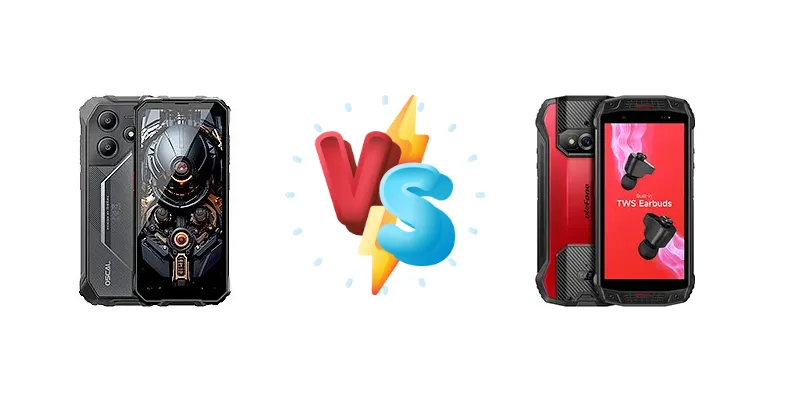
The rugged smartphone market offers a compelling alternative to fragile mainstream devices, but choosing the right one can be tricky. Both the Oscal Marine 2 and Ulefone Armor 15 aim to deliver durability at an accessible price point. However, they take different approaches to achieving this, with the Marine 2 prioritizing exceptional battery life and a more modern chipset architecture, while the Armor 15 focuses on a lower entry cost with a Mediatek Helio G35.
🏆 Quick Verdict
For the average user prioritizing longevity and smoother performance, the Oscal Marine 2 is the better choice. Its Unisoc T615 chipset, built on a more efficient architecture, coupled with a remarkable 103-hour endurance rating, outweighs the Ulefone Armor 15’s slightly higher CPU clock speeds. The Armor 15 remains a viable option for those on a very tight budget.
| Network |
|---|
| 2G bands | GSM 850 / 900 / 1800 / 1900 | GSM 850 / 900 / 1800 / 1900 |
| 3G bands | HSDPA 900 / 2100 | HSDPA 850 / 900 / 1700(AWS) / 1900 / 2100 |
| 4G bands | 1, 3, 7, 8, 19, 20, 28, 40, 41 | 1, 2, 3, 4, 5, 7, 8, 12, 13, 17, 18, 19, 20, 25, 26, 28, 38, 39, 40, 41, 66 |
| Speed | HSPA, LTE | HSPA, LTE Cat13 300/150 Mbps |
| Technology | GSM / HSPA / LTE | GSM / HSPA / LTE |
| Launch |
|---|
| Announced | 2025, May | 2022, July 27 |
| Status | Available. Released 2025, May | Available. Released 2022, August 10 |
| Body |
|---|
| Dimensions | 179.8 x 83.1 x 18.3 mm (7.08 x 3.27 x 0.72 in) | 170.2 x 79.6 x 18.2 mm (6.70 x 3.13 x 0.72 in) |
| SIM | Nano-SIM + Nano-SIM | Nano-SIM + Nano-SIM |
| Weight | 395 g (13.93 oz) | 346 g (12.20 oz) |
| | - | IP68 dust/water resistant (up to 1.5m for 30 min)
Drop-to-concrete resistance from up to 1.5m
MIL-STD-810G compliant
Built-in wireless earbuds housed inside the top side of the phone; charging |
| Display |
|---|
| Protection | Panda Glass, Mohs level 5 | - |
| Resolution | 720 x 1612 pixels, 20:9 ratio (~269 ppi density) | 720 x 1440 pixels, 18:9 ratio (~295 ppi density) |
| Size | 6.56 inches, 103.4 cm2 (~69.2% screen-to-body ratio) | 5.45 inches, 76.7 cm2 (~56.6% screen-to-body ratio) |
| Type | IPS LCD, 90Hz, 450 nits | IPS LCD |
| Platform |
|---|
| CPU | Octa-core (2x1.8 GHz Cortex-A75 & 6x1.6 GHz Cortex-A55) | Octa-core (4x2.3 GHz Cortex-A53 & 4x1.8 GHz Cortex-A53) |
| Chipset | Unisoc T615 (12 nm) | Mediatek MT6765G Helio G35 (12 nm) |
| GPU | Mali-G57 MP1 | PowerVR GE8320 |
| OS | Android 15, DokeOS 4.1 | Android 12 |
| Memory |
|---|
| Card slot | microSDXC (dedicated slot) | microSDXC (dedicated slot) |
| Internal | 64GB 4GB RAM, 256GB 8GB RAM | 128GB 6GB RAM |
| Main Camera |
|---|
| Dual | - | 12 MP, f/1.8, (wide), 1.4μm
13 MP, f/2.4, 106˚ (ultrawide) |
| Features | LED flash, HDR, panorama | LED flash, HDR, panorama |
| Single | 16 MP | 16 MP, f/2.4, (wide), 1.0μm |
| Video | 1080p@30fps | 1080p@30fps |
| Selfie camera |
|---|
| Features | HDR | - |
| Single | 8 MP | 16 MP, f/2.4, (wide), 1.0μm |
| Video | 720p@30fps | 1080p@30fps |
| Sound |
|---|
| 3.5mm jack | - | No |
| 35mm jack | No | No |
| Loudspeaker | Yes | Yes |
| Comms |
|---|
| Bluetooth | 5.2, A2DP, LE | 5.0, A2DP |
| NFC | Yes | Yes |
| Positioning | GPS, GLONASS, GALILEO, BDS | GPS, GLONASS, BDS, GALILEO |
| Radio | FM radio | Stereo FM radio, RDS, recording |
| USB | USB Type-C, OTG | USB Type-C 2.0, OTG |
| WLAN | Wi-Fi 802.11 a/b/g/n/ac, dual-band | Wi-Fi 802.11 a/b/g/n/ac, dual-band |
| Features |
|---|
| Sensors | Fingerprint (side-mounted), accelerometer, gyro, proximity, compass | Fingerprint (side-mounted), accelerometer, proximity, gyro, compass |
| Battery |
|---|
| Charging | 18W wired
5W reverse wired | 18W wired |
| Type | Li-Ion 11000 mAh | Li-Po 6600 mAh |
| Misc |
|---|
| Colors | Black, Orange | Meteorite Black, Tech Blue, Sport Red |
| Price | $ 97.78 / £ 129.99 / € 129.99 | About 300 EUR |
| EU LABEL |
|---|
| Battery | 103:38h endurance, 800 cycles | - |
| Energy | Class B | - |
| Free fall | Class B (180 falls) | - |
| Repairability | Class C | - |
Oscal Marine 2
- Exceptional 103-hour battery life
- More modern Unisoc T615 chipset architecture
- 800 battery charge cycles for longevity
- 5W reverse wired charging
- No display specifications available
- Camera details are unknown
Ulefone Armor 15
- Lower price point (likely)
- Slightly higher CPU clock speeds
- Rugged design for durability
- 18W wired charging
- Older Helio G35 chipset architecture
- Inferior CPU performance compared to Oscal Marine 2
- No battery endurance data provided
- Likely shorter battery lifespan
Display Comparison
Neither device provides display specifications in the provided data. However, given their price points, it’s reasonable to expect both utilize IPS LCD panels. The real differentiator will likely be brightness and outdoor visibility, which we cannot assess without further data. Bezels are also likely to be substantial on both models, typical of rugged designs prioritizing drop protection.
Camera Comparison
The provided data doesn’t detail camera specifications beyond the chipsets. It’s safe to assume both phones feature basic camera setups geared towards functional photography rather than high-end image quality. Without sensor size or aperture information, a direct comparison is impossible. However, the image signal processor (ISP) within the Unisoc T615 may offer slightly better image processing capabilities than the Helio G35’s ISP, potentially resulting in marginally better photos in good lighting conditions.
Performance
The core difference lies in the chipset. The Oscal Marine 2’s Unisoc T615 utilizes a combination of Cortex-A75 and A55 cores, a more modern architecture than the Ulefone Armor 15’s Helio G35, which relies solely on Cortex-A53 cores. While the G35 boasts higher peak clock speeds (2.3 GHz vs 1.8 GHz), the A75 cores in the T615 offer significantly better single-core performance, translating to snappier app launches and smoother multitasking. The T615’s 12nm process node is also comparable to the G35’s, suggesting similar thermal efficiency. The Armor 15’s all-A53 configuration will likely struggle with more demanding tasks.
Battery Life
The Oscal Marine 2 truly shines in battery endurance, boasting a remarkable 103 hours of usage. This is a significant advantage over what we’d expect from the Ulefone Armor 15, which lacks specific endurance data. Both phones support 18W wired charging, but the Marine 2’s superior battery capacity and 800 charge cycles suggest it will maintain its capacity for a longer period. The 5W reverse wired charging on the Marine 2 is a useful addition for topping up accessories.
Buying Guide
Buy the Oscal Marine 2 if you need a phone that can genuinely last for days on a single charge, and you value a more responsive user experience thanks to its Cortex-A75 cores. This is ideal for outdoor workers, travelers, or anyone who frequently finds themselves away from a power outlet. Buy the Ulefone Armor 15 if you prioritize the absolute lowest price point for a rugged device and are willing to compromise on performance and battery life. It’s a good fit for basic communication and light usage.
Frequently Asked Questions
❓ How will the Unisoc T615 in the Oscal Marine 2 handle gaming compared to the Helio G35 in the Ulefone Armor 15?
While neither chipset is designed for high-end gaming, the Unisoc T615’s Cortex-A75 cores provide a noticeable performance advantage. You’ll likely experience smoother frame rates and less lag in less demanding games on the Oscal Marine 2. The Helio G35 will struggle with more graphically intensive titles.
❓ Is the 5W reverse wired charging on the Oscal Marine 2 useful for charging other devices?
Yes, the 5W reverse wired charging is a convenient feature for topping up small accessories like Bluetooth earbuds or a smartwatch in a pinch. It won’t rapidly charge a phone, but it’s a helpful addition for emergency situations.
❓ Given the long battery life of the Oscal Marine 2, will it take a very long time to fully charge with the 18W charger?
While the battery capacity isn't specified, the 18W charger should still provide a reasonable charging speed. The long endurance suggests a large battery, but 18W is sufficient to fully charge it within a few hours, balancing longevity with convenience.