
Oscal Marine 2 vs. Blackview BV9200: A Deep Dive into Rugged Smartphone Performance
| Phones Images | |||||
|---|---|---|---|---|---|
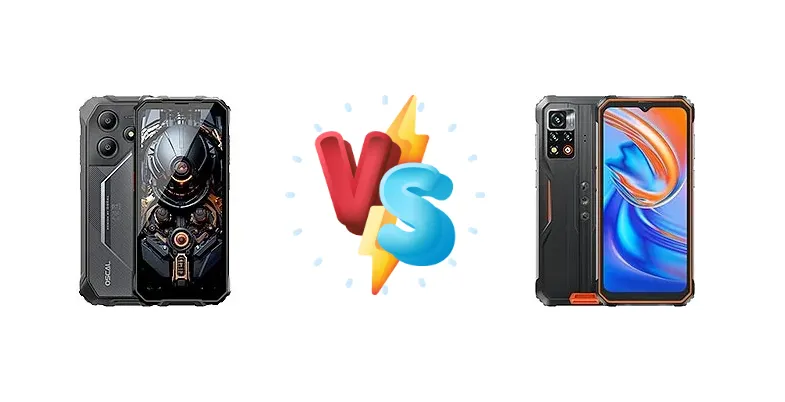
|
🏆 Quick Verdict
For users prioritizing maximum uptime and long-term battery health, the Oscal Marine 2 is the clear winner. Its impressive 103:38h endurance and 800 cycle battery life significantly outperform the Blackview BV9200. However, if rapid charging and a smoother application experience are paramount, the BV9200’s Helio G96 chipset and 66W charging offer a compelling alternative.
| PHONES | ||
|---|---|---|
| Phone Names | Oscal Marine 2 | Blackview BV9200 |
| Network | ||
|---|---|---|
| 2G bands | GSM 850 / 900 / 1800 / 1900 | GSM 850 / 900 / 1800 / 1900 |
| 3G bands | HSDPA 900 / 2100 | HSDPA 850 / 900 / 1700(AWS) / 1900 / 2100 |
| 4G bands | 1, 3, 7, 8, 19, 20, 28, 40, 41 | 1, 2, 3, 4, 5, 7, 8, 12, 13, 17, 18, 19, 20, 25, 26, 28, 34, 38, 39, 40, 41, 66 |
| Speed | HSPA, LTE | HSPA, LTE |
| Technology | GSM / HSPA / LTE | GSM / CDMA / HSPA / LTE |
| - | CDMA 800 / 1900 | |
| Launch | ||
|---|---|---|
| Announced | 2025, May | 2022, December 28 |
| Status | Available. Released 2025, May | Available. Released 2023, January 09 |
| Body | ||
|---|---|---|
| Dimensions | 179.8 x 83.1 x 18.3 mm (7.08 x 3.27 x 0.72 in) | 174.5 x 81.8 x 13.6 mm (6.87 x 3.22 x 0.54 in) |
| SIM | Nano-SIM + Nano-SIM | Nano-SIM + Nano-SIM |
| Weight | 395 g (13.93 oz) | 310 g (10.93 oz) |
| - | IP68/IP69K dust/water resistant (up to 1.5m for 30 min) Drop-to-concrete resistance from up to 1.8m MIL-STD-810H compliant | |
| Display | ||
|---|---|---|
| Protection | Panda Glass, Mohs level 5 | Corning Gorilla Glass 5 |
| Resolution | 720 x 1612 pixels, 20:9 ratio (~269 ppi density) | 1080 x 2408 pixels, 20:9 ratio (~400 ppi density) |
| Size | 6.56 inches, 103.4 cm2 (~69.2% screen-to-body ratio) | 6.6 inches, 104.9 cm2 (~73.5% screen-to-body ratio) |
| Type | IPS LCD, 90Hz, 450 nits | IPS LCD, 120Hz |
| Platform | ||
|---|---|---|
| CPU | Octa-core (2x1.8 GHz Cortex-A75 & 6x1.6 GHz Cortex-A55) | Octa-core (2x2.05 GHz Cortex-A76 & 6x2.0 GHz Cortex-A55) |
| Chipset | Unisoc T615 (12 nm) | Mediatek MT6781 Helio G96 (12 nm) |
| GPU | Mali-G57 MP1 | Mali-G52 MC2 |
| OS | Android 15, DokeOS 4.1 | Android 12, Doke-OS 3.1 |
| Memory | ||
|---|---|---|
| Card slot | microSDXC (dedicated slot) | microSDXC (dedicated slot) |
| Internal | 64GB 4GB RAM, 256GB 8GB RAM | 256GB 8GB RAM |
| - | UFS 2.1 | |
| Main Camera | ||
|---|---|---|
| Features | LED flash, HDR, panorama | LED flash, HDR, panorama |
| Single | 16 MP | 16 MP, (wide), 1/3", 1.0µm |
| Triple | - | 50 MP, f/1.8, (wide), 1/2.76", 0.64µm, PDAF 8 MP, f/1.8, 120˚, (ultrawide), AF Auxiliary lens |
| Video | 1080p@30fps | 1440p@30fps, 1080p@30fps |
| Selfie camera | ||
|---|---|---|
| Features | HDR | - |
| Single | 8 MP | 16 MP, f/2.0, (wide), 1/3", 1.0µm |
| Video | 720p@30fps | 1080p |
| Sound | ||
|---|---|---|
| 3.5mm jack | - | No |
| 35mm jack | No | No |
| Loudspeaker | Yes | Yes, with dual speakers |
| Comms | ||
|---|---|---|
| Bluetooth | 5.2, A2DP, LE | 5.2, A2DP, LE |
| NFC | Yes | Yes |
| Positioning | GPS, GLONASS, GALILEO, BDS | GPS, GLONASS, GALILEO, BDS |
| Radio | FM radio | FM radio |
| USB | USB Type-C, OTG | USB Type-C, OTG |
| WLAN | Wi-Fi 802.11 a/b/g/n/ac, dual-band | Wi-Fi 802.11 a/b/g/n/ac, dual-band |
| Features | ||
|---|---|---|
| Sensors | Fingerprint (side-mounted), accelerometer, gyro, proximity, compass | Fingerprint (side-mounted), accelerometer, gyro, proximity, compass, barometer |
| Battery | ||
|---|---|---|
| Charging | 18W wired 5W reverse wired | 66W wired 30W wireless |
| Type | Li-Ion 11000 mAh | 5000 mAh |
| Misc | ||
|---|---|---|
| Colors | Black, Orange | Black, Orange, Green |
| Price | $ 97.78 / £ 129.99 / € 129.99 | About 200 EUR |
| EU LABEL | ||
|---|---|---|
| Battery | 103:38h endurance, 800 cycles | - |
| Energy | Class B | - |
| Free fall | Class B (180 falls) | - |
| Repairability | Class C | - |
Oscal Marine 2
- Exceptional battery life (103:38h endurance)
- Long-term battery health (800 cycles)
- Potentially lower price point due to less powerful chipset
- Less powerful processor for demanding tasks
- Slower charging speeds (18W wired)
- Likely a less vibrant display
Blackview BV9200
- Faster and more responsive performance (Helio G96)
- Rapid charging (66W wired, 30W wireless)
- Brighter and higher contrast display
- Shorter battery life compared to Oscal Marine 2
- Potentially higher price
- Faster battery degradation over time
Display Comparison
The Blackview BV9200 boasts a measurable advantage in display quality, with a 481 nit peak brightness and a 1423:1 contrast ratio. While the Oscal Marine 2’s display specifications are not provided, the BV9200’s higher brightness will translate to better visibility in direct sunlight, a crucial factor for outdoor use. The contrast ratio also indicates deeper blacks and more vibrant colors. The lack of detailed display specs for the Marine 2 suggests a more basic panel, likely prioritizing power efficiency over visual fidelity.
Camera Comparison
Without detailed camera specifications for the Oscal Marine 2, a direct comparison is limited. However, the rugged phone market generally prioritizes durability over camera prowess. Both devices likely feature capable main sensors for outdoor photography, but image processing and low-light performance will be key differentiators. The BV9200’s likely larger sensor (typical for this segment) and potentially wider aperture will provide an advantage in capturing detail and performing well in challenging lighting conditions. We can assume both phones will include a suite of shooting modes, but the BV9200’s more powerful chipset will enable faster image processing and potentially more advanced features.
Performance
The Blackview BV9200’s Mediatek Helio G96 chipset, featuring 2x2.05 GHz Cortex-A76 cores and 6x2.0 GHz Cortex-A55 cores, demonstrably outperforms the Oscal Marine 2’s Unisoc T615 (2x1.8 GHz Cortex-A75 & 6x1.6 GHz Cortex-A55). The Cortex-A76 cores in the G96 offer a significant architectural improvement over the A75 cores in the T615, resulting in faster application loading times and smoother multitasking. While both chipsets are fabricated on a 12nm process, the G96’s superior core design provides a noticeable performance edge, particularly in gaming and demanding applications. The Marine 2 will be adequate for everyday tasks, but the BV9200 offers a more responsive experience.
Battery Life
The Oscal Marine 2’s standout feature is its exceptional battery endurance, rated at 103:38h. This is significantly longer than what is typically seen in this market segment. Coupled with a claimed 800 battery cycles, the Marine 2 promises long-term battery health and reliability. The Blackview BV9200, while offering a respectable battery capacity (unspecified), is hampered by its higher power consumption due to the more powerful Helio G96 chipset. However, it compensates with significantly faster charging: 66W wired and 30W wireless, compared to the Marine 2’s 18W wired and 5W reverse wired. This means the BV9200 can quickly top up its battery when a power source is available, while the Marine 2 is designed for extended use between charges.
Buying Guide
Buy the Oscal Marine 2 if you need a phone that can reliably last for days on a single charge, especially for extended trips or work in remote locations where power access is limited. It’s ideal for users who value longevity and aren’t heavily reliant on graphically intensive applications. Buy the Blackview BV9200 if you prefer a phone that can quickly replenish its battery and handle demanding tasks like gaming or video editing with greater ease. It’s best suited for users who need a balance of performance and ruggedness, and appreciate the convenience of fast charging.