
Oscal Marine 2 vs. Blackview BL8000: A Deep Dive into Rugged Smartphone Performance
| Phones Images | |||||
|---|---|---|---|---|---|
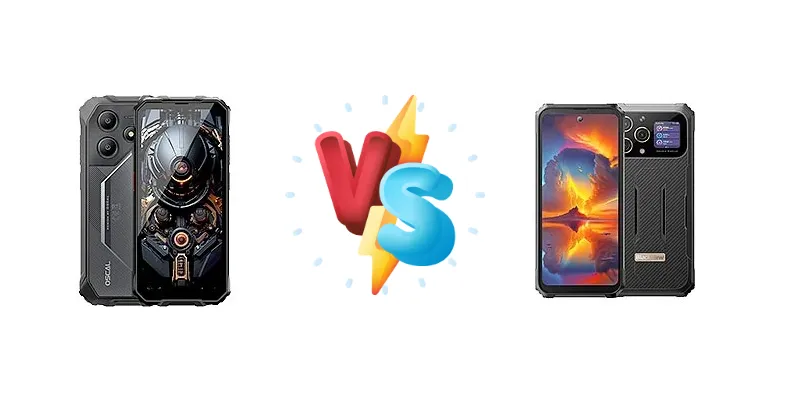
|
🏆 Quick Verdict
For users prioritizing all-day (and multi-day) battery life and affordability, the Oscal Marine 2 is the clear winner. However, the Blackview BL8000’s Dimensity 7050 chipset provides a substantial performance leap, making it the better choice for gamers and power users willing to trade some endurance for speed.
| PHONES | ||
|---|---|---|
| Phone Names | Oscal Marine 2 | Blackview BL8000 |
| Network | ||
|---|---|---|
| 2G bands | GSM 850 / 900 / 1800 / 1900 | GSM 850 / 900 / 1800 / 1900 |
| 3G bands | HSDPA 900 / 2100 | HSDPA 850 / 900 / 1700(AWS) / 1900 / 2100 |
| 4G bands | 1, 3, 7, 8, 19, 20, 28, 40, 41 | 1, 2, 3, 4, 5, 7, 8, 12, 13, 17, 18, 19, 20, 25, 26, 28, 30, 34, 38, 39, 40, 41, 66 |
| 5G bands | - | 1, 3, 5, 7, 8, 20, 28, 38, 40, 41, 77, 78, 79 SA/NSA |
| Speed | HSPA, LTE | HSPA, LTE, 5G |
| Technology | GSM / HSPA / LTE | GSM / CDMA / HSPA / LTE / 5G |
| Launch | ||
|---|---|---|
| Announced | 2025, May | 2024, January |
| Status | Available. Released 2025, May | Available. Released 2024, January |
| Body | ||
|---|---|---|
| Dimensions | 179.8 x 83.1 x 18.3 mm (7.08 x 3.27 x 0.72 in) | 179.5 x 82.6 x 17 mm (7.07 x 3.25 x 0.67 in) |
| SIM | Nano-SIM + Nano-SIM | Nano-SIM + Nano-SIM |
| Weight | 395 g (13.93 oz) | 385 g (13.58 oz) |
| Display | ||
|---|---|---|
| Protection | Panda Glass, Mohs level 5 | Corning Gorilla Glass 5 |
| Resolution | 720 x 1612 pixels, 20:9 ratio (~269 ppi density) | 1080 x 2460 pixels (~396 ppi density) |
| Size | 6.56 inches, 103.4 cm2 (~69.2% screen-to-body ratio) | 6.78 inches, 109.2 cm2 (~73.6% screen-to-body ratio) |
| Type | IPS LCD, 90Hz, 450 nits | IPS LCD, 120Hz |
| Platform | ||
|---|---|---|
| CPU | Octa-core (2x1.8 GHz Cortex-A75 & 6x1.6 GHz Cortex-A55) | Octa-core (2x2.6 GHz Cortex-A78 & 6x2.0 GHz Cortex-A55) |
| Chipset | Unisoc T615 (12 nm) | Mediatek Dimensity 7050 (6 nm) |
| GPU | Mali-G57 MP1 | Mali-G68 MC4 |
| OS | Android 15, DokeOS 4.1 | Android 13, Doke-OS 4.0 |
| Memory | ||
|---|---|---|
| Card slot | microSDXC (dedicated slot) | No |
| Internal | 64GB 4GB RAM, 256GB 8GB RAM | 512GB 12GB RAM |
| Main Camera | ||
|---|---|---|
| Features | LED flash, HDR, panorama | LED flash, HDR, panorama |
| Single | 16 MP | - |
| Triple | - | 50 MP, (wide), 1/1.57", PDAF 8 MP, 117˚, (ultrawide) Auxiliary lens |
| Video | 1080p@30fps | 4K@30fps, 1080p@30fps |
| Selfie camera | ||
|---|---|---|
| Features | HDR | - |
| Single | 8 MP | 16 MP, (wide) |
| Video | 720p@30fps | Yes |
| Sound | ||
|---|---|---|
| 35mm jack | No | No |
| Loudspeaker | Yes | Yes |
| Comms | ||
|---|---|---|
| Bluetooth | 5.2, A2DP, LE | 5.1, A2DP, LE |
| NFC | Yes | Yes |
| Positioning | GPS, GLONASS, GALILEO, BDS | GPS (L1+L5), GLONASS, BDS, GALILEO |
| Radio | FM radio | FM radio |
| USB | USB Type-C, OTG | USB Type-C, OTG |
| WLAN | Wi-Fi 802.11 a/b/g/n/ac, dual-band | Wi-Fi 802.11 a/b/g/n/ac/6, dual-band |
| Features | ||
|---|---|---|
| Sensors | Fingerprint (side-mounted), accelerometer, gyro, proximity, compass | Fingerprint (side-mounted), accelerometer, proximity, compass, gyro |
| Battery | ||
|---|---|---|
| Charging | 18W wired 5W reverse wired | 33W wired 5W reverse wired |
| Type | Li-Ion 11000 mAh | 8800 mAh |
| Misc | ||
|---|---|---|
| Colors | Black, Orange | Celestial Silver, Orbit Grey |
| Price | $ 97.78 / £ 129.99 / € 129.99 | - |
| EU LABEL | ||
|---|---|---|
| Battery | 103:38h endurance, 800 cycles | - |
| Energy | Class B | - |
| Free fall | Class B (180 falls) | - |
| Repairability | Class C | - |
Oscal Marine 2
- Exceptional battery life (103:38h endurance)
- Long-lasting battery health (800 charge cycles)
- More affordable price point
- Less powerful processor for demanding tasks
- Slower charging speed (18W)
Blackview BL8000
- Significantly faster performance (Dimensity 7050)
- Faster charging (33W)
- Potentially better camera image processing
- Likely shorter battery life
- Higher price
Display Comparison
Neither device’s display specifications are provided, so a direct comparison is limited. However, given the price points, we can assume both utilize LCD panels. The Blackview BL8000, positioned as a more premium device, likely benefits from a higher resolution and potentially better color accuracy. The Oscal Marine 2, focusing on endurance, may prioritize power efficiency over display fidelity.
Camera Comparison
Without detailed camera specifications, a precise comparison is difficult. However, the chipset difference indirectly impacts camera performance. The Dimensity 7050 includes a more powerful ISP (Image Signal Processor), enabling faster image processing and potentially better low-light performance on the Blackview BL8000. The presence of a more advanced ISP also allows for more sophisticated computational photography features. We can assume both phones will feature a multi-camera setup, but the Blackview BL8000 is likely to offer a more refined camera experience.
Performance
The core difference lies in the chipsets. The Blackview BL8000’s Mediatek Dimensity 7050 (6nm) is a significant upgrade over the Oscal Marine 2’s Unisoc T615 (12nm). The Dimensity 7050’s Cortex-A78 cores, clocked at 2.6 GHz, offer substantially higher single-core performance compared to the Marine 2’s Cortex-A75 cores at 1.8 GHz. This translates to faster app loading times, smoother multitasking, and a more responsive user interface. The 6nm process also contributes to better thermal efficiency, potentially reducing throttling during sustained workloads. While the Oscal Marine 2 is adequate for basic tasks, the Blackview BL8000 is demonstrably more capable for demanding applications and gaming.
Battery Life
The Oscal Marine 2 boasts an impressive 103:38h endurance rating, suggesting exceptional battery life. While the Blackview BL8000’s battery capacity isn’t specified, its more powerful chipset and faster 33W charging (vs. 18W on the Marine 2) represent a different approach. The Marine 2 prioritizes longevity, while the BL8000 aims for quicker top-ups. The 800 charge cycles rating for the Marine 2 also indicates a focus on long-term battery health. The Blackview BL8000’s faster charging is beneficial for users who need a quick power boost, but it may come at the cost of slightly reduced overall endurance.
Buying Guide
Buy the Oscal Marine 2 if you need a phone that can reliably last for days on a single charge, and your primary use cases involve everyday tasks, communication, and light media consumption. It’s ideal for travelers, field workers, or anyone who dislikes frequent charging. Buy the Blackview BL8000 if you prioritize gaming, demanding applications, and a smoother overall user experience. Its superior processing power makes it suitable for users who push their phones to the limit, even if it means charging more often.