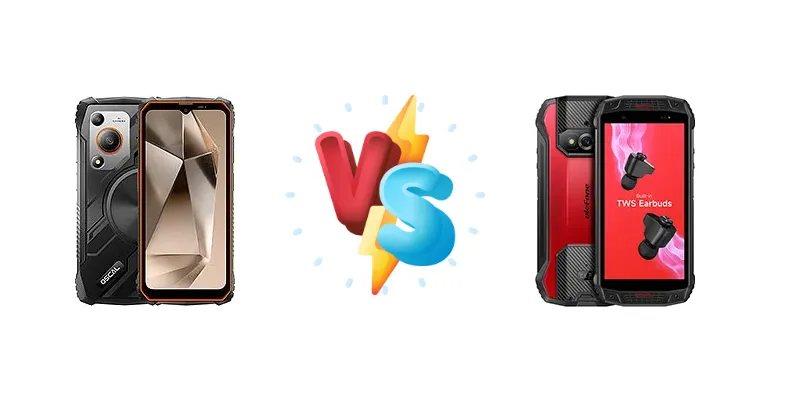
The rugged smartphone market offers a compelling alternative to fragile mainstream devices, but often at a premium. The Oscal Marine 1 and Ulefone Armor 15 both aim to deliver durability without breaking the bank. However, they take different approaches: the Marine 1 prioritizes exceptional battery endurance, while the Armor 15 focuses on a slightly more powerful, though less efficient, processor. This comparison will dissect their key differences to determine which phone best suits your needs.
🏆 Quick Verdict
For users prioritizing longevity and minimizing charging frequency, the Oscal Marine 1 is the clear winner. Its impressive 49:34h endurance significantly outpaces the Ulefone Armor 15. While the Armor 15 offers a marginally faster processor, the Marine 1’s battery life and 800 cycle rating provide a more practical benefit for outdoor enthusiasts and heavy users.
| Network |
|---|
| 2G bands | GSM 850 / 900 / 1800 / 1900 | GSM 850 / 900 / 1800 / 1900 |
| 3G bands | HSDPA 900 / 2100 | HSDPA 850 / 900 / 1700(AWS) / 1900 / 2100 |
| 4G bands | 1, 3, 7, 8, 19, 20, 28, 40, 41 | 1, 2, 3, 4, 5, 7, 8, 12, 13, 17, 18, 19, 20, 25, 26, 28, 38, 39, 40, 41, 66 |
| Speed | HSPA, LTE | HSPA, LTE Cat13 300/150 Mbps |
| Technology | GSM / HSPA / LTE | GSM / HSPA / LTE |
| Launch |
|---|
| Announced | 2025, May | 2022, July 27 |
| Status | Available. Released 2025, May | Available. Released 2022, August 10 |
| Body |
|---|
| Dimensions | 174.7 x 81.5 x 13.5 mm (6.88 x 3.21 x 0.53 in) | 170.2 x 79.6 x 18.2 mm (6.70 x 3.13 x 0.72 in) |
| SIM | Nano-SIM + Nano-SIM | Nano-SIM + Nano-SIM |
| Weight | 304 g (10.72 oz) | 346 g (12.20 oz) |
| | - | IP68 dust/water resistant (up to 1.5m for 30 min)
Drop-to-concrete resistance from up to 1.5m
MIL-STD-810G compliant
Built-in wireless earbuds housed inside the top side of the phone; charging |
| Display |
|---|
| Protection | Panda Glass, Mohs level 7 | - |
| Resolution | 720 x 1612 pixels, 20:9 ratio (~269 ppi density) | 720 x 1440 pixels, 18:9 ratio (~295 ppi density) |
| Size | 6.56 inches, 103.4 cm2 (~72.6% screen-to-body ratio) | 5.45 inches, 76.7 cm2 (~56.6% screen-to-body ratio) |
| Type | IPS LCD, 90Hz, 450 nits | IPS LCD |
| Platform |
|---|
| CPU | Octa-core (2x1.8 GHz Cortex-A75 & 6x1.6 GHz Cortex-A55) | Octa-core (4x2.3 GHz Cortex-A53 & 4x1.8 GHz Cortex-A53) |
| Chipset | Unisoc T615 (12 nm) | Mediatek MT6765G Helio G35 (12 nm) |
| GPU | Mali-G57 MP1 | PowerVR GE8320 |
| OS | Android 15, DokeOS 4.1 | Android 12 |
| Memory |
|---|
| Card slot | microSDXC (dedicated slot) | microSDXC (dedicated slot) |
| Internal | 128GB 4GB RAM | 128GB 6GB RAM |
| Main Camera |
|---|
| Dual | - | 12 MP, f/1.8, (wide), 1.4μm
13 MP, f/2.4, 106˚ (ultrawide) |
| Features | LED flash, HDR, panorama | LED flash, HDR, panorama |
| Single | 16 MP | 16 MP, f/2.4, (wide), 1.0μm |
| Video | 1080p@30fps | 1080p@30fps |
| Selfie camera |
|---|
| Features | HDR | - |
| Single | 8 MP | 16 MP, f/2.4, (wide), 1.0μm |
| Video | 720p@30fps | 1080p@30fps |
| Sound |
|---|
| 3.5mm jack | - | No |
| 35mm jack | No | No |
| Loudspeaker | Yes | Yes |
| Comms |
|---|
| Bluetooth | 5.0, A2DP, LE | 5.0, A2DP |
| NFC | Yes | Yes |
| Positioning | GPS, GLONASS, GALILEO, BDS | GPS, GLONASS, BDS, GALILEO |
| Radio | FM radio | Stereo FM radio, RDS, recording |
| USB | USB Type-C, OTG | USB Type-C 2.0, OTG |
| WLAN | Wi-Fi 802.11 a/b/g/n/ac, dual-band | Wi-Fi 802.11 a/b/g/n/ac, dual-band |
| Features |
|---|
| Sensors | Fingerprint (side-mounted), accelerometer, gyro, proximity, compass | Fingerprint (side-mounted), accelerometer, proximity, gyro, compass |
| Battery |
|---|
| Charging | 10W wired
5W reverse wired | 18W wired |
| Type | Li-Ion 5100 mAh | Li-Po 6600 mAh |
| Misc |
|---|
| Colors | Black, Orange | Meteorite Black, Tech Blue, Sport Red |
| Price | - | About 300 EUR |
| EU LABEL |
|---|
| Battery | 49:34h endurance, 800 cycles | - |
| Energy | Class B | - |
| Free fall | Class A (278 falls) | - |
| Repairability | Class C | - |
Oscal Marine 1
- Exceptional battery life (49:34h endurance)
- Long-lasting battery health (800 cycles)
- More efficient processor architecture (Unisoc T615)
- Slower charging speed (10W)
- Potentially less responsive for demanding games
Ulefone Armor 15
- Faster charging speed (18W)
- Higher clocked CPU cores (Helio G35)
- Potentially better for casual gaming
- Lower battery endurance (estimated)
- Less efficient processor architecture (Helio G35)
Display Comparison
Neither device boasts a standout display. Both utilize 12nm chipsets, suggesting similar display controller capabilities. Without specific display specs (resolution, brightness, panel type) beyond the chipsets, a direct comparison is limited. However, the focus on ruggedness suggests both will prioritize durability over high-end display features. Expect adequate, but not exceptional, viewing experiences.
Camera Comparison
Without detailed camera specifications, a meaningful comparison is difficult. Both phones likely feature budget-oriented camera systems. The absence of information regarding sensor size, aperture, or optical image stabilization (OIS) suggests neither will excel in low-light photography. The focus on ruggedness typically means camera quality is a secondary consideration. Expect acceptable results in good lighting conditions, but limitations in challenging environments.
Performance
The core difference lies in the chipsets. The Oscal Marine 1’s Unisoc T615 utilizes a Cortex-A75 based core configuration (2x1.8 GHz) paired with Cortex-A55 efficiency cores (6x1.6 GHz). This architecture balances performance and power efficiency. Conversely, the Ulefone Armor 15’s MediaTek Helio G35 relies solely on Cortex-A53 cores (4x2.3 GHz & 4x1.8 GHz). While the G35’s higher clock speed *appears* faster, the older A53 architecture is less efficient and offers lower Instructions Per Clock (IPC) than the A75. This means the Marine 1 will likely provide smoother sustained performance under load, despite the lower clock speeds. The Unisoc T615’s architecture is better suited for multitasking and demanding applications.
Battery Life
This is where the Oscal Marine 1 truly shines. Its 49:34h endurance is a significant advantage over the Ulefone Armor 15 (endurance data unavailable, but expected to be lower given the less efficient chipset). The Marine 1’s 800 battery cycle rating also indicates superior long-term battery health. The Armor 15 compensates with 18W wired charging, compared to the Marine 1’s 10W, meaning faster top-ups when needed. However, the Marine 1’s exceptional endurance minimizes the need for frequent charging, making the slower charging speed less of a drawback. The 5W reverse wired charging on the Marine 1 is a useful, albeit slow, feature for emergency charging of other devices.
Buying Guide
Buy the Oscal Marine 1 if you need a phone that can reliably last for days on a single charge, making it ideal for extended trips, fieldwork, or anyone who dislikes frequent charging. Buy the Ulefone Armor 15 if you prioritize slightly quicker app loading times and responsiveness for casual gaming, and are willing to compromise on battery life and potentially charge more often. The Armor 15 is better suited for users who need a bit more processing power for everyday tasks but don't demand extreme endurance.
Frequently Asked Questions
❓ Will the Unisoc T615 in the Oscal Marine 1 struggle with graphically intensive games?
While the Unisoc T615 isn't a gaming powerhouse, its Cortex-A75 cores provide a decent level of performance for casual gaming. Expect to play less demanding titles smoothly, but you may need to lower graphics settings for more resource-intensive games. The focus of this phone is endurance, not high-end gaming.
❓ How much faster is the 18W charging on the Ulefone Armor 15 compared to the 10W charging on the Oscal Marine 1?
The 18W charging on the Armor 15 will noticeably reduce charging times. While exact 0-100% times are unavailable, expect a roughly 40-60% reduction in charging duration compared to the Marine 1. However, given the Marine 1’s exceptional battery life, the slower charging speed is less of a concern for most users.
❓ What does the 800 battery cycle rating on the Oscal Marine 1 mean for long-term use?
A battery cycle is a complete discharge and recharge of the battery. The Oscal Marine 1’s 800 cycle rating indicates that the battery is designed to retain at least 80% of its original capacity after 800 full charge cycles. This suggests superior long-term battery health compared to phones with lower cycle ratings.