
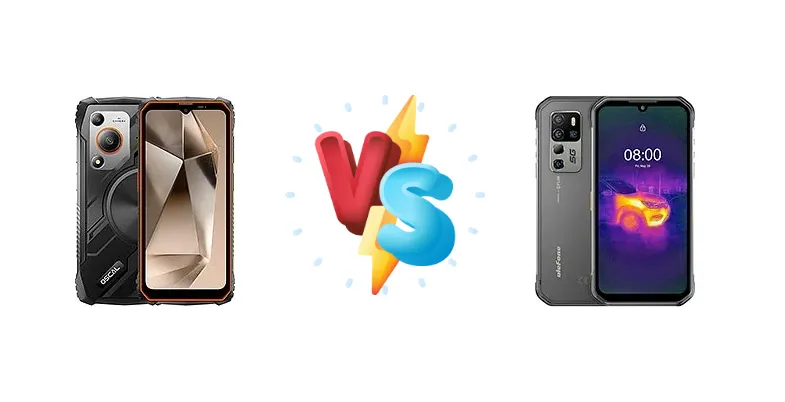
Oscal Marine 1 vs. Ulefone Armor 11T 5G: A Deep Dive into Rugged Performance and Battery Life
| Phones Images | |||||
|---|---|---|---|---|---|
|
🏆 Quick Verdict
For the average user prioritizing sustained performance and 5G connectivity, the Ulefone Armor 11T 5G is the clear winner. Its Mediatek Dimensity 800 chipset offers a substantial performance leap over the Oscal Marine 1’s Unisoc T615. However, users who value maximum battery endurance and are less concerned with intensive applications will find the Oscal Marine 1 a compelling option.
| PHONES | ||
|---|---|---|
| Phone Names | Oscal Marine 1 | Ulefone Armor 11T 5G |
| Network | ||
|---|---|---|
| 2G bands | GSM 850 / 900 / 1800 / 1900 | GSM 850 / 900 / 1800 / 1900 |
| 3G bands | HSDPA 900 / 2100 | HSDPA 850 / 900 / 1700(AWS) / 1900 / 2100 |
| 4G bands | 1, 3, 7, 8, 19, 20, 28, 40, 41 | 1, 2, 3, 4, 5, 7, 8, 12, 13, 17, 18, 19, 20, 25, 26, 28, 34, 38, 39, 40, 41, 66 |
| 5G bands | - | 1, 3, 5, 8, 20, 28, 38, 41, 77, 78, 79 SA/NSA |
| Speed | HSPA, LTE | HSPA, LTE, 5G |
| Technology | GSM / HSPA / LTE | GSM / CDMA / HSPA / EVDO / LTE / 5G |
| - | CDMA2000 1xEV-DO | |
| Launch | ||
|---|---|---|
| Announced | 2025, May | 2021, May 29 |
| Status | Available. Released 2025, May | Available. Released 2021, June 07 |
| Body | ||
|---|---|---|
| Build | - | Front glass, aluminum back with rubber, aluminum frame |
| Dimensions | 174.7 x 81.5 x 13.5 mm (6.88 x 3.21 x 0.53 in) | 163.8 x 81.6 x 14.2 mm (6.45 x 3.21 x 0.56 in) |
| SIM | Nano-SIM + Nano-SIM | Nano-SIM + Nano-SIM |
| Weight | 304 g (10.72 oz) | 293 g (10.34 oz) |
| - | IP69K dust/water resistant (up to 1.5m for 30 min) Drop-to-concrete resistance from up to 1.2m MIL-STD-810G compliant | |
| Display | ||
|---|---|---|
| Protection | Panda Glass, Mohs level 7 | Oleophobic coating |
| Resolution | 720 x 1612 pixels, 20:9 ratio (~269 ppi density) | 720 x 1560 pixels, 19.5:9 ratio (~282 ppi density) |
| Size | 6.56 inches, 103.4 cm2 (~72.6% screen-to-body ratio) | 6.1 inches, 91.3 cm2 (~68.3% screen-to-body ratio) |
| Type | IPS LCD, 90Hz, 450 nits | IPS LCD |
| Platform | ||
|---|---|---|
| CPU | Octa-core (2x1.8 GHz Cortex-A75 & 6x1.6 GHz Cortex-A55) | Octa-core (4x2.0 GHz Cortex-A76 & 4x2.0 GHz Cortex-A55) |
| Chipset | Unisoc T615 (12 nm) | Mediatek Dimensity 800 (7 nm) |
| GPU | Mali-G57 MP1 | Mali-G57 MP4 |
| OS | Android 15, DokeOS 4.1 | Android 11 |
| Memory | ||
|---|---|---|
| Card slot | microSDXC (dedicated slot) | No |
| Internal | 128GB 4GB RAM | 256GB 8GB RAM |
| - | UFS 2.1 | |
| Main Camera | ||
|---|---|---|
| Features | LED flash, HDR, panorama | Dual-LED dual-tone flash, HDR, panorama |
| Penta | - | 48 MP, f/1.8, 26mm (wide), 1/2.0", 0.8µm, PDAF FLIR thermal camera (Lepton module) 5 MP 2 MP (macro) Auxiliary lens |
| Single | 16 MP | 16 MP, f/2.0 |
| Video | 1080p@30fps | 4K@30fps, 1080p@30fps |
| Selfie camera | ||
|---|---|---|
| Features | HDR | HDR, panorama |
| Single | 8 MP | 16 MP, f/2.0 |
| Video | 720p@30fps | 1080p@30fps |
| Sound | ||
|---|---|---|
| 3.5mm jack | - | Yes |
| 35mm jack | No | Yes |
| Loudspeaker | Yes | Yes |
| Comms | ||
|---|---|---|
| Bluetooth | 5.0, A2DP, LE | 5.0, A2DP, LE |
| NFC | Yes | Yes |
| Positioning | GPS, GLONASS, GALILEO, BDS | GPS, GLONASS, GALILEO, BDS |
| Radio | FM radio | FM radio, RDS, recording |
| USB | USB Type-C, OTG | USB Type-C 2.0, OTG |
| WLAN | Wi-Fi 802.11 a/b/g/n/ac, dual-band | Wi-Fi 802.11 a/b/g/n/ac, Wi-Fi Direct |
| Features | ||
|---|---|---|
| Sensors | Fingerprint (side-mounted), accelerometer, gyro, proximity, compass | Fingerprint (side-mounted), accelerometer, gyro, proximity, compass, baroceptor |
| Battery | ||
|---|---|---|
| Charging | 10W wired 5W reverse wired | 18W wired 10W wireless |
| Type | Li-Ion 5100 mAh | Li-Po 5200 mAh |
| Misc | ||
|---|---|---|
| Colors | Black, Orange | Black |
| Price | - | About 590 EUR |
| EU LABEL | ||
|---|---|---|
| Battery | 49:34h endurance, 800 cycles | - |
| Energy | Class B | - |
| Free fall | Class A (278 falls) | - |
| Repairability | Class C | - |
Oscal Marine 1
- Exceptional battery endurance (49:34h)
- Long-term battery health (800 cycles)
- More affordable price point
- Less powerful processor (Unisoc T615)
- Slower charging speed (10W wired)
- Limited 5G connectivity
Ulefone Armor 11T 5G
- Significantly faster processor (Dimensity 800)
- 5G connectivity for faster data speeds
- Faster charging (18W wired, 10W wireless)
- Likely shorter battery life
- Higher price point
- Potentially more thermal throttling under heavy load
Display Comparison
Neither device’s display specifications are provided, so a direct comparison is limited. However, given the Armor 11T 5G’s higher overall positioning, it likely features a higher resolution and potentially a higher refresh rate panel. The lack of display details on the Marine 1 suggests a more budget-focused approach, potentially impacting color accuracy and viewing angles. Both will likely feature ruggedized glass for impact resistance.
Camera Comparison
Without detailed camera specifications, a precise comparison is difficult. However, the Armor 11T 5G’s higher price point suggests a more capable camera system. While both phones likely include multiple lenses, the Armor 11T 5G is more likely to feature a larger primary sensor and optical image stabilization (OIS), resulting in better low-light performance and sharper images. The inclusion of a 2MP macro lens on either device is unlikely to provide significant photographic value.
Performance
The Ulefone Armor 11T 5G’s Mediatek Dimensity 800 (7nm) represents a significant architectural advantage over the Oscal Marine 1’s Unisoc T615 (12nm). The Dimensity 800 utilizes Cortex-A76 cores clocked at 2.0 GHz, offering substantially higher single-core and multi-core performance compared to the Marine 1’s Cortex-A75 cores at 1.8 GHz. The 7nm process node also translates to improved thermal efficiency, reducing the likelihood of throttling during sustained workloads. This means the Armor 11T 5G will handle demanding games and applications with greater ease.
Battery Life
The Oscal Marine 1 boasts an impressive 49:34h endurance rating and a claimed 800 charge cycles, indicating a focus on long-term battery health and longevity. While the Armor 11T 5G’s battery capacity isn’t specified, its more powerful chipset and 5G connectivity will inevitably consume more power. The Armor 11T 5G compensates with faster charging – 18W wired and 10W wireless – compared to the Marine 1’s 10W wired and 5W reverse wired. The Marine 1’s endurance suggests it can easily last a full day, even with moderate use, while the Armor 11T 5G may require a midday top-up for heavy users.
Buying Guide
Buy the Oscal Marine 1 if you need a phone that can reliably last through multi-day work trips or outdoor adventures without frequent charging, and your primary use cases are communication, navigation, and light media consumption. Buy the Ulefone Armor 11T 5G if you prefer a faster, more responsive experience for gaming, streaming, and multitasking, and require 5G connectivity for faster data speeds, even if it means more frequent charging.