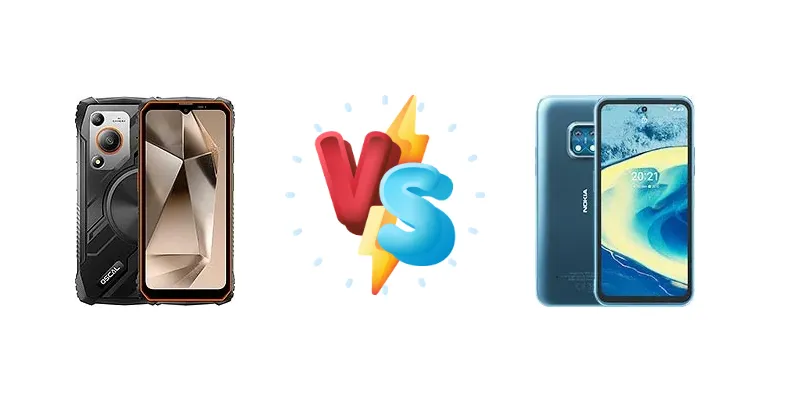
The rugged smartphone market offers a compelling alternative for users prioritizing durability and longevity. The Oscal Marine 1 and Nokia XR20 both cater to this need, but approach it with different philosophies. The Marine 1 focuses on maximizing battery life and offering a robust build at a lower price point, while the XR20 integrates 5G connectivity and wireless charging, representing a more modern, albeit pricier, option.
🏆 Quick Verdict
For users prioritizing exceptional battery life and a no-frills, durable experience, the Oscal Marine 1 is the clear winner. Its 49:34h endurance significantly outpaces the XR20. However, if 5G connectivity and the convenience of wireless charging are essential, the Nokia XR20 is the more suitable choice.
| Network |
|---|
| 2G bands | GSM 850 / 900 / 1800 / 1900 | GSM 850 / 900 / 1800 / 1900 |
| 3G bands | HSDPA 900 / 2100 | HSDPA 850 / 900 / 1700(AWS) / 1900 / 2100 |
| 4G bands | 1, 3, 7, 8, 19, 20, 28, 40, 41 | 1, 2, 3, 4, 5, 7, 8, 12, 13, 14, 20, 25, 26, 28, 30, 38, 40, 41, 48, 66, 71 |
| 5G bands | - | 2, 5, 25, 38, 41, 48, 66, 77, 78 SA/NSA |
| Speed | HSPA, LTE | HSPA, LTE, 5G |
| Technology | GSM / HSPA / LTE | GSM / CDMA / HSPA / EVDO / LTE / 5G |
| | - | CDMA2000 1xEV-DO |
| Launch |
|---|
| Announced | 2025, May | 2021, July 27 |
| Status | Available. Released 2025, May | Available. Released 2021, August 04 |
| Body |
|---|
| Dimensions | 174.7 x 81.5 x 13.5 mm (6.88 x 3.21 x 0.53 in) | 171.6 x 81.5 x 10.6 mm (6.76 x 3.21 x 0.42 in) |
| SIM | Nano-SIM + Nano-SIM | · Nano-SIM· Nano-SIM + Nano-SIM |
| Weight | 304 g (10.72 oz) | 248 g (8.75 oz) |
| | - | IP68 dust/water resistant (up to 1.5m for 60 min)
Drop-to-concrete resistance from up to 1.8m
MIL-STD-810H compliant |
| Display |
|---|
| Protection | Panda Glass, Mohs level 7 | Corning Gorilla Glass Victus |
| Resolution | 720 x 1612 pixels, 20:9 ratio (~269 ppi density) | 1080 x 2400 pixels, 20:9 ratio (~395 ppi density) |
| Size | 6.56 inches, 103.4 cm2 (~72.6% screen-to-body ratio) | 6.67 inches, 107.4 cm2 (~76.8% screen-to-body ratio) |
| Type | IPS LCD, 90Hz, 450 nits | IPS LCD, 550 nits |
| Platform |
|---|
| CPU | Octa-core (2x1.8 GHz Cortex-A75 & 6x1.6 GHz Cortex-A55) | Octa-core (2x2.0 GHz Kryo 460 & 6x1.8 GHz Kryo 460) |
| Chipset | Unisoc T615 (12 nm) | Qualcomm SM4350 Snapdragon 480 5G (8 nm) |
| GPU | Mali-G57 MP1 | Adreno 619 |
| OS | Android 15, DokeOS 4.1 | Android 11, upgradable to Android 13 |
| Memory |
|---|
| Card slot | microSDXC (dedicated slot) | microSDXC (uses shared SIM slot) |
| Internal | 128GB 4GB RAM | 64GB 4GB RAM, 128GB 6GB RAM |
| Main Camera |
|---|
| Dual | - | 48 MP, f/1.8, (wide), 1/2.25", 0.8µm, PDAF
13 MP, f/2.4, 123˚ (ultrawide), 1/3.0", 1.12µm |
| Features | LED flash, HDR, panorama | Zeiss optics, Dual-LED dual-tone flash, second LED flash, HDR, panorama |
| Single | 16 MP | 8 MP, f/2.0 (wide), 1/4.0", 1.12µm |
| Video | 1080p@30fps | 1080p@30fps |
| Selfie camera |
|---|
| Features | HDR | - |
| Single | 8 MP | 8 MP, f/2.0 (wide), 1/4.0", 1.12µm |
| Video | 720p@30fps | 1080p@30fps |
| Sound |
|---|
| 3.5mm jack | - | Yes |
| 35mm jack | No | Yes |
| Loudspeaker | Yes | Yes, with stereo speakers |
| Comms |
|---|
| Bluetooth | 5.0, A2DP, LE | 5.1, A2DP, LE, aptX Adaptive |
| NFC | Yes | Yes |
| Positioning | GPS, GLONASS, GALILEO, BDS | GPS (L1+L5), GLONASS, BDS, GALILEO, QZSS, NavIC |
| Radio | FM radio | Unspecified |
| USB | USB Type-C, OTG | USB Type-C 3.0 |
| WLAN | Wi-Fi 802.11 a/b/g/n/ac, dual-band | Wi-Fi 802.11 a/b/g/n/ac/6, dual-band, Wi-Fi Direct |
| Features |
|---|
| Sensors | Fingerprint (side-mounted), accelerometer, gyro, proximity, compass | Fingerprint (side-mounted), accelerometer, gyro, proximity, compass, barometer |
| Battery |
|---|
| Charging | 10W wired
5W reverse wired | 18W wired
15W wireless |
| Type | Li-Ion 5100 mAh | Li-Po 4630 mAh |
| Misc |
|---|
| Colors | Black, Orange | Ultra Blue, Granite Gray |
| Models | - | TA-1368, TA-1362 |
| Price | - | About 270 EUR |
| SAR EU | - | 1.13 W/kg (head) 1.43 W/kg (body) |
| EU LABEL |
|---|
| Battery | 49:34h endurance, 800 cycles | - |
| Energy | Class B | - |
| Free fall | Class A (278 falls) | - |
| Repairability | Class C | - |
Oscal Marine 1
- Exceptional battery life (49:34h endurance)
- Robust build quality for demanding environments
- More affordable price point
- Slow 10W wired charging
- Less powerful processor compared to XR20
- Lacks 5G connectivity
Nokia XR20
- 5G connectivity for faster data speeds
- Convenient 18W wired and 15W wireless charging
- More modern chipset (Snapdragon 480)
- Significantly shorter battery life than Oscal Marine 1
- Higher price point
- Potentially more susceptible to throttling under heavy load
Display Comparison
Neither device boasts a cutting-edge display. Details regarding panel type, resolution, and refresh rate are missing, but the focus here is clearly on durability, not visual fidelity. The lack of detailed display specs suggests both phones target practicality over premium aesthetics. Bezels are likely substantial on both to contribute to impact resistance.
Camera Comparison
Without detailed camera specifications beyond the chipsets, a direct comparison is difficult. Both phones likely feature modest camera systems geared towards functional photography rather than professional-grade results. The absence of information regarding sensor size and aperture suggests neither device will excel in low-light conditions. It's reasonable to assume the XR20, leveraging Qualcomm's image signal processor, may offer slightly better image processing capabilities, but this is speculative.
Performance
The Nokia XR20’s Qualcomm Snapdragon 480 5G, fabricated on an 8nm process, offers a theoretical performance advantage over the Oscal Marine 1’s Unisoc T615 (12nm). The Snapdragon 480’s Kryo 460 cores, clocked at 2.0 GHz, are generally more efficient and powerful than the T615’s Cortex-A75 cores at 1.8 GHz. However, the real-world difference may be less pronounced in everyday tasks. The 8nm process of the Snapdragon 480 also implies better thermal management, potentially reducing throttling during sustained workloads. The Unisoc T615 prioritizes efficiency, likely contributing to the Marine 1’s exceptional battery life.
Battery Life
The Oscal Marine 1’s standout feature is its incredible 49:34h battery endurance. This is a significant advantage over the Nokia XR20, which lacks a published endurance figure but will undoubtedly fall short given its 18W wired and 15W wireless charging capabilities – features that typically come at the cost of efficiency. The Marine 1’s 10W wired charging is slow, but the massive battery capacity mitigates this. The XR20’s wireless charging is a convenience feature the Marine 1 lacks, but the trade-off is substantial battery life.
Buying Guide
Buy the Oscal Marine 1 if you need a phone that can last for days on a single charge, work reliably in harsh environments, and don't require the latest 5G speeds. This is ideal for outdoor workers, travelers in remote areas, or anyone who simply wants a phone that won't die mid-day. Buy the Nokia XR20 if you prioritize 5G connectivity for faster data speeds, appreciate the convenience of wireless charging, and want a phone with a more modern feature set, even if it means sacrificing some battery endurance.
Frequently Asked Questions
❓ How does the Unisoc T615 in the Oscal Marine 1 handle demanding apps like navigation or video recording?
While the Unisoc T615 isn't a flagship processor, it's capable of handling everyday tasks and moderately demanding apps. Navigation and standard video recording should be fine, but expect some slowdowns with prolonged use or when recording in higher resolutions. The focus of this chipset is efficiency, prioritizing battery life over raw performance.
❓ Is the Nokia XR20's 15W wireless charging speed fast enough for convenient daily use?
15W wireless charging is slower than many flagship phones, but it's still a convenient option for topping up the battery overnight or during downtime. It won't provide a rapid charge, but it eliminates the need for cables. However, remember that wireless charging is less efficient than wired charging, contributing to the XR20's lower overall battery endurance.
❓ Given the Oscal Marine 1's slow charging speed, how long does it realistically take to fully charge the battery?
With only 10W wired charging, a full charge from 0% on the Oscal Marine 1 will likely take several hours – potentially 6-8 hours or more. However, the massive battery capacity means you won't need to charge it every day, mitigating the inconvenience of the slow charging speed.