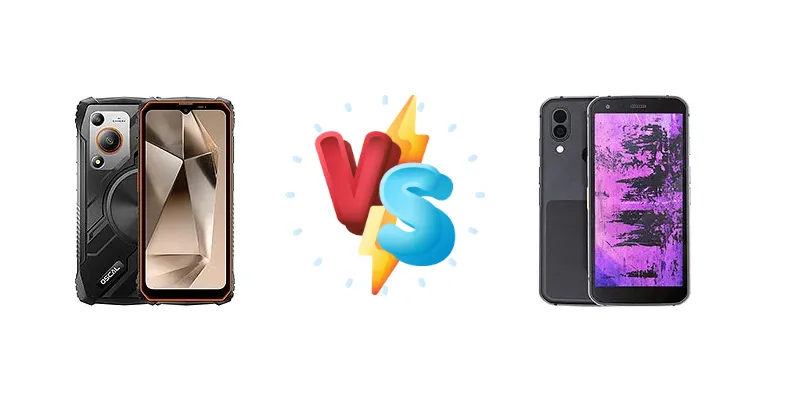
The rugged smartphone market caters to a specific need: durability. The Oscal Marine 1 enters as a newcomer promising exceptional battery life at a competitive price, while the Cat S62 Pro represents a more established brand with a proven track record in the field. This comparison dissects their core components to determine which device best suits demanding users.
🏆 Quick Verdict
For users prioritizing longevity and value, the Oscal Marine 1 emerges as the winner. Its impressive 49:34h endurance and 800 charge cycles significantly outweigh the Cat S62 Pro’s more mature chipset, especially for those needing a phone that lasts through multi-day deployments. However, the Cat S62 Pro’s Snapdragon 660 offers a more refined experience for users who prioritize consistent performance.
| Network |
|---|
| 2G bands | GSM 850 / 900 / 1800 / 1900 | GSM 850 / 900 / 1800 / 1900 |
| 3G bands | HSDPA 900 / 2100 | HSDPA 850 / 900 / 1700(AWS) / 1900 / 2100 |
| 4G bands | 1, 3, 7, 8, 19, 20, 28, 40, 41 | 1, 2, 3, 4, 5, 7, 8, 20, 28, 38, 40 |
| Speed | HSPA, LTE | HSPA 42.2/5.76 Mbps, LTE (2CA) Cat13 400/150 Mbps |
| Technology | GSM / HSPA / LTE | GSM / HSPA / LTE |
| Launch |
|---|
| Announced | 2025, May | 2020, June 28. Released 2020, August 17 |
| Status | Available. Released 2025, May | Discontinued |
| Body |
|---|
| Build | - | Glass front (Gorilla Glass 6), plastic back, aluminum frame |
| Dimensions | 174.7 x 81.5 x 13.5 mm (6.88 x 3.21 x 0.53 in) | 158.5 x 76.7 x 11.9 mm (6.24 x 3.02 x 0.47 in) |
| SIM | Nano-SIM + Nano-SIM | · Nano-SIM· Nano-SIM + Nano-SIM |
| Weight | 304 g (10.72 oz) | 248 g (8.75 oz) |
| | - | IP68/IP69 dust/water resistant (up to 1.5m for 35 mins)
Drop-to-concrete resistance from up to 1.8m
MIL-STD-810H compliant |
| Display |
|---|
| Protection | Panda Glass, Mohs level 7 | Corning Gorilla Glass 6 |
| Resolution | 720 x 1612 pixels, 20:9 ratio (~269 ppi density) | 1080 x 2160 pixels, 18:9 ratio (~424 ppi density) |
| Size | 6.56 inches, 103.4 cm2 (~72.6% screen-to-body ratio) | 5.7 inches, 83.8 cm2 (~69.0% screen-to-body ratio) |
| Type | IPS LCD, 90Hz, 450 nits | IPS LCD |
| Platform |
|---|
| CPU | Octa-core (2x1.8 GHz Cortex-A75 & 6x1.6 GHz Cortex-A55) | Octa-core (4x2.2 GHz Kryo 260 Gold & 4x1.8 GHz Kryo 260 Silver) |
| Chipset | Unisoc T615 (12 nm) | Qualcomm SDM660 Snapdragon 660 (14 nm) |
| GPU | Mali-G57 MP1 | Adreno 512 |
| OS | Android 15, DokeOS 4.1 | Android 10 |
| Memory |
|---|
| Card slot | microSDXC (dedicated slot) | microSDXC (dedicated slot) |
| Internal | 128GB 4GB RAM | 128GB 6GB RAM |
| Main Camera |
|---|
| Dual | - | 12 MP, f/1.8, (wide), 1/2.55", 1.4µm, dual pixel PDAF
FLIR thermal camera (Lepton 3.5 module) |
| Features | LED flash, HDR, panorama | Thermal imaging, heat palettes, temp. spot meter, LED flash |
| Single | 16 MP | - |
| Video | 1080p@30fps | 1080p@30fps, gyro-EIS |
| Selfie camera |
|---|
| Features | HDR | - |
| Single | 8 MP | 8 MP |
| Video | 720p@30fps | 1080p@30fps |
| Sound |
|---|
| 3.5mm jack | - | No |
| 35mm jack | No | No |
| Loudspeaker | Yes | Yes |
| Comms |
|---|
| Bluetooth | 5.0, A2DP, LE | 5.0, A2DP, LE |
| NFC | Yes | Yes |
| Positioning | GPS, GLONASS, GALILEO, BDS | GPS, GLONASS, GALILEO, BDS |
| Radio | FM radio | FM radio |
| USB | USB Type-C, OTG | USB Type-C 2.0, OTG |
| WLAN | Wi-Fi 802.11 a/b/g/n/ac, dual-band | Wi-Fi 802.11 a/b/g/n/ac, dual-band, Wi-Fi Direct |
| Features |
|---|
| Sensors | Fingerprint (side-mounted), accelerometer, gyro, proximity, compass | Fingerprint (rear-mounted), accelerometer, gyro, proximity, compass |
| Battery |
|---|
| Charging | 10W wired
5W reverse wired | - |
| Type | Li-Ion 5100 mAh | Li-Ion 4000 mAh |
| Misc |
|---|
| Colors | Black, Orange | Black |
| Price | - | About 530 EUR |
| EU LABEL |
|---|
| Battery | 49:34h endurance, 800 cycles | - |
| Energy | Class B | - |
| Free fall | Class A (278 falls) | - |
| Repairability | Class C | - |
Oscal Marine 1
- Exceptional battery life (49:34h endurance)
- High battery cycle count (800 cycles)
- Competitive price point
- Slow 10W charging
- Unisoc T615 chipset may struggle with demanding tasks
Cat S62 Pro
- More powerful Snapdragon 660 chipset
- Established brand reputation for ruggedness
- Potentially smoother multitasking experience
- Likely shorter battery life
- Less efficient 14nm process
Display Comparison
Neither device boasts a cutting-edge display. Details are missing for the Oscal Marine 1, but the focus here is clearly on practicality over aesthetics. The Cat S62 Pro’s display specifications are also unavailable, but given its market positioning, it likely prioritizes visibility in direct sunlight and durability over high resolution or refresh rates. Both will likely feature toughened glass, but the Oscal Marine 1’s overall ruggedization may offer better protection.
Camera Comparison
Camera details are sparse for both devices. Given the rugged focus, image quality is likely secondary to durability. It’s reasonable to assume both phones will offer functional cameras for documentation purposes, but neither is likely to compete with mainstream smartphone photography. Without sensor size or aperture information, it’s difficult to make a direct comparison. The Cat S62 Pro’s Qualcomm ISP may offer slightly better image processing, but the real-world difference will likely be minimal.
Performance
The core difference lies in the chipsets. The Oscal Marine 1 utilizes the Unisoc T615 (12nm), an octa-core processor with a mix of Cortex-A75 and A55 cores. This architecture aims for efficiency, prioritizing battery life over raw power. Conversely, the Cat S62 Pro features the Qualcomm Snapdragon 660 (14nm). While older, the Snapdragon 660’s Kryo 260 cores, particularly the Gold cores clocked at 2.2 GHz, offer a performance advantage in demanding tasks and multitasking. The 14nm process, however, is less efficient than the Unisoc’s 12nm, potentially impacting battery life. The Unisoc T615’s architecture suggests it will handle everyday tasks adequately, but the Snapdragon 660 will provide a smoother experience with graphically intensive applications.
Battery Life
Battery life is where the Oscal Marine 1 truly shines. Its reported 49:34h endurance is exceptional, significantly exceeding what most smartphones offer. The 800 charge cycles also indicate a focus on long-term battery health. The Cat S62 Pro’s battery capacity is unknown, but its Snapdragon 660 chipset and 14nm process will likely result in shorter runtimes. The Oscal Marine 1’s 10W wired charging is slow, but the extended battery life mitigates this drawback. The 5W reverse wired charging is a useful addition for emergency situations.
Buying Guide
Buy the Oscal Marine 1 if you need a phone that can genuinely go the distance – multiple days on a single charge is its strength, making it ideal for extended fieldwork, travel, or emergency preparedness. Buy the Cat S62 Pro if you prefer a more established brand with a proven track record, and require a consistently responsive experience for everyday tasks and moderate multitasking, even if it means more frequent charging.
Frequently Asked Questions
❓ How does the Unisoc T615 handle sustained workloads like GPS navigation and data logging for extended periods?
The Unisoc T615’s efficiency-focused architecture is designed to manage heat effectively during prolonged use. While it won’t match the peak performance of the Snapdragon 660, it should handle continuous GPS navigation and data logging without significant throttling, thanks to its Cortex-A75 cores and 12nm process. However, expect some performance degradation over very long sessions.
❓ Is the Cat S62 Pro still receiving software updates and security patches, given its age?
Cat phones generally provide a reasonable level of software support for their devices. However, the S62 Pro is an older model, so the frequency of updates may be reduced. It’s crucial to check Cat’s official website or forums for the latest information on software support before purchasing to ensure continued security and functionality.
❓ What type of USB-C charging does the Oscal Marine 1 support – Power Delivery or Quick Charge?
The Oscal Marine 1 supports standard 10W wired charging via USB-C. It does *not* appear to support faster charging protocols like Power Delivery or Quick Charge. This means charging will be relatively slow, but the exceptional battery life minimizes the need for frequent top-ups.