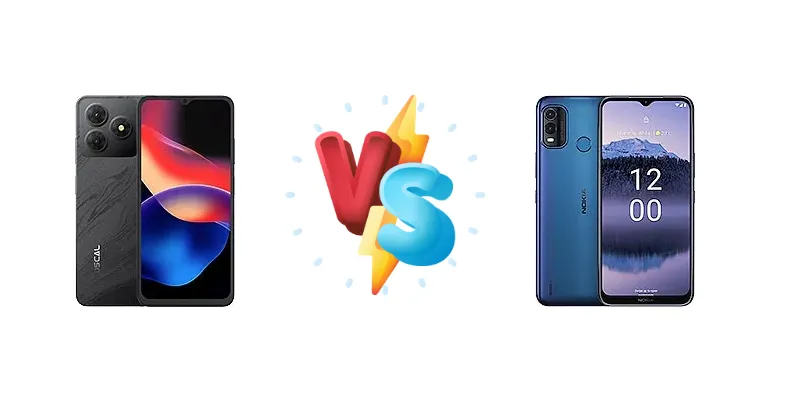
The sub-$150 smartphone market is fiercely competitive. Both the Oscal Flat 2C and Nokia G11 Plus aim to deliver essential functionality at an accessible price point, relying on Unisoc chipsets to power the experience. This comparison dissects the key differences between these two devices, focusing on performance, battery life, and overall value.
🏆 Quick Verdict
For the average user prioritizing longevity and consistent performance, the Oscal Flat 2C emerges as the better choice. Its impressive 51-hour endurance and 1100 charge cycles outweigh the Nokia G11 Plus’s slightly more powerful CPU, especially given both phones share the same slow 10W charging.
| Network |
|---|
| 2G bands | GSM 850 / 900 / 1800 / 1900 | GSM 850 / 900 / 1800 / 1900 |
| 3G bands | HSDPA 900 / 2100 | HSDPA 850 / 900 / 2100 - International |
| 4G bands | 1, 3, 7, 8, 19, 20, 38, 40, 41 | 1, 3, 5, 7, 8, 20, 28, 38, 40, 41 - International |
| Speed | HSPA, LTE | HSPA 42.2/5.76 Mbps, LTE Cat4 150/50 Mbps |
| Technology | GSM / HSPA / LTE | GSM / HSPA / LTE |
| | - | 1, 3, 5, 8, 40, 41 - India |
| Launch |
|---|
| Announced | 2025, January | 2022, June 29 |
| Status | Available. Released 2025, January | Available. Released 2022, July 20 |
| Body |
|---|
| Build | - | Glass front, plastic frame, plastic back |
| Dimensions | 163.2 x 75.2 x 8.8 mm (6.43 x 2.96 x 0.35 in) | 164.8 x 75.9 x 8.6 mm (6.49 x 2.99 x 0.34 in) |
| SIM | Nano-SIM + Nano-SIM | · Nano-SIM· Nano-SIM + Nano-SIM |
| Weight | 193 g (6.81 oz) | 192 g (6.77 oz) |
| | - | Splash protection |
| Display |
|---|
| Protection | Mohs level 5 | - |
| Resolution | 720 x 1612 pixels, 20:9 ratio (~269 ppi density) | 720 x 1600 pixels, 20:9 ratio (~269 ppi density) |
| Size | 6.56 inches, 103.4 cm2 (~84.2% screen-to-body ratio) | 6.52 inches, 102.6 cm2 (~82.1% screen-to-body ratio) |
| Type | IPS LCD, 450 nits | IPS LCD, 90Hz, 400 nits (typ) |
| Platform |
|---|
| CPU | Octa-core 8x1.6 GHz Cortex-A55 | Octa-core (2x1.6 GHz Cortex-A75 & 6x1.6 GHz Cortex-A55) |
| Chipset | Unisoc T603 (22 nm) | Unisoc T606 (12 nm) |
| GPU | IMG8322 | Mali-G57 MP1 |
| OS | Android 14 (Go edition), DokeOS 4.0 | Android 12, upgradable to Android 13 |
| Memory |
|---|
| Card slot | microSDXC (dedicated slot) | microSDXC (dedicated slot) |
| Internal | 64GB 2GB RAM | 32GB 3GB RAM, 64GB 3GB RAM, 64GB 4GB RAM, 128GB 3GB RAM |
| | - | eMMC 5.1 |
| Main Camera |
|---|
| Dual | - | 50 MP, f/1.8, (wide), 1/2.67", PDAF
Auxiliary lens |
| Features | LED flash, HDR, panorama | LED flash |
| Single | 13 MP, (wide), 1/4.0", 1.12 μm | 8 MP, f/2.0, (wide), 1/4.0" |
| Video | 1080p@30fps | 1080p@30fps |
| Selfie camera |
|---|
| Single | 8 MP, (wide) | 8 MP, f/2.0, (wide), 1/4.0" |
| Video | 1080p@30fps | 1080p@30fps |
| Sound |
|---|
| 3.5mm jack | - | Yes |
| 35mm jack | Yes | Yes |
| Loudspeaker | Yes | Yes |
| Comms |
|---|
| Bluetooth | 4.2, A2DP | 5.0, A2DP, LE |
| NFC | No | No |
| Positioning | GPS, GLONASS, GALILEO | GPS |
| Radio | FM radio | FM radio |
| USB | USB Type-C, OTG | USB Type-C 2.0, OTG |
| WLAN | Wi-Fi 802.11 b/g/n | Wi-Fi 802.11 a/b/g/n/ac, dual-band, Wi-Fi Direct |
| Features |
|---|
| Sensors | Accelerometer, proximity | Fingerprint (rear-mounted), accelerometer, proximity |
| Battery |
|---|
| Charging | 10W wired | 10W wired |
| Type | 5000 mAh | Li-Ion 5000 mAh |
| Misc |
|---|
| Colors | Phantom Black, Ripple Blue, Sky Purple | Lake Blue, Charcoal Grey |
| Price | - | About 130 EUR |
| EU LABEL |
|---|
| Battery | 51:18h endurance, 1100 cycles | - |
| Energy | Class B | - |
| Free fall | Class C (90 falls) | - |
| Repairability | Class B | - |
Oscal Flat 2C
- Exceptional battery life (51h 18m)
- Superior long-term battery health (1100 cycles)
- More power-efficient chipset (Unisoc T603)
- Less powerful CPU compared to the Nokia G11 Plus
- Slow 10W charging
Nokia G11 Plus
- More powerful CPU with Cortex-A75 cores
- Potentially better multitasking performance
- Slightly more responsive app launches
- Shorter battery life than the Oscal Flat 2C
- Less efficient chipset (Unisoc T606)
- Slow 10W charging
Display Comparison
Neither device boasts a standout display. Both likely utilize LCD panels, common in this price bracket. The absence of display specifications necessitates focusing on performance impact. A less demanding chipset, like the Oscal’s, may translate to smoother scrolling and animations even on a basic panel.
Camera Comparison
Both phones likely feature basic camera setups geared towards casual photography. Without detailed sensor information, it’s difficult to make a definitive judgment. However, the inclusion of a 2MP macro lens on either device is largely a marketing tactic, offering limited practical benefit. Image processing will likely be similar, prioritizing computational photography to enhance image quality in good lighting conditions. The focus should be on the main sensor's capabilities, which are currently unknown.
Performance
The Nokia G11 Plus holds a theoretical performance edge thanks to its Unisoc T606 chipset, featuring two Cortex-A75 cores clocked at 1.6 GHz alongside six Cortex-A55 cores. The Oscal Flat 2C, conversely, relies solely on eight Cortex-A55 cores at the same clock speed. The A75 cores offer a significant boost in single-core performance, beneficial for app launch times and responsiveness. However, the T606 is fabricated on a 12nm process, while the T603 uses a 22nm process. This larger node size typically translates to higher power consumption and potentially more heat, partially offsetting the CPU advantage. The real-world difference will likely be noticeable in multitasking and moderately demanding apps, but not in basic tasks.
Battery Life
This is where the Oscal Flat 2C truly shines. Its reported 51-hour and 18-minute endurance is exceptional for a budget smartphone. This is likely due to the more efficient Unisoc T603 chipset and potentially a larger battery capacity (though not specified). The Nokia G11 Plus, while still offering respectable battery life, will fall short of the Oscal’s longevity. Both devices are limited by 10W wired charging, meaning a full charge will take a considerable amount of time – likely exceeding 3 hours. The Oscal’s 1100 charge cycles suggest superior long-term battery health, a significant advantage for users planning to keep their phone for several years.
Buying Guide
Buy the Oscal Flat 2C if you need a phone that will reliably last through a full day (and then some) of moderate use, and if battery health over the long term is a primary concern. Buy the Nokia G11 Plus if you occasionally engage in more demanding tasks like light gaming or multitasking and prefer a chipset with a couple of higher-performance Cortex-A75 cores, understanding that this comes at the cost of reduced battery endurance.
Frequently Asked Questions
❓ Will the Unisoc T606 in the Nokia G11 Plus struggle with graphically intensive games?
While the T606 is a step up from the T603, it's still a budget chipset. Expect to play most games on low to medium settings to maintain a playable frame rate. Demanding titles may experience significant frame drops or require further graphical compromises.
❓ How long will it realistically take to fully charge the Oscal Flat 2C with the 10W charger?
Given the 10W charging rate and the likely battery capacity required to achieve 51+ hours of endurance, a full charge from 0% to 100% will likely take between 3.5 and 4.5 hours. This is a common trade-off for extended battery life in this price segment.
❓ Is the difference in CPU architecture (A75 vs all A55) noticeable in everyday tasks?
For basic tasks like browsing, social media, and messaging, the difference will be minimal. The A75 cores in the Nokia G11 Plus will become more apparent when multitasking, opening multiple apps simultaneously, or using apps that require more processing power.
❓ Does either phone support fast charging standards beyond 10W?
Neither device officially supports fast charging beyond the standard 10W. While some generic USB-PD chargers *might* offer slightly faster charging, it's unlikely to be a significant improvement due to the phone's internal charging circuitry limitations.