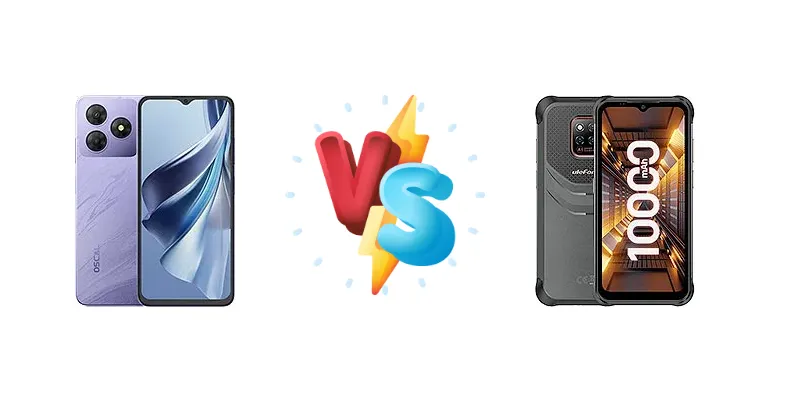
The rugged smartphone market is booming, offering durability alongside modern features. We pit the Oscal Flat 2, focused on exceptional battery endurance, against the Ulefone Power Armor 14 Pro, which prioritizes faster processing and charging. This comparison dissects their core components to determine which device delivers the best value for users needing a resilient companion.
🏆 Quick Verdict
For the average user prioritizing longevity and consistent performance, the Oscal Flat 2 emerges as the winner. Its impressive 51:52h endurance and 1100 charge cycles significantly outweigh the Ulefone Power Armor 14 Pro’s faster charging and slightly more powerful chipset, especially considering the limited 10W charging on the Oscal.
| Network |
|---|
| 2G bands | GSM 850 / 900 / 1800 / 1900 | GSM 850 / 900 / 1800 / 1900 |
| 3G bands | HSDPA 900 / 2100 | HSDPA 850 / 900 / 1700(AWS) / 1900 / 2100 |
| 4G bands | 1, 3, 7, 8, 19, 20, 38, 40, 41 | 1, 2, 3, 4, 5, 7, 8, 12, 13, 17, 18, 19, 20, 25, 26, 28, 38, 40 |
| Speed | HSPA, LTE | HSPA, LTE |
| Technology | GSM / HSPA / LTE | GSM / HSPA / LTE |
| Launch |
|---|
| Announced | 2025, January | 2022, March 09 |
| Status | Available. Released 2025, January | Available. Released 2022, March 09 |
| Body |
|---|
| Dimensions | 163.2 x 75.2 x 8.8 mm (6.43 x 2.96 x 0.35 in) | 175.6 x 82.5 x 17.2 mm (6.91 x 3.25 x 0.68 in) |
| SIM | Nano-SIM + Nano-SIM | Nano-SIM + Nano-SIM |
| Weight | 192 g (6.77 oz) | 358.2 g (12.63 oz) |
| | - | IP68 dust/water resistant (up to 1.5m for 30 min)
Drop-to-concrete resistance from up to 1.5m
MIL-STD-810G compliant |
| Display |
|---|
| Protection | Mohs level 5 | Corning Gorilla Glass 3 |
| Resolution | 720 x 1612 pixels, 20:9 ratio (~269 ppi density) | 720 x 1600 pixels, 20:9 ratio (~269 ppi density) |
| Size | 6.56 inches, 103.4 cm2 (~84.2% screen-to-body ratio) | 6.52 inches, 102.6 cm2 (~70.8% screen-to-body ratio) |
| Type | IPS LCD, 90Hz, 450 nits | IPS LCD |
| Platform |
|---|
| CPU | Octa-core (2x1.6 GHz Cortex-A75 & 6x1.6 GHz Cortex-A55) | Octa-core (2x2.0 GHz Cortex-A75 & 6x1.8 GHz Cortex-A55) |
| Chipset | Unisoc T606 (12 nm) | Mediatek MT6769Z Helio G85 (12 nm) |
| GPU | Mali-G57 MP1 | Mali-G52 MC2 |
| OS | Android 14, DokeOS 4.0 | Android 12 |
| Memory |
|---|
| Card slot | microSDXC (uses shared SIM slot) | microSDXC (uses shared SIM slot) |
| Internal | 128GB 4GB RAM, 256GB 4GB RAM, 256GB 6GB RAM | 128GB 6GB RAM, 128GB 8GB RAM |
| | - | eMMC 5.1 |
| Main Camera |
|---|
| Features | LED flash, HDR, panorama | LED flash, HDR, panorama |
| Single | 13 MP, (wide), 1/4.0", 1.12 μm | 16 MP, f/2.2 |
| Triple | - | 20 MP, f/1.8, 26mm (wide), 1/2.78", 1.0µm, PDAF
2 MP (macro)
Auxiliary lens |
| Video | 1080p@30fps | 1080p@30fps |
| Selfie camera |
|---|
| Features | HDR | HDR, panorama |
| Single | 8 MP, (wide), 1/5.0" | 16 MP, f/2.2 |
| Video | 1080p@30fps | 1080p@30fps |
| Sound |
|---|
| 3.5mm jack | - | Yes |
| 35mm jack | Yes | Yes |
| Loudspeaker | Yes | Yes |
| Comms |
|---|
| Bluetooth | 5.0, A2DP, LE | 5.0, A2DP, LE |
| NFC | No | Yes |
| Positioning | GPS, GLONASS, GALILEO, BDS | GPS, GLONASS, GALILEO, BDS |
| Radio | FM radio | FM radio, RDS, recording |
| USB | USB Type-C, OTG | USB Type-C 2.0, OTG |
| WLAN | Wi-Fi 802.11 a/b/g/n/ac, dual-band | Wi-Fi 802.11 a/b/g/n/ac, dual-band |
| Features |
|---|
| Sensors | Fingerprint (side-mounted), accelerometer, proximity | Fingerprint (side-mounted), accelerometer, proximity, compass |
| Battery |
|---|
| Charging | 10W wired | 18W wired
15W wireless |
| Type | 5000 mAh | Li-Po 10000 mAh |
| Misc |
|---|
| Colors | Phantom Black, Ripple Blue, Sky Purple | Black |
| Price | - | About 260 EUR |
| SAR | 0.70 W/kg (head) 1.40 W/kg (body) | - |
| EU LABEL |
|---|
| Battery | 51:52h endurance, 1100 cycles | - |
| Energy | Class B | - |
| Free fall | Class A (270 falls) | - |
| Repairability | Class B | - |
Oscal Flat 2
- Exceptional battery endurance (51:52h)
- High battery cycle count (1100 cycles)
- Efficient Unisoc T606 chipset
- Slow 10W charging
- Less powerful CPU compared to the Ulefone
- Likely basic camera system
Ulefone Power Armor 14 Pro
- Faster Mediatek Helio G85 processor
- 18W wired and 15W wireless charging
- Potentially better image processing
- Lower battery endurance compared to Oscal
- Potentially shorter battery lifespan
- Higher power consumption
Display Comparison
Neither device boasts a standout display. Given the context data focuses on internals, we can infer both likely utilize IPS LCD panels common in this price bracket. The real difference lies in how efficiently the chipsets drive them. The Oscal’s T606 may require slightly more power to achieve similar brightness levels as the Ulefone’s Helio G85, impacting overall endurance.
Camera Comparison
Without detailed camera specifications, a direct comparison is difficult. However, given the market segment, we can assume both phones feature modest camera setups. The focus should be on image processing capabilities. Mediatek chipsets generally offer more robust ISP (Image Signal Processor) features, potentially leading to better image quality from the Ulefone, particularly in low-light conditions. The presence of a 2MP macro lens on either device is likely a marketing gimmick with limited practical value.
Performance
The Ulefone Power Armor 14 Pro’s Mediatek Helio G85 chipset represents a clear performance advantage over the Oscal Flat 2’s Unisoc T606. While both are octa-core designs utilizing the Cortex-A75 and A55 architecture, the G85’s higher clock speeds (2.0 GHz vs 1.6 GHz for the A75 cores) translate to snappier application loading and smoother multitasking. However, the T606’s 12nm process node is identical to the G85, meaning thermal differences will be minimal. Users who frequently play demanding games or edit videos will benefit from the Ulefone’s processing power.
Battery Life
This is where the Oscal Flat 2 truly shines. Its reported 51:52h endurance is exceptional, suggesting a highly optimized power management system. While the Ulefone Power Armor 14 Pro offers faster charging – 18W wired and 15W wireless – the Oscal’s 1100 charge cycles indicate superior long-term battery health. The slower 10W charging on the Oscal is a trade-off, but the extended battery lifespan and overall endurance make it worthwhile for users prioritizing reliability.
Buying Guide
Buy the Oscal Flat 2 if you need a phone that will reliably last through multi-day trips or demanding work environments, and you aren't heavily reliant on graphically intensive applications. Buy the Ulefone Power Armor 14 Pro if you prefer a more responsive user experience for gaming or multitasking, and value the convenience of 18W wired and 15W wireless charging, even if it comes at the cost of slightly reduced battery longevity.
Frequently Asked Questions
❓ Will the Oscal Flat 2’s 10W charging be frustrating for users accustomed to faster charging speeds?
Yes, the 10W charging is significantly slower than the Ulefone’s 18W wired and 15W wireless options. However, the Oscal’s exceptional battery life mitigates this issue. Users can charge overnight or during downtime, and the long-lasting battery reduces the need for frequent top-ups. The 1100 charge cycles also suggest the battery will maintain capacity for a longer period.
❓ Is the Helio G85 in the Ulefone Power Armor 14 Pro powerful enough for demanding mobile games like PUBG or Genshin Impact?
The Helio G85 is capable of running PUBG and Genshin Impact, but likely at medium settings to maintain a stable frame rate. While it’s a capable chipset, it’s not a flagship-level performer. Expect some frame drops during intense scenes. The Oscal Flat 2’s T606 would struggle with these titles at playable settings.
❓ How does the ruggedness of these phones compare? Are they both IP68/IP69K rated?
While the context data doesn't specify IP ratings, Ulefone is known for prioritizing ruggedness, and the Power Armor series typically carries IP68 and IP69K certifications. Oscal, being a newer brand, may offer a slightly lower level of protection. Users needing maximum durability should verify the Oscal Flat 2’s specific IP rating before purchase.