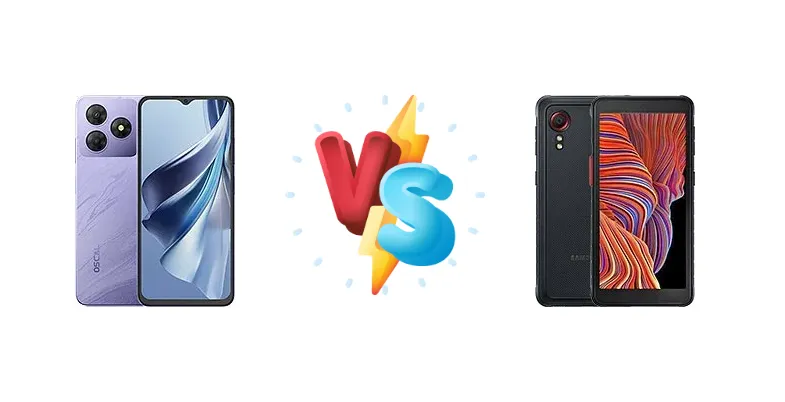
The rugged smartphone market caters to a specific need: durability. Both the Oscal Flat 2 and the Samsung Galaxy XCover 5 aim to deliver on that promise, but they approach it with different philosophies. The Oscal Flat 2 prioritizes exceptional battery life and affordability, while the Samsung XCover 5 leverages Samsung’s brand recognition and a more efficient chipset for a balanced experience. This comparison will dissect their strengths and weaknesses to determine which device best suits your needs.
🏆 Quick Verdict
For users prioritizing maximum battery life and value, the Oscal Flat 2 is the clear winner. Its 51:52h endurance significantly outpaces what the XCover 5 can likely achieve. However, the Samsung Galaxy XCover 5 offers a more refined experience with its 8nm Exynos 850 chipset and Samsung’s software ecosystem, making it ideal for users invested in the Samsung ecosystem.
| Network |
|---|
| 2G bands | GSM 850 / 900 / 1800 / 1900 | GSM 850 / 900 / 1800 / 1900 |
| 3G bands | HSDPA 900 / 2100 | HSDPA 850 / 900 / 1700(AWS) / 1900 / 2100 |
| 4G bands | 1, 3, 7, 8, 19, 20, 38, 40, 41 | 1, 2, 3, 4, 5, 7, 8, 12, 17, 20, 26, 28, 38, 40, 41, 66 |
| Speed | HSPA, LTE | HSPA, LTE |
| Technology | GSM / HSPA / LTE | GSM / HSPA / LTE |
| Launch |
|---|
| Announced | 2025, January | 2021, March 04 |
| Status | Available. Released 2025, January | Available. Released 2021, March 12 |
| Body |
|---|
| Dimensions | 163.2 x 75.2 x 8.8 mm (6.43 x 2.96 x 0.35 in) | 147.1 x 71.6 x 9.2 mm (5.79 x 2.82 x 0.36 in) |
| SIM | Nano-SIM + Nano-SIM | · Nano-SIM· Nano-SIM + Nano-SIM |
| Weight | 192 g (6.77 oz) | 172 g (6.07 oz) |
| | - | IP68 dust/water resistant (up to 1.5m for 30 min)
MIL-STD-810H compliant |
| Display |
|---|
| Protection | Mohs level 5 | - |
| Resolution | 720 x 1612 pixels, 20:9 ratio (~269 ppi density) | 720 x 1480 pixels, 18.5:9 ratio (~311 ppi density) |
| Size | 6.56 inches, 103.4 cm2 (~84.2% screen-to-body ratio) | 5.3 inches, 71.3 cm2 (~67.7% screen-to-body ratio) |
| Type | IPS LCD, 90Hz, 450 nits | PLS LCD |
| Platform |
|---|
| CPU | Octa-core (2x1.6 GHz Cortex-A75 & 6x1.6 GHz Cortex-A55) | Octa-core (4x2.0 GHz Cortex-A55 & 4x2.0 GHz Cortex-A55) |
| Chipset | Unisoc T606 (12 nm) | Exynos 850 (8 nm) |
| GPU | Mali-G57 MP1 | Mali-G52 |
| OS | Android 14, DokeOS 4.0 | Android 11, upgradable to Android 14, One UI 6.1 |
| Memory |
|---|
| Card slot | microSDXC (uses shared SIM slot) | microSDXC (dedicated slot) |
| Internal | 128GB 4GB RAM, 256GB 4GB RAM, 256GB 6GB RAM | 64GB 4GB RAM |
| | - | eMMC 5.1 |
| Main Camera |
|---|
| Features | LED flash, HDR, panorama | Dual LED flash, HDR, panorama |
| Single | 13 MP, (wide), 1/4.0", 1.12 μm | 16 MP, f/1.8, PDAF |
| Video | 1080p@30fps | 1080p@30fps |
| Selfie camera |
|---|
| Features | HDR | - |
| Single | 8 MP, (wide), 1/5.0" | 5 MP, f/2.2 |
| Video | 1080p@30fps | - |
| Sound |
|---|
| 3.5mm jack | - | Yes |
| 35mm jack | Yes | Yes |
| Loudspeaker | Yes | Yes |
| Comms |
|---|
| Bluetooth | 5.0, A2DP, LE | 5.0, A2DP, LE |
| NFC | No | Yes |
| Positioning | GPS, GLONASS, GALILEO, BDS | GPS, GLONASS, GALILEO, BDS |
| Radio | FM radio | Unspecified |
| USB | USB Type-C, OTG | USB Type-C 2.0, charging connector pins |
| WLAN | Wi-Fi 802.11 a/b/g/n/ac, dual-band | Wi-Fi 802.11 a/b/g/n/ac, dual-band, Wi-Fi Direct |
| Features |
|---|
| Sensors | Fingerprint (side-mounted), accelerometer, proximity | Accelerometer, gyro, proximity, compass |
| Battery |
|---|
| Charging | 10W wired | 15W wired |
| Type | 5000 mAh | Li-Ion 3000 mAh, removable |
| Misc |
|---|
| Colors | Phantom Black, Ripple Blue, Sky Purple | Black |
| Models | - | SM-G525F, SM-G525F/DS, SM-G525N |
| Price | - | £ 61.49 / € 74.89 |
| SAR | 0.70 W/kg (head) 1.40 W/kg (body) | - |
| SAR EU | - | 0.70 W/kg (head) 1.27 W/kg (body) |
| EU LABEL |
|---|
| Battery | 51:52h endurance, 1100 cycles | - |
| Energy | Class B | - |
| Free fall | Class A (270 falls) | - |
| Repairability | Class B | - |
Oscal Flat 2
- Exceptional battery life (51:52h endurance)
- Highly affordable price point
- Durable build quality (expected for the segment)
- Less efficient chipset (Unisoc T606)
- Slower charging speed (10W)
- Potentially less refined software experience
Samsung Galaxy XCover 5
- More efficient chipset (Exynos 850)
- Faster charging (15W)
- Samsung’s software ecosystem and support
- Shorter battery life compared to Oscal Flat 2
- Higher price point
- May not offer significantly better performance for everyday tasks
Display Comparison
Neither device boasts a cutting-edge display. Details on panel type and resolution are missing for the Oscal Flat 2, but given its price point, it’s likely a standard LCD. The Samsung XCover 5 also utilizes an LCD, focusing on visibility in direct sunlight rather than color accuracy. The key difference lies in processing power; the Exynos 850’s image signal processor (ISP) will likely deliver slightly better image quality from the camera, even if the panels themselves are comparable. Bezels are expected to be substantial on both, prioritizing screen protection over a modern, edge-to-edge design.
Camera Comparison
Without detailed camera specs, a direct comparison is difficult. However, the Exynos 850’s ISP provides a processing advantage for the XCover 5. It’s reasonable to assume the XCover 5 will deliver more consistent image quality, particularly in challenging lighting conditions. The Oscal Flat 2 will likely rely more heavily on software processing, which may introduce artifacts. The presence of a 2MP macro camera on either device is largely a marketing gimmick; image quality will be limited. Focus should be on the main sensor performance, which remains unspecified for both.
Performance
The chipset is where a significant difference emerges. The Samsung Galaxy XCover 5’s Exynos 850, fabricated on an 8nm process, offers a clear advantage in efficiency over the Oscal Flat 2’s Unisoc T606 (12nm). While both are octa-core CPUs, the Exynos 850’s architecture – 4x2.0 GHz Cortex-A55 and 4x2.0 GHz Cortex-A55 – is more balanced than the Oscal’s 2x1.6 GHz Cortex-A75 & 6x1.6 GHz Cortex-A55. The Cortex-A75 cores in the Oscal offer a performance boost for single-threaded tasks, but the Exynos 850’s overall efficiency will translate to better sustained performance and less heat generation during prolonged use. The XCover 5 will likely handle multitasking and demanding apps more smoothly.
Battery Life
The Oscal Flat 2’s standout feature is its exceptional battery endurance – a tested 51:52h. This is a significant achievement, likely due to the less power-hungry Unisoc T606 chipset and optimized software. The Samsung Galaxy XCover 5, while offering a respectable battery life, will likely fall short of this mark. The XCover 5 compensates with 15W wired charging, slightly faster than the Oscal’s 10W, reducing 0-100% charge times. However, the Oscal’s longevity means you’ll need to charge it less frequently, mitigating the slower charging speed.
Buying Guide
Buy the Oscal Flat 2 if you need a phone that can genuinely last for days on a single charge, and if budget is a primary concern. It’s perfect for extended outdoor adventures, remote work where charging isn’t readily available, or as a reliable backup device. Buy the Samsung Galaxy XCover 5 if you prefer a more polished user experience, benefit from Samsung’s software features and ecosystem integration, and require a phone that balances durability with everyday usability and slightly faster performance.
Frequently Asked Questions
❓ Does the Unisoc T606 chipset in the Oscal Flat 2 struggle with demanding games like PUBG?
The Unisoc T606 is a capable chipset for everyday tasks, but it's not designed for high-end gaming. While PUBG may be playable at lower settings, expect frame drops and potential lag, especially during intense firefights. The Exynos 850 in the XCover 5 will offer a smoother gaming experience, though still not ideal for maximum settings.
❓ Is the 10W charging on the Oscal Flat 2 a significant drawback considering its large battery?
While 10W is slower than the XCover 5’s 15W, the Oscal Flat 2’s exceptional battery life mitigates this issue. You’ll simply need to charge it less often. Overnight charging is perfectly viable, and the extended battery life means you won’t be constantly searching for an outlet.
❓ How does the software experience differ between the Oscal Flat 2 and the Samsung Galaxy XCover 5?
The Samsung Galaxy XCover 5 benefits from Samsung’s One UI, offering a polished and feature-rich experience with regular software updates. The Oscal Flat 2 likely runs a more basic version of Android, potentially with less frequent updates and a less refined user interface. This is a key consideration for users who value software support and features.
❓ What level of water and dust resistance can I expect from each device?
The Samsung Galaxy XCover 5 is IP68 rated, offering robust protection against dust and water immersion. The Oscal Flat 2's ruggedness certification is not specified, but it is marketed as a rugged phone, suggesting a degree of protection, though likely not to the same standard as the XCover 5. Check Oscal's official documentation for specific details.