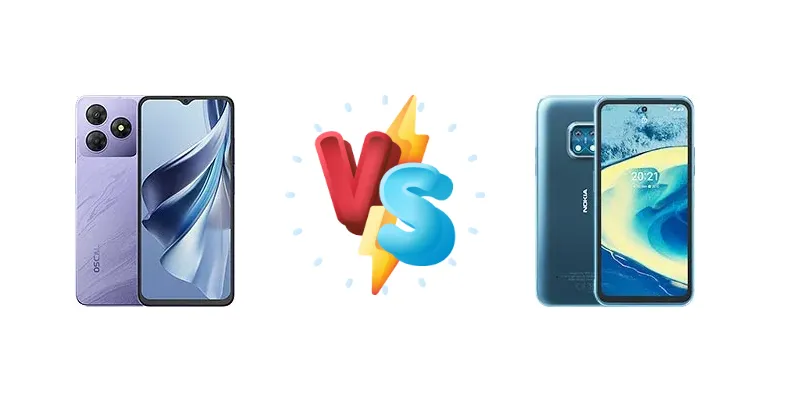
The rugged smartphone market caters to users needing durability, but often at the expense of performance or battery life. The Oscal Flat 2 and Nokia XR20 represent distinct approaches: the Oscal focuses on maximizing uptime with a massive battery and efficient chipset, while the Nokia XR20 prioritizes 5G connectivity and faster charging, leveraging Qualcomm's Snapdragon platform. This comparison dissects these choices to determine which phone best suits your needs.
🏆 Quick Verdict
For users prioritizing exceptional battery life and value, the Oscal Flat 2 is the clear winner. Its 51:52h endurance significantly outpaces the Nokia XR20, making it ideal for extended outdoor use. However, if 5G connectivity and faster charging are essential, the Nokia XR20 offers a compelling alternative.
| Network |
|---|
| 2G bands | GSM 850 / 900 / 1800 / 1900 | GSM 850 / 900 / 1800 / 1900 |
| 3G bands | HSDPA 900 / 2100 | HSDPA 850 / 900 / 1700(AWS) / 1900 / 2100 |
| 4G bands | 1, 3, 7, 8, 19, 20, 38, 40, 41 | 1, 2, 3, 4, 5, 7, 8, 12, 13, 14, 20, 25, 26, 28, 30, 38, 40, 41, 48, 66, 71 |
| 5G bands | - | 2, 5, 25, 38, 41, 48, 66, 77, 78 SA/NSA |
| Speed | HSPA, LTE | HSPA, LTE, 5G |
| Technology | GSM / HSPA / LTE | GSM / CDMA / HSPA / EVDO / LTE / 5G |
| | - | CDMA2000 1xEV-DO |
| Launch |
|---|
| Announced | 2025, January | 2021, July 27 |
| Status | Available. Released 2025, January | Available. Released 2021, August 04 |
| Body |
|---|
| Dimensions | 163.2 x 75.2 x 8.8 mm (6.43 x 2.96 x 0.35 in) | 171.6 x 81.5 x 10.6 mm (6.76 x 3.21 x 0.42 in) |
| SIM | Nano-SIM + Nano-SIM | · Nano-SIM· Nano-SIM + Nano-SIM |
| Weight | 192 g (6.77 oz) | 248 g (8.75 oz) |
| | - | IP68 dust/water resistant (up to 1.5m for 60 min)
Drop-to-concrete resistance from up to 1.8m
MIL-STD-810H compliant |
| Display |
|---|
| Protection | Mohs level 5 | Corning Gorilla Glass Victus |
| Resolution | 720 x 1612 pixels, 20:9 ratio (~269 ppi density) | 1080 x 2400 pixels, 20:9 ratio (~395 ppi density) |
| Size | 6.56 inches, 103.4 cm2 (~84.2% screen-to-body ratio) | 6.67 inches, 107.4 cm2 (~76.8% screen-to-body ratio) |
| Type | IPS LCD, 90Hz, 450 nits | IPS LCD, 550 nits |
| Platform |
|---|
| CPU | Octa-core (2x1.6 GHz Cortex-A75 & 6x1.6 GHz Cortex-A55) | Octa-core (2x2.0 GHz Kryo 460 & 6x1.8 GHz Kryo 460) |
| Chipset | Unisoc T606 (12 nm) | Qualcomm SM4350 Snapdragon 480 5G (8 nm) |
| GPU | Mali-G57 MP1 | Adreno 619 |
| OS | Android 14, DokeOS 4.0 | Android 11, upgradable to Android 13 |
| Memory |
|---|
| Card slot | microSDXC (uses shared SIM slot) | microSDXC (uses shared SIM slot) |
| Internal | 128GB 4GB RAM, 256GB 4GB RAM, 256GB 6GB RAM | 64GB 4GB RAM, 128GB 6GB RAM |
| Main Camera |
|---|
| Dual | - | 48 MP, f/1.8, (wide), 1/2.25", 0.8µm, PDAF
13 MP, f/2.4, 123˚ (ultrawide), 1/3.0", 1.12µm |
| Features | LED flash, HDR, panorama | Zeiss optics, Dual-LED dual-tone flash, second LED flash, HDR, panorama |
| Single | 13 MP, (wide), 1/4.0", 1.12 μm | 8 MP, f/2.0 (wide), 1/4.0", 1.12µm |
| Video | 1080p@30fps | 1080p@30fps |
| Selfie camera |
|---|
| Features | HDR | - |
| Single | 8 MP, (wide), 1/5.0" | 8 MP, f/2.0 (wide), 1/4.0", 1.12µm |
| Video | 1080p@30fps | 1080p@30fps |
| Sound |
|---|
| 3.5mm jack | - | Yes |
| 35mm jack | Yes | Yes |
| Loudspeaker | Yes | Yes, with stereo speakers |
| Comms |
|---|
| Bluetooth | 5.0, A2DP, LE | 5.1, A2DP, LE, aptX Adaptive |
| NFC | No | Yes |
| Positioning | GPS, GLONASS, GALILEO, BDS | GPS (L1+L5), GLONASS, BDS, GALILEO, QZSS, NavIC |
| Radio | FM radio | Unspecified |
| USB | USB Type-C, OTG | USB Type-C 3.0 |
| WLAN | Wi-Fi 802.11 a/b/g/n/ac, dual-band | Wi-Fi 802.11 a/b/g/n/ac/6, dual-band, Wi-Fi Direct |
| Features |
|---|
| Sensors | Fingerprint (side-mounted), accelerometer, proximity | Fingerprint (side-mounted), accelerometer, gyro, proximity, compass, barometer |
| Battery |
|---|
| Charging | 10W wired | 18W wired
15W wireless |
| Type | 5000 mAh | Li-Po 4630 mAh |
| Misc |
|---|
| Colors | Phantom Black, Ripple Blue, Sky Purple | Ultra Blue, Granite Gray |
| Models | - | TA-1368, TA-1362 |
| Price | - | About 270 EUR |
| SAR | 0.70 W/kg (head) 1.40 W/kg (body) | - |
| SAR EU | - | 1.13 W/kg (head) 1.43 W/kg (body) |
| EU LABEL |
|---|
| Battery | 51:52h endurance, 1100 cycles | - |
| Energy | Class B | - |
| Free fall | Class A (270 falls) | - |
| Repairability | Class B | - |
Oscal Flat 2
- Exceptional battery life (51:52h endurance)
- High battery cycle count (1100 cycles)
- Excellent value for money
- Slower charging speed (10W)
- Less powerful processor compared to the XR20
- Limited 5G connectivity
Nokia XR20
- 5G connectivity for faster data speeds
- Faster charging (18W wired, 15W wireless)
- More powerful processor (Snapdragon 480)
- Shorter battery life compared to the Oscal Flat 2
- Potentially higher price point
- Battery cycle count not specified
Display Comparison
Neither device's display specifications are provided, so a direct comparison is limited. However, given the Oscal Flat 2's focus on endurance, it likely utilizes a power-efficient panel. The Nokia XR20, benefiting from a more modern chipset, may have a slightly brighter display and potentially better color accuracy. The absence of details like refresh rate or resolution makes a definitive statement impossible, but the XR20's chipset suggests a more capable display subsystem.
Camera Comparison
Without detailed camera specifications, a comprehensive comparison is challenging. However, the Nokia XR20, typically associated with a more refined image processing pipeline, likely delivers more consistent and visually appealing photos. The absence of sensor size or aperture information prevents a detailed analysis, but Qualcomm's image signal processor (ISP) within the Snapdragon 480 generally offers superior noise reduction and dynamic range compared to Unisoc's offerings. It's reasonable to assume the XR20 will perform better in low-light conditions. We can expect both phones to include basic camera functionality, but the XR20 likely offers a more polished experience.
Performance
The Nokia XR20's Qualcomm Snapdragon 480 5G (8nm) holds a clear architectural advantage over the Oscal Flat 2's Unisoc T606 (12nm). The 8nm process node allows for greater transistor density and improved power efficiency, translating to better sustained performance and potentially lower thermal throttling. While both CPUs feature an octa-core configuration, the Snapdragon 480's Kryo 460 cores operate at a higher clock speed (2.0 GHz vs 1.6 GHz), indicating superior single-core performance. This difference will be noticeable in demanding applications and multitasking scenarios. The Unisoc T606 prioritizes efficiency, contributing to the Oscal's impressive battery life, but at the cost of raw processing power.
Battery Life
The Oscal Flat 2's standout feature is its exceptional battery endurance of 51:52h. This is significantly longer than what is typically achieved by smartphones in this price range. While the Nokia XR20's battery capacity isn't specified, its 18W wired and 15W wireless charging capabilities offer greater convenience. The Oscal Flat 2 is limited to 10W wired charging, meaning a full charge will take considerably longer. The trade-off is clear: the Oscal prioritizes longevity, while the Nokia prioritizes charging speed. The Oscal Flat 2 also boasts 1100 charge cycles, suggesting a longer lifespan before significant battery degradation.
Buying Guide
Buy the Oscal Flat 2 if you need a phone that can reliably last for days on a single charge, and 5G isn't a priority. This is the phone for outdoor workers, travelers, or anyone who frequently finds themselves away from power outlets. Buy the Nokia XR20 if you require 5G connectivity for faster data speeds, appreciate the convenience of 18W wired and 15W wireless charging, and value a more mainstream brand reputation.
Frequently Asked Questions
❓ How much faster is the Nokia XR20's charging compared to the Oscal Flat 2?
The Nokia XR20 supports 18W wired and 15W wireless charging, while the Oscal Flat 2 is limited to 10W wired charging. This means the XR20 will significantly reduce charging times, potentially taking half the time to reach a full charge, depending on battery capacity.
❓ Will the Unisoc T606 in the Oscal Flat 2 struggle with demanding games?
The Unisoc T606 is a capable processor for everyday tasks, but it will likely struggle with graphically intensive games at higher settings. Expect to lower graphics settings and potentially experience frame drops in demanding titles. The Nokia XR20's Snapdragon 480 offers a more robust gaming experience.
❓ Is the lack of 5G on the Oscal Flat 2 a significant drawback?
Whether the lack of 5G is a drawback depends on your location and data needs. If you live in an area with widespread 5G coverage and frequently download large files or stream high-resolution video, the XR20's 5G connectivity will be beneficial. However, if 5G isn't available or you primarily use Wi-Fi, the Oscal Flat 2's lack of 5G won't be a major issue.
❓ How does the 1100 charge cycle rating of the Oscal Flat 2 impact its long-term usability?
The 1100 charge cycle rating suggests the Oscal Flat 2's battery will maintain a significant portion of its original capacity after undergoing 1100 full charge-discharge cycles. This indicates a longer lifespan and reduced battery degradation compared to phones with lower cycle ratings, offering greater long-term value.