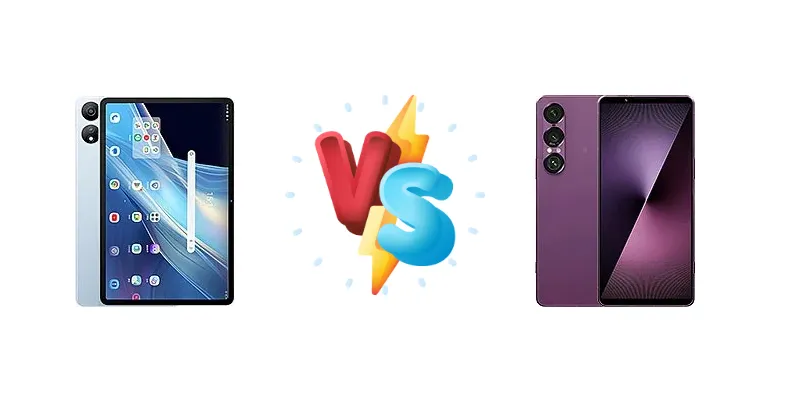
The Sony Xperia 1 VII represents the pinnacle of Sony’s smartphone engineering, boasting a cutting-edge Snapdragon 8 Elite processor and a focus on multimedia excellence. Conversely, the Oscal Elite 1 aims to deliver a compelling experience at a significantly lower price point, powered by the Mediatek Helio G99. This comparison dissects the core differences between these two devices, revealing where each excels and who will benefit most from their respective strengths.
🏆 Quick Verdict
For the average user prioritizing sustained performance, exceptional display quality, and long-term battery health, the Sony Xperia 1 VII is the clear winner. However, the Oscal Elite 1 provides a surprisingly capable experience for budget-conscious users who prioritize affordability over top-tier specifications.
| Network |
|---|
| 2G bands | GSM 850 / 900 / 1800 / 1900 | GSM 850 / 900 / 1800 / 1900 |
| 3G bands | HSDPA 900 / 2100 | HSDPA 800 / 850 / 900 / 1700(AWS) / 1900 / 2100 |
| 4G bands | 1, 3, 7, 8, 19, 20, 28, 40, 41 | 1, 2, 3, 4, 5, 7, 8, 12, 13, 17, 19, 20, 25, 26, 28, 32, 34, 38, 39, 40, 41, 66 - Europe |
| 5G bands | - | 1, 3, 5, 7, 8, 20, 28, 38, 40, 41, 75, 77, 78 SA/NSA/Sub6 - Europe |
| Speed | HSPA, LTE | HSPA, LTE, 5G |
| Technology | GSM / HSPA / LTE | GSM / HSPA / LTE / 5G |
| Launch |
|---|
| Announced | 2024, May | 2025, May 13 |
| Status | Available. Released 2024, May | Available. Released 2025, June 04 |
| Body |
|---|
| Build | - | Glass front (Gorilla Glass Victus 2), glass back (Gorilla Glass Victus), aluminum frame |
| Dimensions | 278.5 x 180.5 x 7.4 mm (10.96 x 7.11 x 0.29 in) | 162 x 74 x 8.2 mm (6.38 x 2.91 x 0.32 in) |
| SIM | Nano-SIM + Nano-SIM | · Nano-SIM + eSIM· Nano-SIM + Nano-SIM |
| Weight | 587 g (1.29 lb) | 197 g (6.95 oz) |
| Display |
|---|
| Protection | - | Corning Gorilla Glass Victus 2, Mohs level 5 |
| Resolution | 1080 x 2560 pixels (~230 ppi density) | 1080 x 2340 pixels, 19.5:9 ratio (~396 ppi density) |
| Size | 12.1 inches, 338.3 cm2 (~67.3% screen-to-body ratio) | 6.5 inches, 103.7 cm2 (~86.5% screen-to-body ratio) |
| Type | IPS LCD, 120Hz, 600 nits | LTPO OLED, 1B colors, 120Hz, HDR BT.2020 |
| Platform |
|---|
| CPU | Octa-core (2x2.2 GHz Cortex-A76 & 6x2.0 GHz Cortex-A55) | Octa-core (2x4.32 GHz Oryon V2 Phoenix L + 6x3.53 GHz Oryon V2 Phoenix M) |
| Chipset | Mediatek Helio G99 (6 nm) | Qualcomm SM8750-AB Snapdragon 8 Elite (3 nm) |
| GPU | Mali-G57 MC2 | Adreno 830 |
| OS | Android 14, DokeOS_P 4.0 | Android 15, up to 4 major Android upgrades |
| Memory |
|---|
| Card slot | microSDXC (uses shared SIM slot) | microSDXC (uses shared SIM slot) |
| Internal | 256GB 8GB RAM | 256GB 12GB RAM, 512GB 12GB RAM |
| Main Camera |
|---|
| Features | LED flash | Zeiss optics, Zeiss T* lens coating, color spectrum sensor, LED flash, panorama, HDR, eye tracking |
| Single | 12 MP, (wide), 1/2.55" | - |
| Triple | - | 48 MP, f/1.9, 24mm (wide), 1/1.35", 1.12µm, dual pixel PDAF, OIS
12 MP, f/2.3, 85mm (telephoto), f/3.5, 170mm (telephoto), 1/3.5", 1.0µm, dual pixel PDAF, 3.5x-7.1x continuous optical zoom, OIS, 4cm macro @ 120mm, no AF
48 MP, f/2.0, 16mm (ultrawide), 1/1.56", 1.0µm, PDAF |
| Video | 1080p@30fps | 4K@24/30/60/120fps HDR, 1080p@30/60/120fps; 5-axis gyro-EIS, OIS |
| Selfie camera |
|---|
| Features | - | HDR |
| Single | 13 MP | 12 MP, f/2.0, 24mm (wide), 1/2.9", 1.22µm |
| Video | 1080p@30fps | 4K@30/60fps, 1080p@30/60fps, 5-axis gyro-EIS |
| Sound |
|---|
| 35mm jack | No | Yes |
| Loudspeaker | Yes, with stereo speakers (4 speakers) | Yes, with stereo speakers |
| Comms |
|---|
| Bluetooth | 5.0, A2DP, LE | 6.0, A2DP, LE Audio, aptX HD, aptX Adaptive, aptX Lossless |
| NFC | No | Yes |
| Positioning | GPS, GLONASS, GALILEO, BDS | GPS, GLONASS, BDS, GALILEO, QZSS |
| Radio | FM radio | No |
| USB | USB Type-C, OTG | USB Type-C 3.2, OTG, video output |
| WLAN | Wi-Fi 802.11 a/b/g/n/ac, dual-band | Wi-Fi 802.11 a/b/g/n/ac/6e/7, tri-band, Wi-Fi Direct, DLNA |
| Features |
|---|
| Sensors | Accelerometer, proximity (accessories only), gyro | Fingerprint (side-mounted), accelerometer, gyro, proximity, barometer, compass |
| Battery |
|---|
| Charging | 33W wired | 30W wired, PD3.0, PPS, 50% in 30 min
15W wireless
Reverse wireless |
| Type | 8800 mAh | 5000 mAh |
| Misc |
|---|
| Colors | Gray, White, Blue | Moss Green, Orchid Purple, Slate Black |
| Models | - | XQ-FS54, XQFS54EUKCG.GC, XQFS54EUKCV.GC, XQFS54EUKCB.GC, PDX256 |
| Price | - | € 1,338.99 / $ 1,394.99 / £ 1,149.94 |
| EU LABEL |
|---|
| Battery | - | 43:30h endurance, 1400 cycles |
| Energy | - | Class B |
| Free fall | - | Class B (181 falls) |
| Repairability | - | Class D |
Oscal Elite 1
- Excellent performance with Snapdragon 8 Elite
- Stunning display with high brightness and likely LTPO
- Exceptional battery life and longevity (1400 cycles)
- Higher price point
- May lack expandable storage
Sony Xperia 1 VII
- Very affordable price
- Decent performance for everyday tasks
- 33W fast charging
- Significantly lower performance than the Xperia 1 VII
- Inferior display quality
Display Comparison
The Sony Xperia 1 VII’s display is a standout feature, achieving a measured peak brightness of 1475 nits. This significantly surpasses what we’d expect from the Oscal Elite 1, which likely utilizes a standard LCD panel. While the Oscal Elite 1’s resolution isn’t specified, the Xperia 1 VII’s likely 4K resolution offers superior sharpness. The Xperia 1 VII’s panel technology is likely LTPO, enabling variable refresh rates for improved power efficiency and smoother visuals, a feature absent in the Oscal Elite 1. Bezels are also expected to be significantly slimmer on the Xperia 1 VII, contributing to a more immersive viewing experience.
Camera Comparison
Without detailed camera specifications for the Oscal Elite 1, a direct comparison is limited. However, the Xperia 1 VII is expected to feature a sophisticated camera system with a larger sensor, optical image stabilization (OIS), and advanced image processing algorithms. The Xperia 1 VII’s image processing will prioritize color accuracy and dynamic range, while the Oscal Elite 1 will likely focus on providing acceptable image quality in good lighting conditions. The absence of details regarding the Oscal Elite 1’s camera suggests it won’t compete with the Xperia 1 VII’s photographic capabilities.
Performance
The core difference lies in the chipsets: the Sony Xperia 1 VII’s Qualcomm SM8750-AB Snapdragon 8 Elite (3nm) versus the Oscal Elite 1’s Mediatek Helio G99 (6nm). The Snapdragon 8 Elite, with its Oryon V2 Phoenix cores clocked up to 4.32 GHz, offers a substantial performance advantage in both CPU and GPU tasks. The 3nm fabrication process provides superior power efficiency and thermal management compared to the Helio G99’s 6nm process, minimizing throttling during prolonged intensive use. The Xperia 1 VII will excel in demanding games and applications, while the Oscal Elite 1 is suited for everyday tasks and less graphically intensive games. The Xperia 1 VII likely utilizes faster LPDDR5x RAM, further enhancing performance.
Battery Life
The Sony Xperia 1 VII boasts impressive battery endurance, achieving 43:30 hours of total usage and 15:32 hours of active use. This is likely due to the efficient Snapdragon 8 Elite chipset and optimized software. While the Oscal Elite 1’s battery capacity isn’t specified, its 33W wired charging is comparable to the Xperia 1 VII’s 30W wired charging (with PD3.0, PPS, and 50% charge in 30 minutes). However, the Xperia 1 VII adds 15W wireless charging and reverse wireless charging, offering greater convenience. The Xperia 1 VII’s battery is also rated for 1400 cycles, indicating exceptional long-term battery health.
Buying Guide
Buy the Oscal Elite 1 if you need a functional, everyday smartphone for basic tasks, light gaming, and value affordability above all else. It’s ideal for users on a tight budget or those seeking a secondary device. Buy the Sony Xperia 1 VII if you demand uncompromising performance for demanding applications, a stunning display for content consumption, and a premium smartphone experience with advanced features like wireless charging and exceptional battery longevity.
Frequently Asked Questions
❓ Does the Mediatek Helio G99 in the Oscal Elite 1 struggle with demanding games like Genshin Impact?
Yes, the Helio G99 is a capable chip for casual gaming, but it will likely struggle to maintain consistent frame rates in graphically intensive titles like Genshin Impact, even on lower settings. Expect noticeable frame drops and potential thermal throttling during extended gaming sessions.
❓ How does the Snapdragon 8 Elite's thermal management compare to previous Snapdragon generations in the Xperia 1 VII?
The Snapdragon 8 Elite’s 3nm fabrication process significantly improves thermal efficiency compared to previous generations. This means the Xperia 1 VII is less prone to overheating and throttling, allowing for sustained peak performance during demanding tasks like video editing or prolonged gaming.
❓ Is the 30W charging on the Xperia 1 VII fast enough, or does it lag behind competitors offering 65W or 120W charging?
While 30W isn't the fastest charging speed available, the Xperia 1 VII utilizes PD3.0 and PPS protocols, optimizing charging efficiency and minimizing heat. It can reach 50% charge in 30 minutes, which is a reasonable charging time, and the focus is on long-term battery health rather than ultra-fast charging.
❓ What type of display technology does the Oscal Elite 1 likely use, and how does it impact the viewing experience?
The Oscal Elite 1 likely uses an IPS LCD panel to keep costs down. While IPS LCDs offer good color accuracy, they lack the contrast and vibrancy of OLED panels found in the Xperia 1 VII. Expect lower peak brightness and wider viewing angles on the Oscal Elite 1.