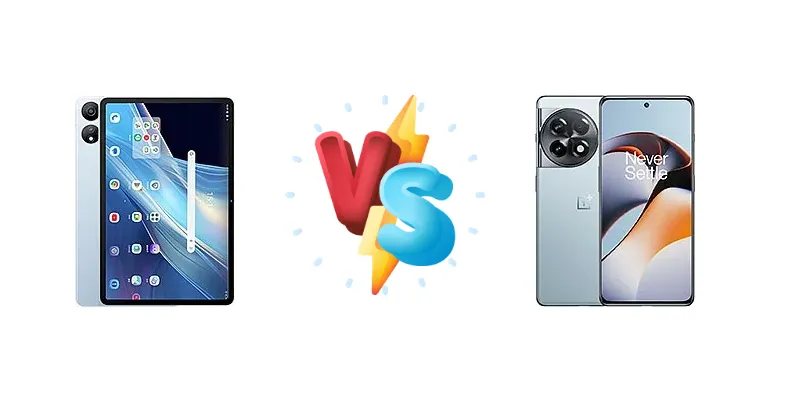
The smartphone landscape is increasingly competitive, with options spanning a wide range of price points. We're pitting the Oscal Elite 1, a budget-focused device leveraging MediaTek's Helio G99, against the OnePlus 11R, a former flagship now offering premium specs at a more accessible price thanks to the Snapdragon 8+ Gen 1. This comparison aims to determine which phone delivers the best balance of performance, features, and value for your money.
🏆 Quick Verdict
For the average user prioritizing raw performance and fast charging, the OnePlus 11R is the clear winner. Its Snapdragon 8+ Gen 1 chipset offers a substantial leap in processing power and gaming capabilities. However, the Oscal Elite 1 presents a compelling value proposition for those seeking efficient performance for everyday tasks and longer battery life on a tighter budget.
| Network |
|---|
| 2G bands | GSM 850 / 900 / 1800 / 1900 | GSM 850 / 900 / 1800 / 1900 |
| 3G bands | HSDPA 900 / 2100 | HSDPA 850 / 900 / 1700(AWS) / 2100 |
| 4G bands | 1, 3, 7, 8, 19, 20, 28, 40, 41 | 1, 3, 4, 5, 8, 28, 34, 38, 39, 40, 41 |
| 5G bands | - | 1, 3, 5, 8, 28, 40, 41, 77, 78 SA/NSA |
| Speed | HSPA, LTE | HSPA, LTE (3CA), 5G |
| Technology | GSM / HSPA / LTE | GSM / CDMA / HSPA / LTE / 5G |
| | - | CDMA 800 |
| Launch |
|---|
| Announced | 2024, May | 2023, February 07 |
| Status | Available. Released 2024, May | Available. Released 2023, February 21 |
| Body |
|---|
| Build | - | Glass front, glass back (Gorilla Glass 5), plastic frame |
| Dimensions | 278.5 x 180.5 x 7.4 mm (10.96 x 7.11 x 0.29 in) | 163.4 x 74.3 x 8.7 mm (6.43 x 2.93 x 0.34 in) |
| SIM | Nano-SIM + Nano-SIM | Nano-SIM + Nano-SIM |
| Weight | 587 g (1.29 lb) | 204 g (7.20 oz) |
| Display |
|---|
| Resolution | 1080 x 2560 pixels (~230 ppi density) | 1240 x 2772 pixels, 20:9 ratio (~451 ppi density) |
| Size | 12.1 inches, 338.3 cm2 (~67.3% screen-to-body ratio) | 6.74 inches, 109.2 cm2 (~90.0% screen-to-body ratio) |
| Type | IPS LCD, 120Hz, 600 nits | Fluid AMOLED, 1B colors, 120Hz, HDR10+, 1450 nits (peak) |
| Platform |
|---|
| CPU | Octa-core (2x2.2 GHz Cortex-A76 & 6x2.0 GHz Cortex-A55) | Octa-core (1x3.0 GHz Cortex-X2 & 3x2.5 GHz Cortex-A710 & 4x1.80 GHz Cortex-A510) |
| Chipset | Mediatek Helio G99 (6 nm) | Qualcomm SM8475 Snapdragon 8+ Gen 1 (4 nm) |
| GPU | Mali-G57 MC2 | Adreno 730 |
| OS | Android 14, DokeOS_P 4.0 | Android 13, upgradable to Android 15, OxygenOS 15 |
| Memory |
|---|
| Card slot | microSDXC (uses shared SIM slot) | No |
| Internal | 256GB 8GB RAM | 128GB 8GB RAM, 256GB 16GB RAM, 512GB 18GB RAM |
| | - | UFS 3.1 |
| Main Camera |
|---|
| Features | LED flash | Color spectrum sensor, LED flash, HDR, panorama |
| Single | 12 MP, (wide), 1/2.55" | 16 MP, f/2.4, 24mm (wide), 1/3.09", 1.0µm |
| Triple | - | 50 MP, f/1.8, 24mm (wide), 1/1.56", 1.0µm, multi-directional PDAF, OIS
8 MP, f/2.2, 120˚ (ultrawide), 1/4.0", 1.12µm
2 MP (macro) |
| Video | 1080p@30fps | 4K@30/60fps, 1080p@30/60/240fps, gyro-EIS |
| Selfie camera |
|---|
| Features | - | HDR |
| Single | 13 MP | 16 MP, f/2.4, 24mm (wide), 1/3.09", 1.0µm |
| Video | 1080p@30fps | 1080p@30fps |
| Sound |
|---|
| 3.5mm jack | - | No |
| 35mm jack | No | No |
| Loudspeaker | Yes, with stereo speakers (4 speakers) | Yes, with stereo speakers |
| | - | 24-bit/192kHz audio |
| Comms |
|---|
| Bluetooth | 5.0, A2DP, LE | 5.3, A2DP, LE, aptX HD |
| Infrared port | - | Yes |
| NFC | No | Yes |
| Positioning | GPS, GLONASS, GALILEO, BDS | GPS (L1+L5), GLONASS (G1), BDS (B1I+B1c+B2a), GALILEO (E1+E5a), QZSS (L1+L5) |
| Radio | FM radio | No |
| USB | USB Type-C, OTG | USB Type-C 2.0 |
| WLAN | Wi-Fi 802.11 a/b/g/n/ac, dual-band | Wi-Fi 802.11 a/b/g/n/ac/6, dual-band |
| Features |
|---|
| Sensors | Accelerometer, proximity (accessories only), gyro | Fingerprint (under display, optical), accelerometer, gyro, proximity, compass |
| Battery |
|---|
| Charging | 33W wired | 100W wired |
| Type | 8800 mAh | Li-Po 5000 mAh |
| Misc |
|---|
| Colors | Gray, White, Blue | Galactic Silver, Sonic Black, Solar Red |
| Models | - | CPH2487 |
| Price | - | About 600 EUR |
| SAR | - | 1.16 W/kg (head) 0.61 W/kg (body) |
Oscal Elite 1
- More affordable price point
- Potentially longer battery life due to efficient chipset
- Sufficient performance for basic tasks
- Significantly slower charging speed
- Lower overall performance compared to the OnePlus 11R
- Likely inferior camera performance
OnePlus 11R
- Flagship-level performance with Snapdragon 8+ Gen 1
- Ultra-fast 100W charging
- Superior camera capabilities
- Higher price tag
- Potentially shorter battery life under heavy load
- May run warmer under sustained gaming
Display Comparison
While both devices likely feature LCD panels (based on price point and market segment), the display experience will differ. Specifics like resolution and refresh rate are missing, but the core difference lies in the processing power driving the display. The Snapdragon 8+ Gen 1 in the OnePlus 11R has a more powerful ISP and display engine, potentially leading to better image processing and smoother animations. The Oscal Elite 1's Helio G99 will be adequate for everyday use, but may struggle with demanding visual tasks.
Camera Comparison
Without detailed camera specifications, a direct comparison is difficult. However, the OnePlus 11R, being a former flagship, likely benefits from a more sophisticated image signal processor (ISP) within the Snapdragon 8+ Gen 1. This allows for better noise reduction, dynamic range, and overall image quality. While the Oscal Elite 1 may offer acceptable image quality in good lighting conditions, it will likely struggle in low-light scenarios. The OnePlus 11R is also more likely to feature Optical Image Stabilization (OIS) on its main sensor, further enhancing image clarity and reducing blur.
Performance
The performance gap is the most significant differentiator. The OnePlus 11R’s Snapdragon 8+ Gen 1 (4nm) is a flagship-level chipset featuring a Cortex-X2 prime core clocked at 3.0 GHz, alongside Cortex-A710 and A510 cores. This architecture delivers substantially higher CPU and GPU performance compared to the Oscal Elite 1’s MediaTek Helio G99 (6nm). The G99 utilizes a Cortex-A76 and A55 configuration, optimized for efficiency but lacking the raw power of the Snapdragon. This translates to faster app loading, smoother multitasking, and a far superior gaming experience on the OnePlus 11R. The 4nm process node of the Snapdragon also contributes to better thermal efficiency, reducing throttling during sustained workloads.
Battery Life
The Oscal Elite 1’s 33W charging is significantly slower than the OnePlus 11R’s 100W SuperVOOC charging. The 11R can likely charge from 0-100% in under 30 minutes, while the Elite 1 will take considerably longer. While battery capacity isn’t specified, the more efficient Snapdragon 8+ Gen 1 in the OnePlus 11R may offset a potentially smaller battery size, providing comparable or even better real-world battery life despite the faster charging speeds. The Helio G99 in the Oscal Elite 1 prioritizes efficiency, potentially offering longer screen-on time for less demanding users.
Buying Guide
Buy the Oscal Elite 1 if you need a reliable daily driver for basic tasks, prioritize battery life over peak performance, and are looking for the most affordable option. You'll benefit from a smooth experience for social media, browsing, and light gaming. Buy the OnePlus 11R if you demand a significantly faster processor for demanding games and applications, value incredibly fast 100W charging, and are willing to spend more for a more premium experience.
Frequently Asked Questions
❓ Will the Oscal Elite 1 struggle with graphically intensive games like Genshin Impact or Call of Duty Mobile?
Yes, the Helio G99 is not designed for demanding gaming. While it can handle less intensive titles, you'll likely need to lower graphics settings significantly and may still experience frame drops in games like Genshin Impact or Call of Duty Mobile. The OnePlus 11R, with its Snapdragon 8+ Gen 1, will provide a much smoother and more enjoyable gaming experience.
❓ How long does it realistically take to fully charge the Oscal Elite 1 with the 33W charger?
Expect a full charge from 0% to 100% on the Oscal Elite 1 to take approximately 2 to 2.5 hours with the included 33W charger. This is considerably slower than the OnePlus 11R's 100W charging, which can achieve a full charge in under 30 minutes.
❓ Is the difference in performance between the Helio G99 and Snapdragon 8+ Gen 1 noticeable for everyday tasks like browsing and social media?
For basic tasks like browsing, social media, and messaging, the difference may not be immediately apparent. However, the Snapdragon 8+ Gen 1 will feel noticeably snappier when switching between apps, opening multiple tabs, or performing more complex operations. The Elite 1 will handle these tasks, but with a slight delay compared to the 11R.
❓ Does the OnePlus 11R support high refresh rate displays for smoother scrolling?
While not explicitly stated in the provided data, OnePlus 11R typically features a 120Hz display. This contributes to a much smoother visual experience when scrolling through content and playing games, a feature likely absent in the Oscal Elite 1.