
Oscal Elite 1 vs. Nothing Phone (2): A Detailed Comparison of Performance and Value
| Phones Images | |||||
|---|---|---|---|---|---|
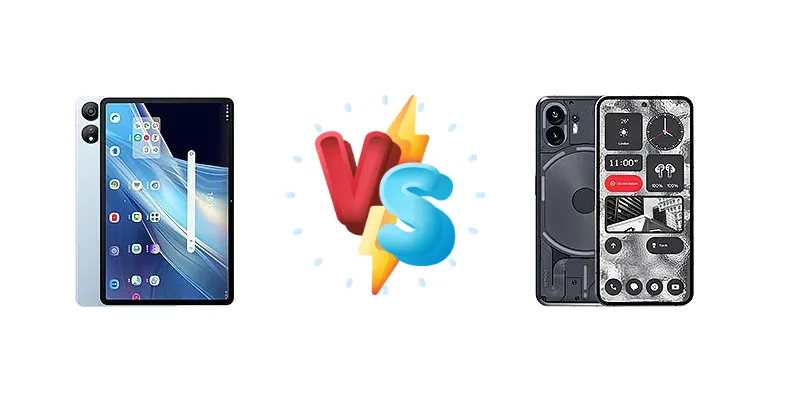
|
🏆 Quick Verdict
For the average user prioritizing overall performance and a refined experience, the Nothing Phone (2) is the clear winner. Its Snapdragon 8+ Gen 1 chipset and superior battery endurance justify the higher price. However, gamers on a budget will find the Oscal Elite 1 a compelling option, offering respectable performance thanks to the Helio G99.
| PHONES | ||
|---|---|---|
| Phone Names | Oscal Elite 1 | Nothing Phone (2) |
| Network | ||
|---|---|---|
| 2G bands | GSM 850 / 900 / 1800 / 1900 | GSM 850 / 900 / 1800 / 1900 |
| 3G bands | HSDPA 900 / 2100 | HSDPA 800 / 850 / 900 / 1700(AWS) / 1900 / 2100 |
| 4G bands | 1, 3, 7, 8, 19, 20, 28, 40, 41 | 1, 2, 3, 4, 5, 7, 8, 12, 17, 18, 19, 20, 25, 26, 28, 30, 32, 34, 38, 39, 40, 41, 42, 48, 66, 71 |
| 5G bands | - | 1, 2, 3, 5, 7, 8, 12, 20, 25, 28, 30, 38, 40, 41, 66, 71, 75, 77, 78 SA/NSA |
| Speed | HSPA, LTE | HSPA, LTE, 5G |
| Technology | GSM / HSPA / LTE | GSM / HSPA / LTE / 5G |
| Launch | ||
|---|---|---|
| Announced | 2024, May | 2023, July 11 |
| Status | Available. Released 2024, May | Available. Released 2023, July 17 |
| Body | ||
|---|---|---|
| Build | - | Glass front (Gorilla Glass 5), glass back (Gorilla Glass 5), aluminum frame |
| Dimensions | 278.5 x 180.5 x 7.4 mm (10.96 x 7.11 x 0.29 in) | 162.1 x 76.4 x 8.6 mm (6.38 x 3.01 x 0.34 in) |
| SIM | Nano-SIM + Nano-SIM | Nano-SIM + Nano-SIM |
| Weight | 587 g (1.29 lb) | 201.2 g (7.09 oz) |
| Display | ||
|---|---|---|
| Protection | - | Corning Gorilla Glass 5 |
| Resolution | 1080 x 2560 pixels (~230 ppi density) | 1080 x 2412 pixels, 20:9 ratio (~394 ppi density) |
| Size | 12.1 inches, 338.3 cm2 (~67.3% screen-to-body ratio) | 6.7 inches, 108.0 cm2 (~87.2% screen-to-body ratio) |
| Type | IPS LCD, 120Hz, 600 nits | LTPO OLED, 1B colors, 120Hz, 1920Hz PWM, HDR10+, 1600 nits (HBM), 1600 nits (peak) |
| Platform | ||
|---|---|---|
| CPU | Octa-core (2x2.2 GHz Cortex-A76 & 6x2.0 GHz Cortex-A55) | Octa-core (1x3.0 GHz Cortex-X2 & 3x2.5 GHz Cortex-A710 & 4x1.80 GHz Cortex-A510) |
| Chipset | Mediatek Helio G99 (6 nm) | Qualcomm SM8475 Snapdragon 8+ Gen 1 (4 nm) |
| GPU | Mali-G57 MC2 | Adreno 730 |
| OS | Android 14, DokeOS_P 4.0 | Android 13, upgradable to Android 15, up to 3 major Android upgrades, Nothing OS 3.0 |
| Memory | ||
|---|---|---|
| Card slot | microSDXC (uses shared SIM slot) | No |
| Internal | 256GB 8GB RAM | 128GB 8GB RAM, 256GB 12GB RAM, 512GB 12GB RAM |
| Main Camera | ||
|---|---|---|
| Dual | - | 50 MP, f/1.9, 24mm (wide), 1/1.56", 1.0µm, PDAF, OIS 50 MP, f/2.2, 114˚ (ultrawide), 1/2.76", 0.64µm, AF |
| Features | LED flash | LED flash, panorama, HDR |
| Single | 12 MP, (wide), 1/2.55" | - |
| Video | 1080p@30fps | 4K@30/60fps, 1080p@30/60fps, gyro-EIS, live HDR, OIS |
| Selfie camera | ||
|---|---|---|
| Features | - | HDR |
| Single | 13 MP | 32 MP, f/2.5, (wide), 1/2.74", 0.8µm |
| Video | 1080p@30fps | 1080p@30fps |
| Sound | ||
|---|---|---|
| 35mm jack | No | No |
| Loudspeaker | Yes, with stereo speakers (4 speakers) | Yes, with stereo speakers |
| Comms | ||
|---|---|---|
| Bluetooth | 5.0, A2DP, LE | 5.3, A2DP, LE, aptX HD, aptX Adaptive |
| NFC | No | Yes |
| Positioning | GPS, GLONASS, GALILEO, BDS | GPS (L1+L5), GLONASS (L1), BDS (B1I+B1c), GALILEO (E1), QZSS (L1), NavIC |
| Radio | FM radio | No |
| USB | USB Type-C, OTG | USB Type-C 2.0, OTG |
| WLAN | Wi-Fi 802.11 a/b/g/n/ac, dual-band | Wi-Fi 802.11 a/b/g/n/ac/6, dual-band, Wi-Fi Direct |
| Features | ||
|---|---|---|
| Sensors | Accelerometer, proximity (accessories only), gyro | Fingerprint (under display, optical), accelerometer, proximity, gyro, compass |
| Battery | ||
|---|---|---|
| Charging | 33W wired | 45W wired, PD3.0, PPS, QC4, 100% in 55 min 15W wireless, 100% in 130 min 5W reverse wireless |
| Type | 8800 mAh | Li-Ion 4700 mAh |
| Misc | ||
|---|---|---|
| Colors | Gray, White, Blue | White, Dark Gray |
| Models | - | A065 |
| Price | - | $ 379.99 / £ 370.00 |
Oscal Elite 1
- Aggressive price point offers excellent value.
- Helio G99 provides capable gaming performance.
- 33W charging is reasonably fast.
- Likely inferior camera quality compared to the Nothing Phone (2).
- Less powerful chipset than the Snapdragon 8+ Gen 1.
Nothing Phone (2)
- Flagship-level Snapdragon 8+ Gen 1 performance.
- Excellent battery life and fast charging options.
- Brighter and potentially more advanced display.
- Significantly higher price than the Oscal Elite 1.
- May be overkill for basic smartphone users.
Display Comparison
The Nothing Phone (2) boasts a significantly brighter display, reaching a measured peak of 998 nits, ensuring excellent visibility even in direct sunlight. While the Oscal Elite 1’s display specifications are not provided, it’s likely to be considerably dimmer. The Nothing Phone (2)'s display technology is also likely to be more advanced, potentially including LTPO for adaptive refresh rates, contributing to better battery efficiency. The Nothing Phone (2)'s display is a clear advantage for outdoor use and media consumption.
Camera Comparison
The context data for the Oscal Elite 1’s camera is limited. However, given its price point, it’s reasonable to assume a less sophisticated camera system compared to the Nothing Phone (2). The Nothing Phone (2) offers a more comprehensive camera experience, likely including features like optical image stabilization (OIS) and advanced image processing algorithms. While specific sensor sizes and apertures aren’t provided, the Nothing Phone (2)'s focus on 'Photo / Video' suggests a greater emphasis on image quality and versatility. The Oscal Elite 1 will likely suffice for casual photography, but the Nothing Phone (2) will excel in challenging lighting conditions and offer more creative control.
Performance
The core difference lies in the chipsets. The Nothing Phone (2) utilizes the Qualcomm Snapdragon 8+ Gen 1 (4nm), a flagship-tier processor featuring an octa-core configuration with a Cortex-X2 prime core clocked at 3.0 GHz. This is a substantial leap over the Oscal Elite 1’s MediaTek Helio G99 (6nm). The Snapdragon 8+ Gen 1’s more advanced 4nm process node translates to better thermal efficiency and sustained performance under load, crucial for demanding tasks like gaming and video editing. The Oscal Elite 1’s Helio G99, while capable, is designed for efficient mid-range performance, prioritizing power efficiency over raw speed. The Nothing Phone (2) will deliver a noticeably smoother and faster experience in virtually all scenarios.
Battery Life
The Nothing Phone (2) demonstrates impressive battery endurance, achieving 14:21 hours of active use and an endurance rating of 103 hours. This is a significant advantage over what we might expect from the Oscal Elite 1, given its unspecified battery capacity. The Nothing Phone (2) also supports faster charging at 45W with multiple protocols (PD3.0, PPS, QC4), reaching 100% in 55 minutes, alongside 15W wireless and 5W reverse wireless charging. The Oscal Elite 1’s 33W wired charging is respectable, but slower. The Nothing Phone (2)'s superior battery life and charging options provide greater convenience and peace of mind.
Buying Guide
Buy the Oscal Elite 1 if you need a capable gaming phone without breaking the bank, and are willing to compromise on camera quality and premium features. Buy the Nothing Phone (2) if you prioritize a smooth, responsive user experience, excellent battery life, and a more polished design, and are willing to pay a premium for flagship-level performance.