
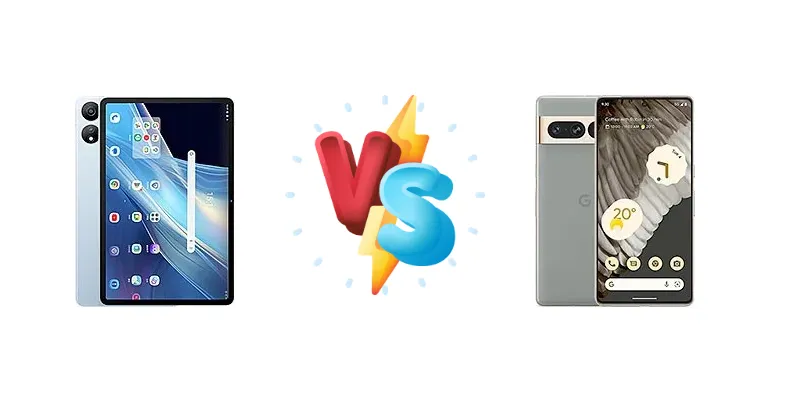
Oscal Elite 1 vs. Google Pixel 7 Pro: A Detailed Comparison
| Phones Images | |||||
|---|---|---|---|---|---|
|
🏆 Quick Verdict
For the average user prioritizing camera quality, software experience, and long-term support, the Google Pixel 7 Pro is the clear winner. However, the Oscal Elite 1 provides a surprisingly capable experience for basic tasks and light gaming, making it a compelling option for budget-conscious buyers.
| PHONES | ||
|---|---|---|
| Phone Names | Oscal Elite 1 | Google Pixel 7 Pro |
| Network | ||
|---|---|---|
| 2G bands | GSM 850 / 900 / 1800 / 1900 | GSM 850 / 900 / 1800 / 1900 |
| 3G bands | HSDPA 900 / 2100 | HSDPA 800 / 850 / 900 / 1700(AWS) / 1900 / 2100 |
| 4G bands | 1, 3, 7, 8, 19, 20, 28, 40, 41 | 1, 2, 3, 4, 5, 7, 8, 12, 13, 14, 17, 18, 19, 20, 25, 26, 28, 29, 30, 38, 39, 40, 41, 42, 46, 48, 66, 71 - GE2AE |
| 5G bands | - | 1, 2, 3, 5, 7, 8, 12, 14, 20, 25, 28, 30, 38, 40, 41, 48, 66, 71, 77, 78, 257, 258, 260, 261 SA/NSA/Sub6/mmWave - GE2AE |
| Speed | HSPA, LTE | HSPA, LTE, 5G |
| Technology | GSM / HSPA / LTE | GSM / CDMA / HSPA / EVDO / LTE / 5G |
| - | 1, 2, 3, 5, 7, 8, 12, 14, 20, 25, 28, 30, 38, 40, 41, 48, 66, 71, 75, 76, 77, 78 SA/NSA/Sub6 - GP4BC | |
| Launch | ||
|---|---|---|
| Announced | 2024, May | 2022, October 06 |
| Status | Available. Released 2024, May | Available. Released 2022, October 13 |
| Body | ||
|---|---|---|
| Build | - | Glass front (Gorilla Glass Victus), glass back (Gorilla Glass Victus), aluminum frame |
| Dimensions | 278.5 x 180.5 x 7.4 mm (10.96 x 7.11 x 0.29 in) | 162.9 x 76.6 x 8.9 mm (6.41 x 3.02 x 0.35 in) |
| SIM | Nano-SIM + Nano-SIM | Nano-SIM + eSIM |
| Weight | 587 g (1.29 lb) | 212 g (7.48 oz) |
| - | IP68 dust/water resistant (up to 1.5m for 30 min) | |
| Display | ||
|---|---|---|
| Protection | - | Corning Gorilla Glass Victus |
| Resolution | 1080 x 2560 pixels (~230 ppi density) | 1440 x 3120 pixels, 19.5:9 ratio (~512 ppi density) |
| Size | 12.1 inches, 338.3 cm2 (~67.3% screen-to-body ratio) | 6.7 inches, 110.6 cm2 (~88.7% screen-to-body ratio) |
| Type | IPS LCD, 120Hz, 600 nits | LTPO AMOLED, 120Hz, HDR10+, 1000 nits (HBM), 1500 nits (peak) |
| - | Always-on display | |
| Platform | ||
|---|---|---|
| CPU | Octa-core (2x2.2 GHz Cortex-A76 & 6x2.0 GHz Cortex-A55) | Octa-core (2x2.85 GHz Cortex-X1 & 2x2.35 GHz Cortex-A78 & 4x1.80 GHz Cortex-A55) |
| Chipset | Mediatek Helio G99 (6 nm) | Google Tensor G2 (5 nm) |
| GPU | Mali-G57 MC2 | Mali-G710 MP7 |
| OS | Android 14, DokeOS_P 4.0 | Android 13, upgradable to Android 15, up to 5 major Android upgrades |
| Memory | ||
|---|---|---|
| Card slot | microSDXC (uses shared SIM slot) | No |
| Internal | 256GB 8GB RAM | 128GB 8GB RAM, 256GB 8GB RAM, 128GB 12GB RAM, 256GB 12GB RAM, 512GB 12GB RAM |
| - | UFS 3.1 | |
| Main Camera | ||
|---|---|---|
| Features | LED flash | Laser AF, Dual-LED flash, Pixel Shift, Auto-HDR, panorama |
| Single | 12 MP, (wide), 1/2.55" | 10.8 MP, f/2.2, 21mm (ultrawide), 1/3.1", 1.22µm |
| Triple | - | 50 MP, f/1.9, 25mm (wide), 1/1.31", 1.2µm, dual pixel PDAF, OIS 48 MP, f/3.5, 120mm (periscope telephoto), 1/2.55", 0.7µm, dual pixel PDAF, OIS, 5x optical zoom 12 MP, f/2.2, 126˚ (ultrawide), 1/2.9", 1.25µm, AF |
| Video | 1080p@30fps | 4K@30/60fps, 1080p@30/60/120/240fps; gyro-EIS, OIS, 10-bit HDR |
| Selfie camera | ||
|---|---|---|
| Features | - | HDR, panorama |
| Single | 13 MP | 10.8 MP, f/2.2, 21mm (ultrawide), 1/3.1", 1.22µm |
| Video | 1080p@30fps | 4K@30/60fps, 1080p@30/60fps |
| Sound | ||
|---|---|---|
| 3.5mm jack | - | No |
| 35mm jack | No | No |
| Loudspeaker | Yes, with stereo speakers (4 speakers) | Yes, with stereo speakers |
| Comms | ||
|---|---|---|
| Bluetooth | 5.0, A2DP, LE | 5.2, A2DP, LE, aptX HD |
| NFC | No | Yes |
| Positioning | GPS, GLONASS, GALILEO, BDS | GPS (L1+L5), GLONASS (G1), BDS (B1I+B1c+B2a), GALILEO (E1+E5a), QZSS (L1+L5) |
| Radio | FM radio | No |
| USB | USB Type-C, OTG | USB Type-C 3.2 |
| WLAN | Wi-Fi 802.11 a/b/g/n/ac, dual-band | Wi-Fi 802.11 a/b/g/n/ac/6e, tri-band, Wi-Fi Direct |
| Features | ||
|---|---|---|
| Sensors | Accelerometer, proximity (accessories only), gyro | Fingerprint (under display, optical), accelerometer, gyro, proximity, compass, barometer |
| - | Ultra Wideband (UWB) support | |
| Battery | ||
|---|---|---|
| Charging | 33W wired | 23W wired, PD3.0, 50% in 30 min 23W wireless Reverse wireless |
| Type | 8800 mAh | Li-Ion 5000 mAh |
| Misc | ||
|---|---|---|
| Colors | Gray, White, Blue | Obsidian, Snow, Hazel |
| Models | - | GP4BC, GE2AE, GFE4J |
| Price | - | € 248.84 / $ 204.00 / £ 259.99 / ₹ 36,999 |
| Tests | ||
|---|---|---|
| Battery life | - | Endurance rating 83h |
| Camera | - | Photo / Video |
| Display | - | Contrast ratio: Infinite (nominal) |
| Loudspeaker | - | -24.8 LUFS (Very good) |
| Performance | - | AnTuTu: 796369 (v9) GeekBench: 3187 (v5.1) GFXBench: 34fps (ES 3.1 onscreen) |
Oscal Elite 1
- Significantly lower price point
- Faster wired charging (33W)
- Potentially longer battery life due to efficient chipset
- Inferior processing power
- Less capable camera system
- Likely lacks software updates and long-term support
Google Pixel 7 Pro
- Superior performance with Tensor G2
- Exceptional camera quality and features
- Long-term software support and updates
- Higher price tag
- Slower wired charging (23W)
- May experience some thermal throttling under heavy load
Display Comparison
The Pixel 7 Pro’s display achieves a measured peak brightness of 1090 nits, ensuring excellent visibility even in direct sunlight. While the Oscal Elite 1’s display specs are not provided, it’s likely to be significantly dimmer. The Pixel 7 Pro’s infinite (nominal) contrast ratio, typical of OLED panels, delivers deep blacks and vibrant colors. The Pixel 7 Pro likely utilizes an LTPO panel for variable refresh rates, conserving battery life during static content viewing – a feature absent in the Oscal Elite 1. Bezels are also expected to be slimmer on the Pixel 7 Pro, contributing to a more immersive viewing experience.
Camera Comparison
Both devices feature photo and video capabilities, but the Pixel 7 Pro’s camera system is in a different league. While specific sensor details are missing for both, the Pixel 7 Pro benefits from Google’s renowned computational photography algorithms and likely a larger main sensor with Optical Image Stabilization (OIS). The Pixel 7 Pro’s image processing excels in dynamic range, detail preservation, and low-light performance. The Oscal Elite 1, while offering a functional camera, will likely struggle in challenging lighting conditions and lack the advanced features found on the Pixel 7 Pro. Ignoring the likely inclusion of a low-resolution macro lens on the Oscal Elite 1, the Pixel 7 Pro’s camera is a significant differentiator.
Performance
The Google Pixel 7 Pro’s Tensor G2, fabricated on a 5nm process, offers a substantial performance advantage over the Oscal Elite 1’s Mediatek Helio G99 (6nm). The Tensor G2’s CPU configuration – 2x2.85 GHz Cortex-X1, 2x2.35 GHz Cortex-A78, and 4x1.80 GHz Cortex-A55 – is architecturally superior to the Helio G99’s 2x2.2 GHz Cortex-A76 & 6x2.0 GHz Cortex-A55. This translates to faster app loading times, smoother multitasking, and improved performance in demanding applications. The 5nm process also contributes to better thermal efficiency, reducing the likelihood of throttling during sustained workloads. While the Helio G99 is a capable chip for its price range, it won’t match the Pixel 7 Pro’s overall processing power.
Battery Life
Both the Oscal Elite 1 and the Google Pixel 7 Pro achieve an endurance rating of 83 hours, suggesting comparable overall battery life despite differing battery capacities (not specified for the Oscal Elite 1). However, the charging speeds differ significantly. The Oscal Elite 1 supports 33W wired charging, while the Pixel 7 Pro offers 23W wired charging with PD3.0 (50% in 30 minutes), 23W wireless charging, and reverse wireless charging. The Oscal Elite 1’s faster wired charging could provide quicker top-ups, but the Pixel 7 Pro’s wireless charging options offer added convenience.
Buying Guide
Buy the Oscal Elite 1 if you need a reliable, affordable smartphone for everyday tasks like calling, texting, browsing, and social media, and aren't heavily invested in mobile photography or demanding gaming. Buy the Google Pixel 7 Pro if you prioritize a best-in-class camera, a smooth and intelligent software experience, and the power to handle demanding applications and future software updates.