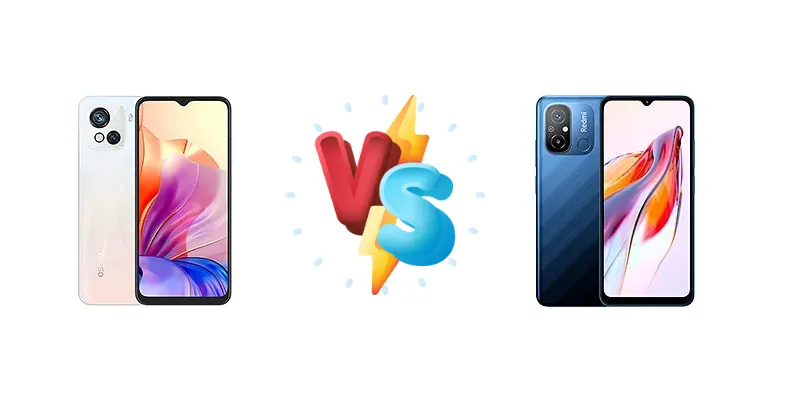
The sub-$150 smartphone market is fiercely competitive. Both the Oscal C80 and Xiaomi Redmi 12C aim to deliver essential smartphone functionality at an incredibly accessible price point. However, they take different approaches to achieving this, primarily through their chipset choices. This comparison dissects those differences, focusing on performance, charging, and the user experience.
🏆 Quick Verdict
For the average user prioritizing responsiveness and light gaming, the Xiaomi Redmi 12C is the better choice. Its Helio G85 chipset, with higher clocked Cortex-A75 cores, provides a noticeable performance advantage over the Oscal C80’s Unisoc T606. While the C80 offers slightly faster charging, the Redmi 12C’s overall processing power is more impactful for daily tasks.
| Network |
|---|
| 2G bands | GSM 850 / 900 / 1800 / 1900 | GSM 850 / 900 / 1800 / 1900 |
| 3G bands | HSDPA 900 / 2100 | HSDPA 850 / 900 / 2100 |
| 4G bands | 1, 3, 7, 8, 20, 40 | 1, 3, 5, 7, 8, 20, 28, 38, 40, 41 - International |
| Speed | HSPA, LTE | HSPA, LTE |
| Technology | GSM / HSPA / LTE | GSM / CDMA / HSPA / EVDO / LTE |
| | - | CDMA2000 1xEV-DO |
| Launch |
|---|
| Announced | 2022, September 07 | 2022, December 31 |
| Status | Available. Released 2022, September 14 | Available. Released 2023, January 01 |
| Body |
|---|
| Dimensions | 164.2 x 76 x 8.6 mm (6.46 x 2.99 x 0.34 in) | 168.8 x 76.4 x 8.8 mm (6.65 x 3.01 x 0.35 in) |
| SIM | Nano-SIM + Nano-SIM | Nano-SIM + Nano-SIM |
| Weight | 188 g (6.63 oz) | 192 g (6.77 oz) |
| Display |
|---|
| Resolution | 720 x 1600 pixels, 20:9 ratio (~270 ppi density) | 720 x 1650 pixels (~268 ppi density) |
| Size | 6.5 inches, 102.0 cm2 (~81.7% screen-to-body ratio) | 6.71 inches, 106.5 cm2 (~82.6% screen-to-body ratio) |
| Type | IPS LCD, 90Hz | IPS LCD, 500 nits (typ) |
| Platform |
|---|
| CPU | Octa-core (2x1.6 GHz Cortex-A75 & 6x1.6 GHz Cortex-A55) | Octa-core (2x2.0 GHz Cortex-A75 & 6x1.8 GHz Cortex-A55) |
| Chipset | Unisoc T606 (12 nm) | Mediatek MT6769Z Helio G85 (12 nm) |
| GPU | Mali-G57 MP1 | Mali-G52 MC2 |
| OS | Android 12, Doke-OS 3.0 | Android 12, MIUI 13 |
| Memory |
|---|
| Card slot | microSDXC (uses shared SIM slot) | microSDXC (dedicated slot) |
| Internal | 128GB 8GB RAM | 32GB 2GB RAM, 32GB 3GB RAM, 32GB 4GB RAM, 64GB 3GB RAM, 64GB 4GB RAM, 128GB 3GB RAM, 128GB 4GB RAM, 128GB 6GB RAM |
| | - | eMMC 5.1 |
| Main Camera |
|---|
| Dual | 50 MP, (wide), 1.2µm, PDAF
Auxiliary lens | 50 MP, (wide), PDAF
0.08 MP (depth) |
| Features | LED flash, HDR, panorama | LED flash, HDR |
| Single | - | 50 MP, f/1.8, (wide), 1/2.76", PDAF
Auxiliary lens |
| Video | 1080p@30fps | 1080p@30fps |
| Selfie camera |
|---|
| Single | 8 MP | 5 MP, f/2.2, (wide) |
| Video | 1080p@30fps | 1080p@30fps |
| Sound |
|---|
| 3.5mm jack | - | Yes |
| 35mm jack | Yes | Yes |
| Loudspeaker | Yes | Yes |
| Comms |
|---|
| Bluetooth | 5.0, A2DP, LE | 5.1, A2DP, LE |
| NFC | No | Yes (market/region dependent) |
| Positioning | GPS, GLONASS, GALILEO, BDS | GPS, GLONASS, BDS, GALILEO |
| Radio | FM radio | FM radio |
| USB | USB Type-C, OTG | microUSB 2.0 |
| WLAN | Wi-Fi 802.11 a/b/g/n/ac, dual-band | Wi-Fi 802.11 a/b/g/n/ac, dual-band, Wi-Fi Direct |
| Features |
|---|
| Sensors | Fingerprint (side-mounted), accelerometer, gyro, compass | Fingerprint (rear-mounted), accelerometer |
| | - | Virtual proximity sensing |
| Battery |
|---|
| Charging | 18W wired | 10W wired |
| Type | 5180 mAh | Li-Po 5000 mAh |
| Misc |
|---|
| Colors | Early Sunny Snow, Midnight Black, Navy Blue | Graphite Gray, Ocean Blue, Mint Green, Lavender Purple |
| Models | - | 22120RN86G, 22120RN86I, 22126RN91Y, 2212ARNC4L |
| Price | About 130 EUR | £ 132.99 / € 107.41 |
| SAR | - | 1.08 W/kg (head) 0.64 W/kg (body) |
| SAR EU | - | 0.98 W/kg (head) 0.99 W/kg (body) |
Oscal C80
- Faster 18W charging
- Potentially slightly longer battery life due to efficient chipset
- Competitive price point
- Slower processor compared to the Redmi 12C
- Less responsive user experience
Xiaomi Redmi 12C
- More powerful Helio G85 chipset
- Faster app launch times and smoother multitasking
- Better gaming performance
- Slower 10W charging
- Potentially slightly shorter battery life during heavy use
Display Comparison
Neither device boasts a standout display. Both utilize standard LCD panels, and detailed specifications like resolution and peak brightness are not provided. However, given the price bracket, expect 720p+ resolution and moderate brightness levels. The focus here is on functionality over visual fidelity. Bezels are likely to be substantial on both, and color accuracy will be typical for this segment – adequate but not color-accurate for professional work.
Camera Comparison
Camera performance is likely to be similar on both devices, relying on budget sensors and software processing. Detailed sensor information is unavailable, but it’s safe to assume both feature a primary camera and potentially depth/macro sensors of limited utility. Image quality will be acceptable in good lighting conditions, but expect noise and a lack of detail in low light. The Redmi 12C’s image processing might be slightly more refined due to Xiaomi’s software expertise, but the difference will be marginal.
Performance
The core difference lies in the chipsets. The Redmi 12C’s MediaTek Helio G85 (12nm) features two Cortex-A75 cores clocked at 2.0 GHz, paired with six Cortex-A55 cores at 1.8 GHz. This contrasts with the Oscal C80’s Unisoc T606 (12nm), which has two Cortex-A75 cores at 1.6 GHz and six Cortex-A55 cores at 1.6 GHz. The higher clock speeds on the G85 translate to faster single-core performance, crucial for app launch times and general responsiveness. While both are 12nm chips, the G85’s architecture is optimized for gaming, offering a slight GPU advantage. The Redmi 12C will handle graphically demanding tasks and multitasking more smoothly.
Battery Life
Both phones offer adequate battery life for typical daily use. The Redmi 12C’s battery capacity is not specified, but it’s likely around 5000mAh, a common size for this segment. The Oscal C80 supports 18W wired charging, while the Redmi 12C is limited to 10W. This means the C80 will charge faster, potentially reducing 0-100% charge time by 30-60 minutes. However, the Redmi 12C’s more efficient chipset might offset this difference through longer battery life during use.
Buying Guide
Buy the Oscal C80 if you prioritize slightly faster charging and are primarily focused on basic smartphone functions like calls, messaging, and light social media use. The 18W charging is a small benefit. Buy the Xiaomi Redmi 12C if you want a more responsive experience, enjoy occasional gaming, or frequently use apps that demand more processing power. The Helio G85 provides a tangible performance boost for a minimal price increase.
Frequently Asked Questions
❓ Will the Redmi 12C’s Helio G85 overheat during prolonged gaming sessions?
The Helio G85 is a relatively efficient chipset. While it will generate heat during extended gaming, it’s unlikely to experience significant thermal throttling in these budget devices, as they typically have less aggressive thermal designs than flagship phones. Expect some warmth, but not performance-crippling overheating.
❓ Is the 18W charging on the Oscal C80 a significant advantage over the Redmi 12C’s 10W charging?
While 18W is faster, the difference isn’t massive. Expect a 30-60 minute reduction in full charge time. The Redmi 12C’s potentially more efficient chipset might partially offset this, offering comparable overall usability throughout the day.
❓ Can the Redmi 12C handle popular games like PUBG Mobile or Call of Duty Mobile?
The Helio G85 can run PUBG Mobile and Call of Duty Mobile, but you’ll likely need to use lower graphics settings to maintain a stable frame rate. It’s not a gaming powerhouse, but it’s capable of providing a playable experience.
❓ How does the Unisoc T606 in the Oscal C80 compare to other chipsets in this price range?
The Unisoc T606 is a decent entry-level chipset, but it generally underperforms compared to the MediaTek Helio G85 found in the Redmi 12C. It’s suitable for basic tasks, but struggles with demanding applications and multitasking.