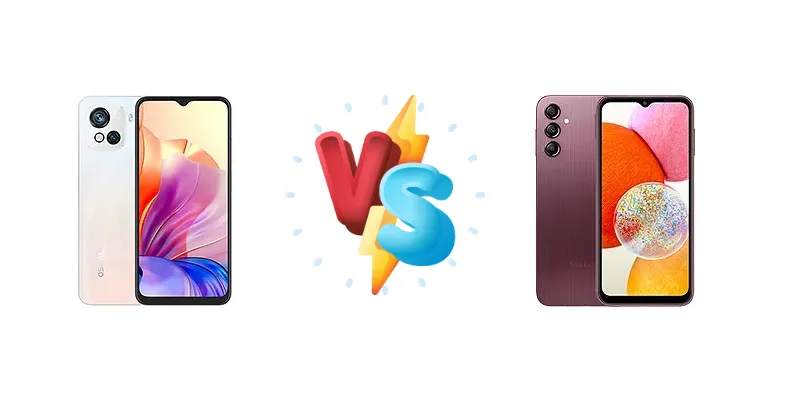
The sub-$200 smartphone market is fiercely competitive. The Oscal C80 and Samsung Galaxy A14 both aim to deliver essential features at an accessible price point, but they take different approaches. The Oscal C80 leverages a Unisoc chipset, while the Samsung Galaxy A14 offers a choice between a Mediatek Helio G80 and an Exynos 850, creating a nuanced comparison for budget-conscious buyers.
🏆 Quick Verdict
For users prioritizing consistent performance and a more established brand reputation, the Samsung Galaxy A14 (specifically the Exynos 850 version) is the better choice. However, the Oscal C80 offers a compelling value proposition if raw CPU performance is the primary concern and brand loyalty isn't a factor.
| Network |
|---|
| 2G bands | GSM 850 / 900 / 1800 / 1900 | GSM 850 / 900 / 1800 / 1900 |
| 3G bands | HSDPA 900 / 2100 | HSDPA 850 / 900 / 2100 |
| 4G bands | 1, 3, 7, 8, 20, 40 | 1, 3, 5, 7, 8, 20, 28, 38, 40, 41 |
| Speed | HSPA, LTE | HSPA, LTE |
| Technology | GSM / HSPA / LTE | GSM / HSPA / LTE |
| Launch |
|---|
| Announced | 2022, September 07 | 2023, February 28 |
| Status | Available. Released 2022, September 14 | Available. Released 2023, March 27 |
| Body |
|---|
| Build | - | Glass front, plastic back, plastic frame |
| Dimensions | 164.2 x 76 x 8.6 mm (6.46 x 2.99 x 0.34 in) | 167.7 x 78 x 9.1 mm (6.60 x 3.07 x 0.36 in) |
| SIM | Nano-SIM + Nano-SIM | · Nano-SIM· Nano-SIM + Nano-SIM |
| Weight | 188 g (6.63 oz) | 201 g (7.09 oz) |
| Display |
|---|
| Resolution | 720 x 1600 pixels, 20:9 ratio (~270 ppi density) | 1080 x 2408 pixels, 20:9 ratio (~400 ppi density) |
| Size | 6.5 inches, 102.0 cm2 (~81.7% screen-to-body ratio) | 6.6 inches, 104.9 cm2 (~80.2% screen-to-body ratio) |
| Type | IPS LCD, 90Hz | PLS LCD |
| Platform |
|---|
| CPU | Octa-core (2x1.6 GHz Cortex-A75 & 6x1.6 GHz Cortex-A55) | Octa-core (2x2.0 GHz Cortex-A75 & 6x1.8 GHz Cortex-A55) - Version AOcta-core (4x2.0 GHz Cortex-A55 & 4x2.0 GHz Cortex-A55) - Version B |
| Chipset | Unisoc T606 (12 nm) | Mediatek MT6769 Helio G80 (12 nm) - Version AExynos 850 (8 nm) - Version B |
| GPU | Mali-G57 MP1 | Mali-G52 MC2 |
| OS | Android 12, Doke-OS 3.0 | Android 13, upgradable to Android 15, One UI 7 |
| Memory |
|---|
| Card slot | microSDXC (uses shared SIM slot) | microSDXC (dedicated slot) |
| Internal | 128GB 8GB RAM | 64GB 4GB RAM, 128GB 4GB RAM, 128GB 6GB RAM |
| Main Camera |
|---|
| Dual | 50 MP, (wide), 1.2µm, PDAF
Auxiliary lens | - |
| Features | LED flash, HDR, panorama | LED flash, panorama, HDR |
| Single | - | 13 MP, f/2.0, (wide) |
| Triple | - | 50 MP, f/1.8, 26mm (wide), 1/2.75", 0.64µm, PDAF
5 MP, f/2.2, 17mm (ultrawide), 1/5.0", 1.12µm
2 MP (macro) |
| Video | 1080p@30fps | 1080p@30fps |
| Selfie camera |
|---|
| Single | 8 MP | 13 MP, f/2.0, 26mm (wide), 1/3.1", 1.12µm |
| Video | 1080p@30fps | 1080p@30fps |
| Sound |
|---|
| 3.5mm jack | - | Yes |
| 35mm jack | Yes | Yes |
| Loudspeaker | Yes | Yes |
| Comms |
|---|
| Bluetooth | 5.0, A2DP, LE | 5.1 or 5.3, A2DP, LE |
| NFC | No | Yes (market/region dependent) |
| Positioning | GPS, GLONASS, GALILEO, BDS | GPS, GALILEO, GLONASS, BDS, QZSS |
| Radio | FM radio | Unspecified |
| USB | USB Type-C, OTG | USB Type-C 2.0 |
| WLAN | Wi-Fi 802.11 a/b/g/n/ac, dual-band | Wi-Fi 802.11 a/b/g/n/ac, dual-band, Wi-Fi Direct |
| Features |
|---|
| Sensors | Fingerprint (side-mounted), accelerometer, gyro, compass | Fingerprint (side-mounted), accelerometer, proximity, compass |
| Battery |
|---|
| Charging | 18W wired | 15W wired |
| Type | 5180 mAh | Li-Po 5000 mAh |
| Misc |
|---|
| Colors | Early Sunny Snow, Midnight Black, Navy Blue | Black, Dark Red, Silver, Green |
| Models | - | SM-A145F, SM-A145F/DSN, SM-A145M, SM-A145M/DS, SM-A145P, SM-A145R |
| Price | About 130 EUR | € 85.76 / $ 147.60 / £ 79.95 |
| SAR EU | - | 0.46 W/kg (head) 1.37 W/kg (body) |
Oscal C80
- Potentially faster CPU performance for basic tasks
- Faster charging speed (18W)
- More aggressive pricing
- Less established brand reputation
- Potentially less refined software experience
Samsung Galaxy A14
- Trusted Samsung brand
- Potentially better camera performance (depending on version)
- More efficient Exynos 850 version available
- Slower charging speed (15W)
- Helio G80 version may offer limited performance gains
Display Comparison
Neither device boasts a standout display. Both are likely to utilize LCD panels, common in this price bracket. While specific details like resolution and refresh rate are missing, the focus will be on basic usability. The lack of information prevents a detailed comparison of color accuracy or brightness. Bezels are expected to be noticeable on both devices, typical for budget phones.
Camera Comparison
Camera performance is difficult to assess without detailed sensor information. Both phones likely feature a primary camera accompanied by auxiliary lenses (potentially including a 2MP macro lens on the A14, which offers limited practical value). The aperture and sensor size of the main camera will be the key determinants of image quality. Samsung’s image processing algorithms are generally more refined, potentially leading to more pleasing results in various lighting conditions. Without specific details, it's reasonable to assume the Galaxy A14 has a slight edge in overall camera quality, particularly in software optimization.
Performance
The performance gap is the most significant differentiator. The Oscal C80’s Unisoc T606, built on a 12nm process, features a Cortex-A75 based octa-core configuration (2x1.6 GHz Cortex-A75 & 6x1.6 GHz Cortex-A55). The Samsung Galaxy A14 presents a split: the Helio G80 (12nm) version (2x2.0 GHz Cortex-A75 & 6x1.8 GHz Cortex-A55) offers a slight CPU clock speed advantage, while the Exynos 850 (8nm) version boasts a more efficient manufacturing process and a different core arrangement (4x2.0 GHz Cortex-A55 & 4x2.0 GHz Cortex-A55). The 8nm process of the Exynos 850 should translate to better thermal management and sustained performance under load. The Unisoc T606 will likely excel in single-core tasks, while the Helio G80 and Exynos 850 may offer better multi-core performance. The Exynos 850 version of the A14 is the clear winner in terms of efficiency and sustained performance.
Battery Life
The Oscal C80 supports 18W wired charging, while the Samsung Galaxy A14 is limited to 15W. While the wattage difference isn't massive, it could translate to slightly faster charging times for the Oscal C80. Battery capacity is not specified for either device, but given the price point, both are likely to feature batteries in the 5000mAh range. The Exynos 850’s superior efficiency in the A14 could offset the slightly slower charging, potentially resulting in comparable real-world battery life.
Buying Guide
Buy the Oscal C80 if you need a phone focused on maximizing CPU performance for basic multitasking and light gaming, and are comfortable with a less-known brand. Buy the Samsung Galaxy A14 if you prefer a more polished software experience, a trusted brand, and potentially better camera performance (depending on the version), even if it means a slight trade-off in raw processing power.
Frequently Asked Questions
❓ Does the Exynos 850 chip in the Samsung Galaxy A14 overheat during extended gaming sessions?
The Exynos 850, built on an 8nm process, is significantly more efficient than the Unisoc T606 and Helio G80. This improved efficiency translates to better thermal management, reducing the likelihood of overheating during prolonged gaming. While it won't match flagship-level performance, it should provide a smoother and more sustained gaming experience than the Oscal C80.
❓ Is the 2MP macro camera on the Samsung Galaxy A14 actually useful for taking detailed close-up photos?
Generally, 2MP macro cameras on budget smartphones offer limited practical value. The low resolution results in images lacking detail and sharpness. While it can be fun to experiment with, don't expect professional-quality macro photography. The primary camera on the A14 will likely produce better results even when cropping in on a subject.
❓ Will the Oscal C80 be able to run popular games like PUBG Mobile at 60fps?
The Unisoc T606 in the Oscal C80 can likely run PUBG Mobile, but achieving a consistent 60fps experience will depend on the graphics settings. You'll likely need to lower the settings to medium or low to maintain a playable frame rate. The Samsung Galaxy A14, particularly the Exynos 850 version, will offer a more stable 60fps experience at higher settings.
❓ Which phone is better for watching videos and streaming content?
While both phones will be adequate for video consumption, the Samsung Galaxy A14 benefits from Samsung's software optimizations and potentially better color accuracy (though this is unconfirmed without testing). The Exynos 850 version will also offer slightly better efficiency, potentially extending battery life during video playback.