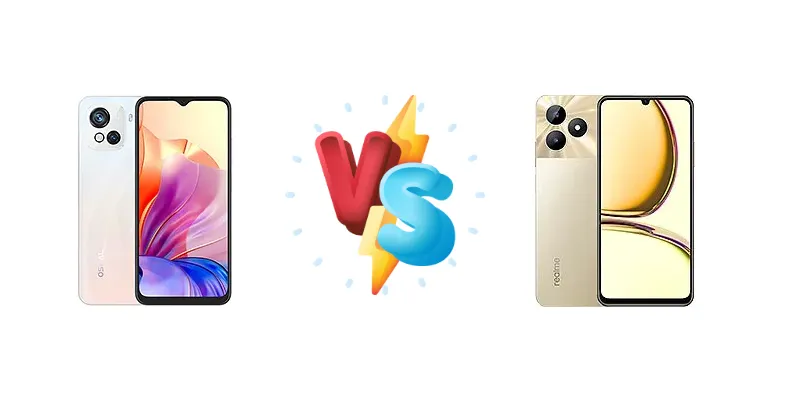
The sub-$150 smartphone market is fiercely competitive. Both the Oscal C80 and the Realme C53 (India variant) aim to deliver essential smartphone functionality at an accessible price point. However, they achieve this with slightly different approaches, primarily revolving around their Unisoc chipsets. This comparison dissects the nuances between the Unisoc T606 powering the Oscal C80 and the T612 in the Realme C53, revealing which device offers the best performance and value.
🏆 Quick Verdict
For most users, the Realme C53 (India) emerges as the slightly better choice. While both phones share the same 18W charging and target the same budget segment, the Realme C53’s Unisoc Tiger T612, with its higher clocked Cortex-A75 cores, provides a noticeable performance edge in everyday tasks and light gaming.
| Network |
|---|
| 2G bands | GSM 850 / 900 / 1800 / 1900 | GSM 850 / 900 / 1800 / 1900 |
| 3G bands | HSDPA 900 / 2100 | HSDPA 850 / 900 / 2100 |
| 4G bands | 1, 3, 7, 8, 20, 40 | 1, 3, 5, 8, 38, 40, 41 |
| Speed | HSPA, LTE | HSPA, LTE |
| Technology | GSM / HSPA / LTE | GSM / HSPA / LTE |
| Launch |
|---|
| Announced | 2022, September 07 | 2023, July 19 |
| Status | Available. Released 2022, September 14 | Available. Released 2023, July 26 |
| Body |
|---|
| Build | - | Glass front, plastic frame, plastic back |
| Dimensions | 164.2 x 76 x 8.6 mm (6.46 x 2.99 x 0.34 in) | 167.2 x 76.7 x 8 mm (6.58 x 3.02 x 0.31 in) |
| SIM | Nano-SIM + Nano-SIM | Nano-SIM + Nano-SIM |
| Weight | 188 g (6.63 oz) | 186 g (6.56 oz) |
| Display |
|---|
| Resolution | 720 x 1600 pixels, 20:9 ratio (~270 ppi density) | 1080 x 2400 pixels, 20:9 ratio (~390 ppi density) |
| Size | 6.5 inches, 102.0 cm2 (~81.7% screen-to-body ratio) | 6.74 inches, 109.7 cm2 (~85.5% screen-to-body ratio) |
| Type | IPS LCD, 90Hz | IPS LCD, 90Hz, 560 nits (peak) |
| Platform |
|---|
| CPU | Octa-core (2x1.6 GHz Cortex-A75 & 6x1.6 GHz Cortex-A55) | Octa-core (2x1.8 GHz Cortex-A75 & 6x1.8 GHz Cortex-A55) |
| Chipset | Unisoc T606 (12 nm) | Unisoc Tiger T612 (12 nm) |
| GPU | Mali-G57 MP1 | Mali-G57 |
| OS | Android 12, Doke-OS 3.0 | Android 13, Realme UI |
| Memory |
|---|
| Card slot | microSDXC (uses shared SIM slot) | microSDXC (dedicated slot) |
| Internal | 128GB 8GB RAM | 64GB 6GB RAM, 128GB 4GB RAM, 128GB 6GB RAM |
| Main Camera |
|---|
| Dual | 50 MP, (wide), 1.2µm, PDAF
Auxiliary lens | 108 MP, (wide), PDAF
Auxiliary lens |
| Features | LED flash, HDR, panorama | LED flash, HDR, panorama |
| Video | 1080p@30fps | 1080p@30fps |
| Selfie camera |
|---|
| Features | - | HDR |
| Single | 8 MP | 8 MP, (wide) |
| Video | 1080p@30fps | 720p@30fps |
| Sound |
|---|
| 35mm jack | Yes | Yes |
| Loudspeaker | Yes | Yes |
| Comms |
|---|
| Bluetooth | 5.0, A2DP, LE | 5.0, A2DP, LE |
| NFC | No | No |
| Positioning | GPS, GLONASS, GALILEO, BDS | GPS, GLONASS, GALILEO |
| Radio | FM radio | Unspecified |
| USB | USB Type-C, OTG | USB Type-C 2.0 |
| WLAN | Wi-Fi 802.11 a/b/g/n/ac, dual-band | Wi-Fi 802.11 a/b/g/n/ac, dual-band |
| Features |
|---|
| Sensors | Fingerprint (side-mounted), accelerometer, gyro, compass | Fingerprint (side-mounted), accelerometer, gyro, proximity, compass |
| Battery |
|---|
| Charging | 18W wired | 18W wired |
| Type | 5180 mAh | 5000 mAh |
| Misc |
|---|
| Colors | Early Sunny Snow, Midnight Black, Navy Blue | Gold, Black |
| Models | - | RMX3762 |
| Price | About 130 EUR | About 110 EUR |
Oscal C80
- Potentially lower price point
- Reliable Unisoc T606 chipset for basic tasks
- 18W fast charging
- Slower CPU performance compared to Realme C53
- Likely less refined software experience
Realme C53 (India)
- Faster Unisoc Tiger T612 chipset
- Improved multitasking and app loading speeds
- 18W fast charging
- May be slightly more expensive than Oscal C80
- Software experience may include pre-installed bloatware
Display Comparison
Neither Oscal nor Realme provide display specifications beyond the basic panel type. Given the price bracket, both likely utilize IPS LCD panels. The absence of details like peak brightness, color gamut coverage, or refresh rate suggests a focus on cost reduction. Bezels are expected to be relatively thick on both devices. Without further data, it's impossible to declare a clear winner; display quality will likely be similar and adequate for basic consumption.
Camera Comparison
Detailed camera specifications are unavailable for either device. However, given the target market, it’s safe to assume both will feature a primary camera alongside auxiliary lenses (likely a depth or macro sensor). The image processing capabilities will likely be similar, relying heavily on software algorithms to enhance image quality. Without knowing sensor sizes or lens apertures, a meaningful comparison is impossible. The presence of a 2MP macro camera on either device should be viewed with skepticism; its utility is limited due to the low resolution and lack of optical image stabilization.
Performance
The core difference lies in the chipsets. The Realme C53 utilizes the Unisoc Tiger T612, featuring two Cortex-A75 cores clocked at 1.8 GHz, paired with six Cortex-A55 cores also at 1.8 GHz. The Oscal C80, conversely, employs the Unisoc T606, with two Cortex-A75 cores clocked lower at 1.6 GHz, and six Cortex-A55 cores at the same 1.6 GHz. This 200 MHz clock speed difference on the A75 cores translates to a tangible performance boost for the Realme C53 in CPU-intensive tasks. While both are 12nm chips, the T612’s slightly more aggressive clock speeds will result in faster app launches and smoother multitasking. Both devices likely feature similar RAM configurations, further emphasizing the chipset as the primary differentiator.
Battery Life
Both the Oscal C80 and Realme C53 support 18W wired charging. While the battery capacity isn't specified, typical capacities for phones in this price range are around 5000mAh. The 18W charging, while not particularly fast, should provide a reasonable 0-100% charge time of approximately 2.5-3 hours. The actual battery life will depend heavily on usage patterns, but both devices should comfortably last a full day with moderate use. The similar charging wattage and likely comparable battery capacities mean neither phone has a significant advantage in this area.
Buying Guide
Buy the Oscal C80 if you prioritize a potentially lower price point and are primarily focused on basic smartphone functions like calling, texting, and light social media use. Buy the Realme C53 (India) if you value a smoother user experience, slightly faster app loading times, and a bit more headroom for multitasking and casual gaming, even if it means spending a little more.
Frequently Asked Questions
❓ Will the Realme C53's Unisoc T612 handle popular games like PUBG Mobile?
The Unisoc T612 can run PUBG Mobile, but expect to play at lower graphics settings (Balanced or Low) to maintain a stable frame rate. It's not a gaming powerhouse, but it's capable of providing a playable experience for casual gamers.
❓ Is the software on the Oscal C80 heavily customized, and will it receive regular updates?
Oscal is a relatively newer brand, and their software update track record is less established than Realme's. Expect a more basic Android experience with potential for customization, but don't anticipate frequent or long-term software support. Realme, while not known for rapid updates, generally provides more consistent software maintenance.
❓ Does the Realme C53 (India) support VoLTE on all Indian carriers?
The Realme C53 (India) is designed for the Indian market and *should* support VoLTE on all major Indian carriers (Jio, Airtel, Vi). However, it's always recommended to check carrier compatibility on their respective websites before purchasing to ensure full functionality.