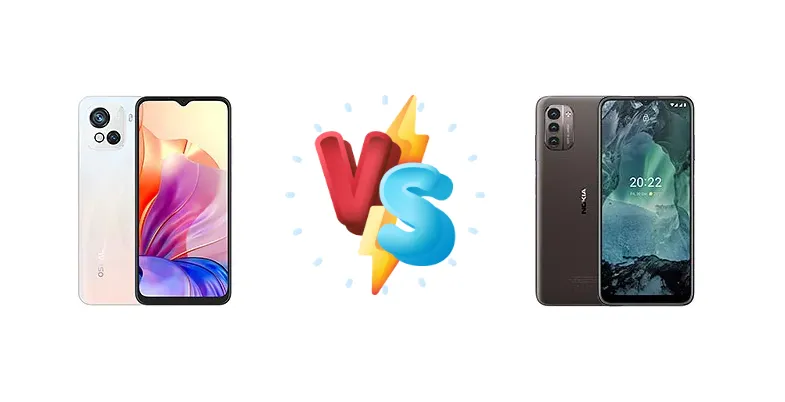
The Oscal C80 and Nokia G21 represent a growing segment of ultra-affordable smartphones. Both devices leverage the Unisoc T606 chipset, aiming to deliver a functional Android experience without breaking the bank. This comparison dissects their similarities and differences, focusing on where each phone excels to help you determine the best fit for your needs.
🏆 Quick Verdict
For the average user prioritizing longevity and a slightly more refined software experience, the Nokia G21 emerges as the better choice. While both phones share the same Unisoc T606 chipset and 18W charging, the Nokia G21’s established endurance rating of 126 hours and PD3.0 support give it a slight edge.
| Network |
|---|
| 2G bands | GSM 850 / 900 / 1800 / 1900 | GSM 850 / 900 / 1800 / 1900 |
| 3G bands | HSDPA 900 / 2100 | HSDPA 850 / 900 / 2100 - International |
| 4G bands | 1, 3, 7, 8, 20, 40 | 1, 3, 5, 7, 8, 20, 28, 38, 40, 41 - International |
| Speed | HSPA, LTE | HSPA 42.2/5.76 Mbps, LTE Cat4 150/50 Mbps |
| Technology | GSM / HSPA / LTE | GSM / HSPA / LTE |
| | - | 1, 2, 3, 4, 5, 7, 8, 12, 17, 28, 40, 66 - LATAM |
| Launch |
|---|
| Announced | 2022, September 07 | 2022, February 14 |
| Status | Available. Released 2022, September 14 | Available. Released 2022, February 15 |
| Body |
|---|
| Build | - | Glass front, plastic frame, plastic back |
| Dimensions | 164.2 x 76 x 8.6 mm (6.46 x 2.99 x 0.34 in) | 164.6 x 75.9 x 8.5 mm (6.48 x 2.99 x 0.33 in) |
| SIM | Nano-SIM + Nano-SIM | · Nano-SIM· Nano-SIM + Nano-SIM |
| Weight | 188 g (6.63 oz) | 190 g (6.70 oz) |
| Display |
|---|
| Resolution | 720 x 1600 pixels, 20:9 ratio (~270 ppi density) | 720 x 1600 pixels, 20:9 ratio (~270 ppi density) |
| Size | 6.5 inches, 102.0 cm2 (~81.7% screen-to-body ratio) | 6.5 inches, 102.0 cm2 (~81.6% screen-to-body ratio) |
| Type | IPS LCD, 90Hz | IPS LCD, 90Hz, 400 nits (typ) |
| Platform |
|---|
| CPU | Octa-core (2x1.6 GHz Cortex-A75 & 6x1.6 GHz Cortex-A55) | Octa-core (2x1.6 GHz Cortex-A75 & 6x1.6 GHz Cortex-A55) |
| Chipset | Unisoc T606 (12 nm) | Unisoc T606 (12 nm) |
| GPU | Mali-G57 MP1 | Mali-G57 MP1 |
| OS | Android 12, Doke-OS 3.0 | Android 11, upgradable to Android 13 |
| Memory |
|---|
| Card slot | microSDXC (uses shared SIM slot) | microSDXC (dedicated slot) |
| Internal | 128GB 8GB RAM | 64GB 3GB RAM, 64GB 4GB RAM, 128GB 4GB RAM, 128GB 6GB RAM |
| | - | eMMC 5.1 |
| Main Camera |
|---|
| Dual | 50 MP, (wide), 1.2µm, PDAF
Auxiliary lens | - |
| Features | LED flash, HDR, panorama | LED flash, HDR, panorama |
| Single | - | 8 MP, f/2.0, (wide) |
| Triple | - | 50 MP, f/1.8, 28mm (wide), 1/2.76", 0.64µm, PDAF
2 MP (macro)
Auxiliary lens |
| Video | 1080p@30fps | 1080p@30fps |
| Selfie camera |
|---|
| Single | 8 MP | 8 MP, f/2.0, (wide) |
| Video | 1080p@30fps | 1080p@30fps |
| Sound |
|---|
| 3.5mm jack | - | Yes |
| 35mm jack | Yes | Yes |
| Loudspeaker | Yes | Yes |
| Comms |
|---|
| Bluetooth | 5.0, A2DP, LE | 5.0, A2DP, LE |
| NFC | No | Yes (market/region dependent) |
| Positioning | GPS, GLONASS, GALILEO, BDS | GPS, GLONASS, GALILEO |
| Radio | FM radio | FM radio, RDS |
| USB | USB Type-C, OTG | USB Type-C 2.0, OTG |
| WLAN | Wi-Fi 802.11 a/b/g/n/ac, dual-band | Wi-Fi 802.11 a/b/g/n/ac, dual-band, Wi-Fi Direct |
| Features |
|---|
| Sensors | Fingerprint (side-mounted), accelerometer, gyro, compass | Fingerprint (side-mounted), accelerometer, proximity |
| Battery |
|---|
| Charging | 18W wired | 18W wired, PD3.0 |
| Type | 5180 mAh | Li-Po 5050 mAh |
| Misc |
|---|
| Colors | Early Sunny Snow, Midnight Black, Navy Blue | Nordic Blue, Dusk |
| Models | - | TA-1418, TA-1477, TA-1415, TA-1405, TA-1404, TA-1412 |
| Price | About 130 EUR | About 90 EUR |
| SAR | - | 1.00 W/kg (head) 1.10 W/kg (body) |
| SAR EU | - | 0.34 W/kg (head) 1.05 W/kg (body) |
| Tests |
|---|
| Battery life | - |
Endurance rating 126h
|
| Camera | - |
Photo / Video |
| Display | - |
Contrast ratio: 1631:1 (nominal) |
| Loudspeaker | - |
-30.7 LUFS (Below average)
|
| Performance | - |
AnTuTu: 171299 (v9)
GeekBench: 1193 (v5.1)
GFXBench: 8.9fps (ES 3.1 onscreen) |
Oscal C80
- Potentially lower price point
- Unisoc T606 provides adequate performance for basic tasks
- 18W wired charging
- Lack of detailed specifications
- Unknown battery capacity
- Potentially less refined software experience
Nokia G21
- Excellent 126-hour endurance rating
- 500 nits peak brightness for better outdoor visibility
- PD3.0 charging support for wider compatibility
- Unisoc T606 performance is limited for demanding tasks
- Basic camera specifications
- May be slightly more expensive than the Oscal C80
Display Comparison
Both the Oscal C80 and Nokia G21 feature displays with a 1631:1 contrast ratio, suggesting similar visual pop. However, the Nokia G21’s measured peak brightness of 500 nits provides a noticeable advantage in outdoor visibility compared to the Oscal C80, where brightness data is unavailable. While both likely utilize IPS LCD panels, the Nokia G21’s specified brightness makes it more usable in direct sunlight. The nominal contrast ratio suggests neither display will offer the deep blacks of an OLED panel.
Camera Comparison
Both phones list 'Photo / Video' capabilities, but lack specific details regarding sensor size, aperture, or image processing. This suggests a focus on basic photography functionality rather than high-quality image capture. The lack of detail makes it difficult to assess camera performance, but it’s reasonable to assume both phones will struggle in low-light conditions. The omission of any mention of Optical Image Stabilization (OIS) on either device further reinforces the expectation of basic camera performance. Avoid expecting flagship-level image quality.
Performance
The core performance of both devices is identical, powered by the Unisoc T606 chipset with an octa-core CPU configuration (2x1.6 GHz Cortex-A75 & 6x1.6 GHz Cortex-A55). This means everyday tasks like browsing, social media, and light app usage will feel similar on both phones. The absence of information regarding RAM type and speed on both devices suggests they likely utilize LPDDR4X, a common choice in this price bracket. Thermal management will likely be similar, with the 12nm process node of the T606 potentially leading to throttling under sustained heavy loads, but neither phone is positioned as a gaming powerhouse.
Battery Life
The Nokia G21 boasts an endurance rating of 126 hours, a significant metric indicating excellent battery life. While the Oscal C80’s battery capacity is unknown, the Nokia G21’s endurance suggests a larger battery or more efficient power management. Both phones support 18W wired charging, but the Nokia G21 adds Power Delivery 3.0 (PD3.0) support, offering wider compatibility with chargers and potentially faster charging speeds with compatible adapters. This PD3.0 support is a practical advantage for users with existing PD chargers.
Buying Guide
Buy the Oscal C80 if you need a functional smartphone with a focus on affordability and are comfortable with a potentially less polished software experience. Buy the Nokia G21 if you prioritize battery life, a more established brand reputation, and the convenience of Power Delivery (PD) charging compatibility, even if it means paying a small premium.
Frequently Asked Questions
❓ Does the Unisoc T606 in either phone struggle with multitasking?
The Unisoc T606 is a budget chipset. While capable of handling basic multitasking (switching between a few apps), it will likely exhibit slowdowns with numerous apps open simultaneously or with demanding applications. Neither phone is ideal for heavy multitasking.
❓ Is the 18W charging on the Nokia G21 significantly faster due to PD3.0?
While both phones support 18W charging, the Nokia G21’s PD3.0 support allows it to negotiate optimal charging voltages and currents with compatible chargers. This *can* result in faster charging times compared to a standard 18W charger, but the difference will depend on the charger used. Using a non-PD charger with the Nokia G21 will likely result in standard 18W charging speeds.
❓ How does the Nokia G21's endurance rating translate to real-world usage?
The 126-hour endurance rating suggests the Nokia G21 can comfortably last a full day of moderate use (calls, texts, social media, some video streaming) on a single charge. Heavy users may still need to charge daily, but the G21 offers significantly better battery life than many competitors in this price range.