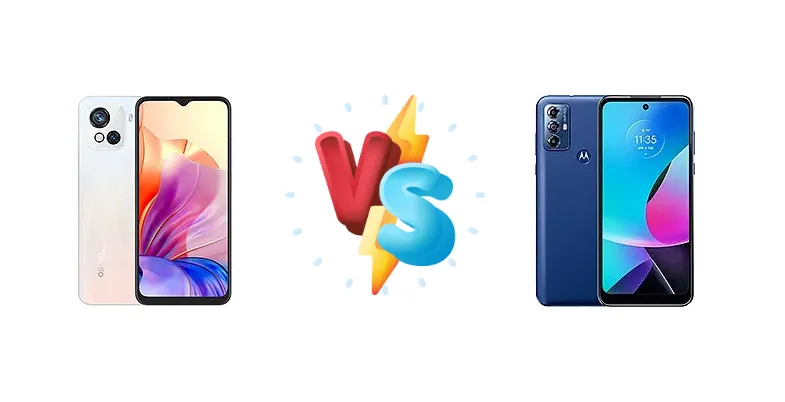
The sub-$150 smartphone market is fiercely competitive. Both the Oscal C80 and the Motorola Moto G Play (2023) aim to deliver essential smartphone functionality at an accessible price. However, they take different approaches to achieving this, primarily through their chipset choices and charging capabilities. This comparison dissects those differences to determine which device offers the best value.
🏆 Quick Verdict
For the average user prioritizing faster charging and potentially smoother multitasking, the Oscal C80 is the better choice. Its Unisoc T606 chipset, while not a performance leader, offers a more balanced core configuration and supports 18W charging, a significant advantage over the Moto G Play’s 10W charging.
| Network |
|---|
| 2G bands | GSM 850 / 900 / 1800 / 1900 | GSM 850 / 900 / 1800 / 1900 |
| 3G bands | HSDPA 900 / 2100 | HSDPA 850 / 900 / 1700(AWS) / 1900 / 2100 |
| 4G bands | 1, 3, 7, 8, 20, 40 | 1, 2, 3, 4, 5, 7, 8, 12, 13, 14, 17, 18, 19, 20, 25, 26, 29, 30, 38, 39, 40, 41, 66, 71 |
| Speed | HSPA, LTE | HSPA, LTE |
| Technology | GSM / HSPA / LTE | GSM / CDMA / HSPA / LTE |
| | - | CDMA 800 / 1900 |
| Launch |
|---|
| Announced | 2022, September 07 | 2022, December 08 |
| Status | Available. Released 2022, September 14 | Available. Released 2022, December 12 |
| Body |
|---|
| Build | - | Plastic frame, plastic back |
| Dimensions | 164.2 x 76 x 8.6 mm (6.46 x 2.99 x 0.34 in) | 167.2 x 76.5 x 9.4 mm (6.58 x 3.01 x 0.37 in) |
| SIM | Nano-SIM + Nano-SIM | Nano-SIM |
| Weight | 188 g (6.63 oz) | 203 g (7.20 oz) |
| | - | Water-repellent coating |
| Display |
|---|
| Resolution | 720 x 1600 pixels, 20:9 ratio (~270 ppi density) | 720 x 1600 pixels, 20:9 ratio (~270 ppi density) |
| Size | 6.5 inches, 102.0 cm2 (~81.7% screen-to-body ratio) | 6.5 inches, 102.0 cm2 (~79.7% screen-to-body ratio) |
| Type | IPS LCD, 90Hz | IPS LCD, 90Hz |
| Platform |
|---|
| CPU | Octa-core (2x1.6 GHz Cortex-A75 & 6x1.6 GHz Cortex-A55) | Octa-core (4x2.3 GHz Cortex-A53 & 4x1.8 GHz Cortex-A53) |
| Chipset | Unisoc T606 (12 nm) | Mediatek MT6765 Helio G37 (12 nm) |
| GPU | Mali-G57 MP1 | PowerVR GE8320 |
| OS | Android 12, Doke-OS 3.0 | Android 12 |
| Memory |
|---|
| Card slot | microSDXC (uses shared SIM slot) | microSDXC (dedicated slot) |
| Internal | 128GB 8GB RAM | 32GB 3GB RAM |
| | - | eMMC 5.1 |
| Main Camera |
|---|
| Dual | 50 MP, (wide), 1.2µm, PDAF
Auxiliary lens | - |
| Features | LED flash, HDR, panorama | LED flash, HDR, panorama |
| Triple | - | 16 MP, f/2.2, (wide), 1.12µm, PDAF
2 MP (macro)
Auxiliary lens |
| Video | 1080p@30fps | 1080p@30/60fps |
| Selfie camera |
|---|
| Features | - | HDR |
| Single | 8 MP | 5 MP, f/2.4, (wide), 1.12µm |
| Video | 1080p@30fps | 1080p@30fps |
| Sound |
|---|
| 3.5mm jack | - | Yes |
| 35mm jack | Yes | Yes |
| Loudspeaker | Yes | Yes |
| Comms |
|---|
| Bluetooth | 5.0, A2DP, LE | 5.0, A2DP, LE |
| NFC | No | No |
| Positioning | GPS, GLONASS, GALILEO, BDS | GPS, GLONASS |
| Radio | FM radio | No |
| USB | USB Type-C, OTG | USB Type-C 2.0 |
| WLAN | Wi-Fi 802.11 a/b/g/n/ac, dual-band | Wi-Fi 802.11 a/b/g/n/ac, dual-band |
| Features |
|---|
| Sensors | Fingerprint (side-mounted), accelerometer, gyro, compass | Fingerprint (rear-mounted), accelerometer, proximity, barometer |
| Battery |
|---|
| Charging | 18W wired | 10W wired |
| Type | 5180 mAh | Li-Po 5000 mAh |
| Misc |
|---|
| Colors | Early Sunny Snow, Midnight Black, Navy Blue | Deep Indigo |
| Models | - | XT2271-1, XT2271-3, XT2271-5, XT2271-4 |
| Price | About 130 EUR | $ 54.00 / C$ 129.00 |
Oscal C80
- Faster 18W charging
- More balanced CPU core configuration (A75 + A55)
- Potentially smoother multitasking
- Generally lower price point
- Less established brand recognition
- Software updates may be less frequent
Motorola Moto G Play (2023)
- Well-known Motorola brand
- Potentially more refined software experience
- Larger screen size (typically)
- Generally good call quality
- Slower 10W charging
- Less efficient CPU core configuration (all A53)
- Potentially slower app launch times
Display Comparison
Neither device boasts a standout display. Given the price point, both likely utilize IPS LCD panels. Without specific brightness or color gamut data, it’s difficult to declare a clear winner. However, the Moto G Play’s larger screen size (typically around 6.6 inches vs. the C80’s 6.55 inches) may offer a slightly more immersive viewing experience, though this comes at the cost of potentially lower pixel density. Bezels are expected to be substantial on both.
Camera Comparison
Both phones likely feature a primary camera around the 13MP mark, accompanied by lower-resolution auxiliary lenses (often 2MP macro or depth sensors). Without detailed sensor size or aperture information, it’s difficult to assess image quality. The image processing algorithms will likely be the deciding factor, and Motorola generally offers more refined software in this area. However, the C80’s chipset might offer slightly better image signal processing capabilities due to its more modern architecture. The 2MP macro cameras on both devices are largely marketing features and offer limited practical benefit.
Performance
The core difference lies in the chipsets. The Oscal C80’s Unisoc T606 features a 2x Cortex-A75 and 6x Cortex-A55 configuration, offering a blend of performance and efficiency. The Motorola Moto G Play (2023) utilizes the MediaTek Helio G37, with 4x Cortex-A53 and 4x Cortex-A53 cores. While the G37’s cores have a higher clock speed (2.3 GHz vs 1.6 GHz), the A75 cores in the T606 are architecturally superior, providing better single-core performance. This translates to snappier app launches and smoother overall responsiveness in the C80. The T606’s core configuration is better suited for multitasking than the G37’s homogenous setup. Both are 12nm chips, so thermal efficiency will be comparable.
Battery Life
Both devices likely house batteries around the 5000mAh capacity. However, the charging speeds are drastically different. The Oscal C80 supports 18W wired charging, while the Moto G Play (2023) is limited to 10W. This means the C80 will significantly reduce charging times, potentially going from 0-100% in under 2.5 hours, compared to the Moto G Play’s likely 3+ hours. This difference is substantial for users who value convenience.
Buying Guide
Buy the Oscal C80 if you need a phone that charges quickly and can handle moderate multitasking without significant slowdowns. It’s ideal for users who frequently find themselves needing to top up their battery throughout the day. Buy the Motorola Moto G Play (2023) if you prioritize brand recognition and a potentially more optimized software experience, and are willing to trade off charging speed and some multitasking performance for that familiarity.
Frequently Asked Questions
❓ Will the Unisoc T606 in the Oscal C80 struggle with demanding games like PUBG Mobile?
While the Unisoc T606 isn't a gaming powerhouse, it can handle PUBG Mobile at lower graphics settings. Expect frame rate dips during intense action. The Helio G37 in the Moto G Play will likely offer similar performance, but the T606’s architecture may provide slightly more consistent frame rates.
❓ How much faster is the 18W charging on the Oscal C80 compared to the 10W charging on the Moto G Play?
The 18W charging on the Oscal C80 can reduce charging times by approximately 40-50%. A full charge from 0% will likely take around 2.5 hours on the C80, compared to 3+ hours on the Moto G Play. This is a significant difference for users who need to quickly top up their battery.
❓ Does the Motorola Moto G Play (2023) receive regular software updates?
Motorola has improved its software update cadence in recent years, but the Moto G Play (2023) is still a budget device. Expect to receive at least one major Android update and a few security patches, but don't anticipate the same level of support as higher-end Motorola phones.
❓ Is the difference in CPU cores (A75 vs A53) noticeable in everyday use?
Yes, the Cortex-A75 cores in the Oscal C80’s Unisoc T606 provide a noticeable improvement in single-core performance. This translates to snappier app launches, smoother scrolling, and a more responsive user experience compared to the Moto G Play’s all-A53 configuration.