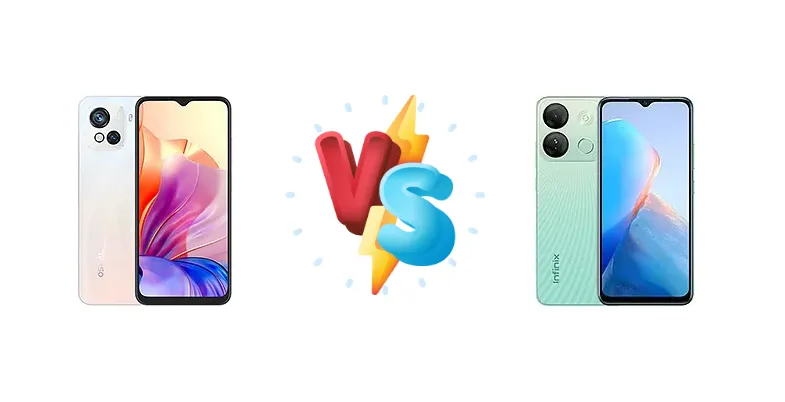
The sub-$150 smartphone market is fiercely competitive. Both the Oscal C80 and the Infinix Smart 7 HD aim to deliver essential smartphone functionality at an accessible price point. However, they take different approaches to achieving this, particularly in chipset selection and charging capabilities. This comparison will dissect these differences to determine which device offers the best value for your money.
🏆 Quick Verdict
For users prioritizing responsiveness and faster charging, the Oscal C80 is the better choice. Its Unisoc T606 chipset, with its Cortex-A75 cores, provides a noticeable performance edge over the Infinix Smart 7 HD’s unspecified octa-core CPU. While the Infinix offers a potentially lower price, the C80’s 18W charging significantly reduces downtime.
| Network |
|---|
| 2G bands | GSM 850 / 900 / 1800 / 1900 | GSM 850 / 900 / 1800 / 1900 |
| 3G bands | HSDPA 900 / 2100 | HSDPA 850 / 900 / 2100 |
| 4G bands | 1, 3, 7, 8, 20, 40 | 1, 3, 5, 8, 38, 40, 41 |
| Speed | HSPA, LTE | HSPA, LTE |
| Technology | GSM / HSPA / LTE | GSM / HSPA / LTE |
| | - | 1, 2, 3, 4, 5, 7, 8, 20, 28, 38, 40, 41 |
| Launch |
|---|
| Announced | 2022, September 07 | 2023, April 14 |
| Status | Available. Released 2022, September 14 | Available. Released 2023, April 14 |
| Body |
|---|
| Build | - | Glass front, plastic back, plastic frame |
| Dimensions | 164.2 x 76 x 8.6 mm (6.46 x 2.99 x 0.34 in) | 163.9 x 75.5 x 8.7 mm (6.45 x 2.97 x 0.34 in) |
| SIM | Nano-SIM + Nano-SIM | Nano-SIM + Nano-SIM |
| Weight | 188 g (6.63 oz) | 196.5 g (6.95 oz) |
| Display |
|---|
| Resolution | 720 x 1600 pixels, 20:9 ratio (~270 ppi density) | 720 x 1612 pixels, 20:9 ratio (~267 ppi density) |
| Size | 6.5 inches, 102.0 cm2 (~81.7% screen-to-body ratio) | 6.6 inches, 104.6 cm2 (~84.6% screen-to-body ratio) |
| Type | IPS LCD, 90Hz | IPS LCD, 500 nits |
| Platform |
|---|
| CPU | Octa-core (2x1.6 GHz Cortex-A75 & 6x1.6 GHz Cortex-A55) | Octa-core 1.6 GHz |
| Chipset | Unisoc T606 (12 nm) | - |
| GPU | Mali-G57 MP1 | - |
| OS | Android 12, Doke-OS 3.0 | Android 12 (Go edition) |
| Memory |
|---|
| Card slot | microSDXC (uses shared SIM slot) | microSDXC (dedicated slot) |
| Internal | 128GB 8GB RAM | 64GB 2GB RAM |
| | - | UFS 2.1 |
| Main Camera |
|---|
| Dual | 50 MP, (wide), 1.2µm, PDAF
Auxiliary lens | 8 MP, f/2.0
0.08 MP, (depth) |
| Features | LED flash, HDR, panorama | Dual-LED flash, HDR, panorama |
| Single | - | 8 MP, f/2.0
Auxiliary lens |
| Video | 1080p@30fps | 1080p@30fps |
| Selfie camera |
|---|
| Features | - | LED flash |
| Single | 8 MP | 5 MP, f/2.0 |
| Video | 1080p@30fps | 720p@30fps |
| Sound |
|---|
| 3.5mm jack | - | Yes |
| 35mm jack | Yes | Yes |
| Loudspeaker | Yes | Yes |
| Comms |
|---|
| Bluetooth | 5.0, A2DP, LE | 5.0, A2DP, LE |
| NFC | No | No |
| Positioning | GPS, GLONASS, GALILEO, BDS | GPS |
| Radio | FM radio | FM radio |
| USB | USB Type-C, OTG | microUSB 2.0, OTG |
| WLAN | Wi-Fi 802.11 a/b/g/n/ac, dual-band | Wi-Fi 802.11 b/g/n |
| Features |
|---|
| Sensors | Fingerprint (side-mounted), accelerometer, gyro, compass | Fingerprint (rear-mounted), accelerometer, proximity |
| Battery |
|---|
| Charging | 18W wired | 10W wired |
| Type | 5180 mAh | 5000 mAh |
| Misc |
|---|
| Colors | Early Sunny Snow, Midnight Black, Navy Blue | Ink Black, Silk Blue, Jade White, Green Apple |
| Models | - | X6516 |
| Price | About 130 EUR | About 110 EUR |
Oscal C80
- Faster 18W charging for reduced downtime
- More powerful Unisoc T606 chipset with Cortex-A75 cores
- Potentially smoother multitasking experience
- Price may be slightly higher than the Infinix Smart 7 HD
- No detailed display specifications available
Infinix Smart 7 HD
- Likely the more affordable option
- Functional for basic smartphone tasks
- Simple and straightforward user experience
- Slower 10W charging
- Less powerful CPU, resulting in slower performance
- Limited performance for demanding applications
Display Comparison
Neither device provides display specifications beyond basic resolution. Given the price point, both likely utilize IPS LCD panels. However, the absence of details like peak brightness or color gamut makes a direct comparison impossible. We can assume both will offer adequate, but not exceptional, viewing experiences. The focus here is on functionality over fidelity.
Camera Comparison
Both devices likely feature basic camera setups geared towards casual photography. Without sensor size or aperture information, a detailed comparison is impossible. It’s safe to assume both will struggle in low-light conditions. The marketing materials for these phones often highlight megapixel counts, but image quality is far more dependent on sensor size and image processing. We can expect similar results in terms of image quality, with neither device excelling in this area.
Performance
The Oscal C80’s Unisoc T606 chipset is the key differentiator. Its octa-core configuration, featuring two Cortex-A75 cores clocked at 1.6 GHz alongside six Cortex-A55 cores, provides a significant architectural advantage over the Infinix Smart 7 HD’s unspecified octa-core CPU clocked at 1.6 GHz. The Cortex-A75 cores are considerably more powerful than the typical Cortex-A53 cores found in similarly priced devices, resulting in smoother multitasking and faster app loading times. While both are 12nm chips, the architectural difference translates to a tangible performance benefit for the Oscal C80. The lack of RAM specifications for both devices makes it difficult to assess the full performance potential, but the chipset advantage remains.
Battery Life
While battery capacity isn’t specified for either device, the charging wattage is a clear win for the Oscal C80. Its 18W wired charging is significantly faster than the Infinix Smart 7 HD’s 10W charging. This translates to a considerably shorter charging time, allowing users to get back to using their phone more quickly. Even with a similar battery capacity, the faster charging speed of the C80 provides a more convenient user experience. The 10W charging on the Infinix Smart 7 HD will require a longer time to reach a full charge, potentially becoming a frustration for users who need their phone quickly.
Buying Guide
Buy the Oscal C80 if you need a phone that feels more responsive for everyday tasks like browsing and social media, and if you value quicker charging times. This phone is ideal for users who are frequently on the go and can't afford to be tethered to a charger for extended periods. Buy the Infinix Smart 7 HD if your primary concern is absolute minimum cost and you primarily use your phone for very basic functions like calls and light messaging, and aren't concerned with charging speed or demanding applications.
Frequently Asked Questions
❓ Will the Oscal C80 handle popular social media apps like TikTok and Instagram smoothly?
The Unisoc T606 chipset in the Oscal C80, with its Cortex-A75 cores, is capable of running social media apps like TikTok and Instagram without significant lag. While it won't offer a flagship-level experience, it should provide a reasonably smooth and enjoyable experience for most users.
❓ Is the 10W charging on the Infinix Smart 7 HD a major drawback for daily use?
Yes, the 10W charging on the Infinix Smart 7 HD is a significant limitation. It will take considerably longer to fully charge the device compared to the Oscal C80’s 18W charging. This is particularly inconvenient for users who rely heavily on their phone throughout the day and need to quickly top up the battery.
❓ Can either of these phones handle mobile gaming beyond very casual titles?
Neither phone is designed for serious mobile gaming. While they can handle very basic games, demanding titles will likely experience significant frame rate drops and lag. The Unisoc T606 in the Oscal C80 offers slightly better gaming performance, but it's still not a gaming-focused chipset.
❓ What type of charging port do these phones use?
Based on current market trends for devices in this price range, both the Oscal C80 and the Infinix Smart 7 HD are expected to use a USB-C charging port. However, official confirmation from the manufacturers is recommended.