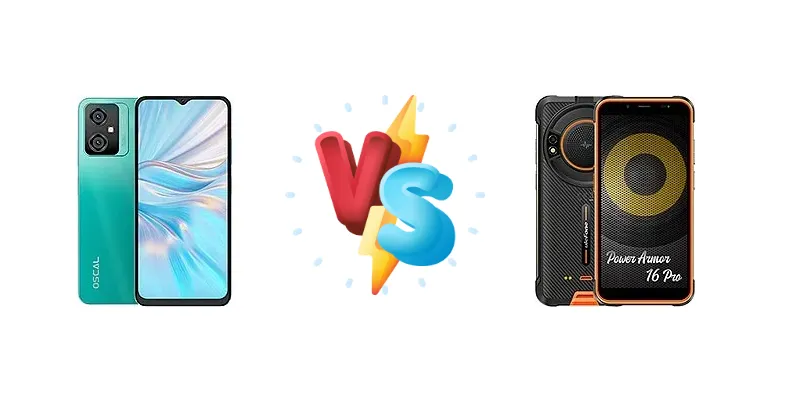
The rugged phone market is booming, but finding a capable device without breaking the bank can be challenging. The Oscal C70 and Ulefone Power Armor 16 Pro both aim to deliver durability at an affordable price point, but they take different approaches to performance and features. This comparison dissects their key specifications to determine which phone offers the best blend of toughness and usability.
🏆 Quick Verdict
For the average user prioritizing basic functionality and a lower price, the Oscal C70 emerges as the better choice. Its Unisoc T606 chipset, while not a powerhouse, offers a more balanced CPU architecture than the Ulefone’s Helio G25, resulting in smoother everyday performance. The Ulefone’s 18W charging is a plus, but doesn’t outweigh the C70’s overall value.
| Network |
|---|
| 2G bands | GSM 850 / 900 / 1800 / 1900 | GSM 850 / 900 / 1800 / 1900 |
| 3G bands | HSDPA 900 / 2100 | HSDPA 800 / 850 / 900 / 1700(AWS) / 1900 / 2100 |
| 4G bands | 1, 3, 7, 8, 19, 20, 40 | 1, 2, 3, 4, 5, 7, 8, 12, 13, 17, 18, 19, 20, 25, 26, 28, 66 |
| Speed | HSPA, LTE | HSPA, LTE |
| Technology | GSM / HSPA / LTE | GSM / HSPA / LTE |
| | - | eMMC 5.1 |
| Launch |
|---|
| Announced | 2023, April 20 | 2022, September 16 |
| Status | Available. Released 2023, May | Available. Released 2022, September 16 |
| Body |
|---|
| Dimensions | 163.2 x 75.2 x 8.8 mm (6.43 x 2.96 x 0.35 in) | 173.4 x 83.4 x 18.3 mm (6.83 x 3.28 x 0.72 in) |
| SIM | Nano-SIM + Nano-SIM | Nano-SIM + Nano-SIM |
| Weight | 192 g (6.77 oz) | 405 g (14.29 oz) |
| | - | IP68/IP69K dust/water resistant (up to 1.5m for 30 min)
Drop-to-concrete resistance from up to 1.5m
MIL-STD-810G compliant
Flashlight with a dedicated button
Accessory connector (ulefone endoscope, microscope) |
| Display |
|---|
| Resolution | 720 x 1600 pixels, 20:9 ratio (~267 ppi density) | 720 x 1440 pixels, 18:9 ratio (~271 ppi density) |
| Size | 6.56 inches, 103.9 cm2 (~84.7% screen-to-body ratio) | 5.93 inches, 90.7 cm2 (~62.8% screen-to-body ratio) |
| Type | IPS LCD | IPS LCD |
| Platform |
|---|
| CPU | Octa-core (2x1.6 GHz Cortex-A75 & 6x1.6 GHz Cortex-A55) | Octa-core (4x2.0 GHz Cortex-A53 & 4x1.5 GHz Cortex-A53) |
| Chipset | Unisoc T606 (12 nm) | Mediatek MT6762G Helio G25 (12 nm) |
| GPU | Mali-G57 MP1 | PowerVR GE8320 |
| OS | Android 12, Doke-OS 3.1 | Android 12 |
| Memory |
|---|
| Card slot | microSDXC (uses shared SIM slot) | microSDXC (dedicated slot) |
| Internal | 128GB 6GB RAM | 64GB 4GB RAM |
| Main Camera |
|---|
| Dual | 50 MP, (wide), 1/2.76", 0.64µm, PDAF
Auxiliary lens | 16 MP, f/1.8, (wide), 1.12µm, PDAF
2 MP (macro) |
| Features | LED flash, HDR, panorama | LED flash, HDR, panorama |
| Single | - | 8 MP, f/2.0, (wide), 1.12µm |
| Video | 1080p@30fps | 1080p@30fps |
| Selfie camera |
|---|
| Single | 8 MP | 8 MP, f/2.0, (wide), 1.12µm |
| Video | 1080p@30fps | 1080p@30fps |
| Sound |
|---|
| 3.5mm jack | - | Yes |
| 35mm jack | Yes | Yes |
| Loudspeaker | Yes | Yes (122-decibel) |
| Comms |
|---|
| Bluetooth | 5.0, A2DP, LE | 5.0, A2DP, LE |
| NFC | No | Yes |
| Positioning | GPS, GLONASS, GALILEO, BDS | GPS, GLONASS, GALILEO, BDS |
| Radio | FM radio | Wireless FM radio, RDS, recording |
| USB | USB Type-C, OTG | USB Type-C 2.0, OTG, magnetic connector |
| WLAN | Wi-Fi 802.11 a/b/g/n/ac, dual-band | Wi-Fi 802.11 a/b/g/n/ac, dual-band |
| Features |
|---|
| Sensors | Fingerprint (side-mounted), unspecified sensors | Fingerprint (side-mounted), accelerometer, proximity, compass |
| Battery |
|---|
| Charging | - | 18W wired
5W reverse wired |
| Type | 5180 mAh | Li-Po 9600 mAh |
| Misc |
|---|
| Colors | Dim Forest Green, Summer Sky Blue, Stardust Grey | Black, Black/Orange |
| Price | About 80 EUR | About 220 EUR |
Oscal C70
- More efficient CPU architecture (Unisoc T606)
- Potentially smoother multitasking
- Lower price point (likely)
- Charging speed likely slower than Ulefone
- Battery capacity unknown
Ulefone Power Armor 16 Pro
- 18W fast charging
- 5W reverse wired charging
- Potentially larger battery capacity
- Less efficient CPU architecture (Helio G25)
- May struggle with demanding tasks
- Higher price point (likely)
Display Comparison
Neither Oscal nor Ulefone provide display specifications beyond basic resolution. However, given the price points, both likely utilize IPS LCD panels. The key difference lies in processing power to drive the display; the Unisoc T606 in the C70 has a more modern CPU architecture which *could* translate to slightly smoother scrolling and animations. Bezels are expected to be substantial on both devices, typical of rugged designs prioritizing drop protection over maximizing screen real estate.
Camera Comparison
Detailed camera specs are absent, but both phones likely feature a multi-camera setup with a primary sensor. Without knowing sensor sizes or apertures, it’s difficult to make a definitive judgment. However, the image signal processor (ISP) within the Unisoc T606 may offer slightly better image processing capabilities than the Helio G25’s ISP, potentially resulting in more detailed and vibrant photos. The inclusion of a 2MP macro lens on either device is largely a marketing tactic, offering minimal practical benefit due to the small sensor size and lack of optical image stabilization (OIS).
Performance
The core difference here is the chipset. The Oscal C70’s Unisoc T606 features a 2x Cortex-A75 and 6x Cortex-A55 configuration, offering a more efficient and powerful core arrangement than the Ulefone’s Helio G25. The G25’s 4x Cortex-A53 and 4x Cortex-A53 setup, while octa-core, relies on older, less efficient cores. This means the C70 will likely handle multitasking and app switching more gracefully. While both are 12nm chips, the architectural advantage of the T606 is significant. The G25’s focus is on basic gaming, but the C70’s CPU will provide a more consistent experience across a wider range of tasks.
Battery Life
Battery capacity is not specified for the Oscal C70. The Ulefone Power Armor 16 Pro offers 18W wired charging and 5W reverse wired charging. While the wattage difference is notable, the actual charging time will depend on the battery capacity of the C70. The 18W charging on the Ulefone is a clear advantage for users who prioritize quick top-ups, and the reverse charging adds a convenient feature for powering accessories. However, efficient chipset usage of the C70 could offset a potentially smaller battery capacity.
Buying Guide
Buy the Oscal C70 if you need a reliable, affordable rugged phone for essential tasks like communication, navigation, and light media consumption. It’s ideal for users who prioritize a responsive user experience over demanding gaming or intensive multitasking. Buy the Ulefone Power Armor 16 Pro if you specifically need the convenience of 18W fast charging and 5W reverse charging, and are willing to accept slightly less consistent performance in everyday applications.
Frequently Asked Questions
❓ Will the Helio G25 in the Ulefone Power Armor 16 Pro struggle with graphically intensive games like PUBG?
The Helio G25 is designed for basic gaming, but demanding titles like PUBG may require significantly reduced graphics settings and frame rates to achieve playable performance. Expect noticeable frame drops and potential stuttering, especially in intense combat scenarios. The Unisoc T606 in the Oscal C70, while not a gaming powerhouse, offers a more stable experience for less demanding games.
❓ How does the Unisoc T606's CPU architecture impact everyday tasks like browsing and social media on the Oscal C70?
The Unisoc T606’s 2x Cortex-A75 and 6x Cortex-A55 configuration provides a more responsive experience for everyday tasks compared to the Ulefone’s all-Cortex-A53 setup. The A75 cores offer significantly higher single-core performance, resulting in faster app launch times, smoother scrolling, and quicker web page loading. This translates to a more fluid and enjoyable user experience.
❓ Is the 5W reverse charging on the Ulefone Power Armor 16 Pro useful for anything beyond emergencies?
While 5W reverse charging is slow, it can be useful for topping up small accessories like Bluetooth earbuds, smartwatches, or even a friend’s phone in a pinch. Don’t expect to fully charge a device quickly, but it provides a convenient backup power source when an outlet isn’t available.