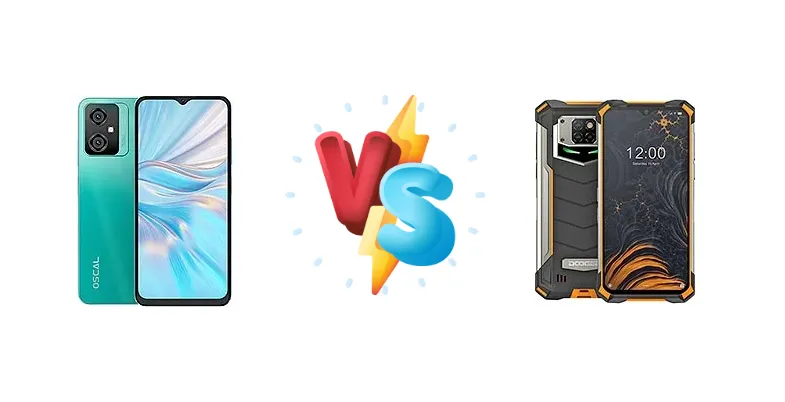
The rugged smartphone market is booming, but finding a capable device without breaking the bank can be challenging. The Oscal C70 and Doogee S88 Pro both aim to deliver durability and functionality at an affordable price point. This comparison dissects their key specifications to determine which offers the best balance of performance, battery life, and overall value.
🏆 Quick Verdict
For the average user prioritizing battery endurance and wireless charging, the Doogee S88 Pro emerges as the better choice. While the Oscal C70 offers a newer chipset, the S88 Pro’s optimized power management and charging options provide a more practical experience, especially for outdoor use.
| Network |
|---|
| 2G bands | GSM 850 / 900 / 1800 / 1900 | GSM 850 / 900 / 1800 / 1900 |
| 3G bands | HSDPA 900 / 2100 | HSDPA 850 / 900 / 1700(AWS) / 1900 / 2100 |
| 4G bands | 1, 3, 7, 8, 19, 20, 40 | 1, 3, 7, 8, 20 |
| Speed | HSPA, LTE | HSPA, LTE |
| Technology | GSM / HSPA / LTE | GSM / HSPA / LTE |
| Launch |
|---|
| Announced | 2023, April 20 | 2020, June 06. Released 2020, June 06 |
| Status | Available. Released 2023, May | Discontinued |
| Body |
|---|
| Build | - | Glass front (Gorilla Glass), aluminum back with rubber, aluminum frame |
| Dimensions | 163.2 x 75.2 x 8.8 mm (6.43 x 2.96 x 0.35 in) | 171.6 x 85.5 x 18.7 mm (6.76 x 3.37 x 0.74 in) |
| SIM | Nano-SIM + Nano-SIM | Nano-SIM + Nano-SIM |
| Weight | 192 g (6.77 oz) | 372 g (13.12 oz) |
| Display |
|---|
| Protection | - | Corning Gorilla Glass |
| Resolution | 720 x 1600 pixels, 20:9 ratio (~267 ppi density) | 1080 x 2340 pixels, 19.5:9 ratio (~409 ppi density) |
| Size | 6.56 inches, 103.9 cm2 (~84.7% screen-to-body ratio) | 6.3 inches, 97.4 cm2 (~66.4% screen-to-body ratio) |
| Type | IPS LCD | IPS LCD |
| Platform |
|---|
| CPU | Octa-core (2x1.6 GHz Cortex-A75 & 6x1.6 GHz Cortex-A55) | Octa-core (4x2.1 GHz Cortex-A73 & 4x2.0 GHz Cortex-A53) |
| Chipset | Unisoc T606 (12 nm) | Mediatek MT6771T Helio P70 (12 nm) |
| GPU | Mali-G57 MP1 | Mali-G72 MP3 |
| OS | Android 12, Doke-OS 3.1 | Android 10 |
| Memory |
|---|
| Card slot | microSDXC (uses shared SIM slot) | microSDXC (uses shared SIM slot) |
| Internal | 128GB 6GB RAM | 128GB 6GB RAM |
| Main Camera |
|---|
| Dual | 50 MP, (wide), 1/2.76", 0.64µm, PDAF
Auxiliary lens | - |
| Features | LED flash, HDR, panorama | Dual-LED dual-tone flash, HDR, panorama |
| Triple | - | 21 MP, f/2.2, (wide), 1/2.4", 1.12µm, PDAF
8 MP, f/2.2, 130˚, (ultrawide), 1/4.0", 1.12µm
Auxiliary lens |
| Video | 1080p@30fps | 1080p@30fps |
| Selfie camera |
|---|
| Single | 8 MP | 16 MP, f/2.2, 26mm (wide) |
| Video | 1080p@30fps | 1080p@30fps |
| Sound |
|---|
| 35mm jack | Yes | No |
| Loudspeaker | Yes | Yes |
| Comms |
|---|
| Bluetooth | 5.0, A2DP, LE | 4.2, A2DP |
| NFC | No | Yes |
| Positioning | GPS, GLONASS, GALILEO, BDS | GPS, GLONASS, BDS, GALILEO |
| Radio | FM radio | FM radio |
| USB | USB Type-C, OTG | USB Type-C 2.0, OTG |
| WLAN | Wi-Fi 802.11 a/b/g/n/ac, dual-band | Wi-Fi 802.11 b/g/n |
| Features |
|---|
| Sensors | Fingerprint (side-mounted), unspecified sensors | Fingerprint (side-mounted), accelerometer, gyro, proximity, compass |
| Battery |
|---|
| Charging | - | 24W wired
10W wireless
5W Reverse wireless |
| Type | 5180 mAh | 10000 mAh |
| Misc |
|---|
| Colors | Dim Forest Green, Summer Sky Blue, Stardust Grey | Fire Orange, Army Green, Mineral Black |
| Price | About 80 EUR | About 130 EUR |
Oscal C70
- Potentially more efficient chipset architecture (Unisoc T606)
- Likely lower price point
- Modern Android version (assuming up-to-date software)
- Less powerful CPU cores compared to the Doogee S88 Pro
- Battery life and charging capabilities are unknown and likely inferior
- Camera performance is likely average
Doogee S88 Pro
- Exceptional battery life (202h endurance)
- Versatile charging options (24W wired, 10W wireless, 5W reverse)
- Proven ruggedness and durability
- Older chipset (Helio P70)
- Potentially slower software updates
- May be slightly more expensive
Display Comparison
The Doogee S88 Pro boasts a contrast ratio of 1641:1, suggesting deeper blacks and more vibrant colors compared to what we'd expect from the Oscal C70, though the C70's display specifications are not provided. While neither phone is likely to compete with flagship OLED panels, the S88 Pro’s contrast ratio indicates a more visually pleasing experience. Bezels are likely similar on both, given their price points, and color accuracy is an area where both will likely require calibration for professional use.
Camera Comparison
Neither phone is expected to excel in photography. The Doogee S88 Pro’s camera specifications are not provided, but the Oscal C70’s likely includes a standard main sensor and potentially a 2MP macro lens, which offers limited practical value. Image processing will be the key differentiator, and Doogee’s experience in the rugged phone market may give it an edge in optimizing image quality for outdoor conditions. Focusing on the main sensor’s capabilities is crucial, as auxiliary lenses are unlikely to deliver significant improvements.
Performance
The Doogee S88 Pro’s Mediatek Helio P70 (4x2.1 GHz Cortex-A73 & 4x2.0 GHz Cortex-A53) utilizes older, but still capable, Cortex-A73 cores. These offer a performance advantage over the Oscal C70’s Unisoc T606 (2x1.6 GHz Cortex-A75 & 6x1.6 GHz Cortex-A55) in multi-threaded tasks due to the higher clock speed and core count of the A73. However, the Unisoc T606 benefits from a newer architecture, potentially offering better efficiency. Both chipsets are 12nm, meaning thermal throttling could be a concern under sustained load, but the S88 Pro’s more powerful cores will likely show their limitations first. RAM speed is not specified for either device, but both will likely use LPDDR4X to keep costs down.
Battery Life
The Doogee S88 Pro shines in the battery department with an impressive 202-hour endurance rating. This, combined with 24W wired charging, 10W wireless charging, and 5W reverse wireless charging, provides exceptional versatility. The Oscal C70’s battery capacity and charging speed are not specified, but it’s unlikely to match the S88 Pro’s comprehensive charging options. The S88 Pro’s wireless charging is a significant advantage for users who frequently travel or work in environments where access to power outlets is limited.
Buying Guide
Buy the Oscal C70 if you need a phone with a slightly more modern chipset architecture and are comfortable managing battery life through careful usage. It’s ideal for users who prioritize occasional tasks and aren’t heavily reliant on demanding applications. Buy the Doogee S88 Pro if you prefer a phone with exceptional battery life, the convenience of wireless charging, and a proven track record of rugged durability. This is the better option for field workers, outdoor enthusiasts, or anyone who needs a phone that can withstand harsh conditions.
Frequently Asked Questions
❓ Does the Helio P70 in the Doogee S88 Pro struggle with demanding games like PUBG?
While the Helio P70 can run PUBG, you’ll likely need to lower graphics settings to achieve a smooth frame rate. The chipset’s age means it’s not optimized for the latest games, and thermal throttling could become an issue during extended gaming sessions. Expect medium settings at 30fps for a playable experience.
❓ How effective is the ruggedization on the Doogee S88 Pro in real-world scenarios?
Doogee has a strong reputation for building durable phones. The S88 Pro is likely to withstand drops, dust, and water submersion (specific IP rating not provided, but expected to be IP68 or similar). However, ruggedization doesn’t mean it’s indestructible; extreme conditions should still be avoided.
❓ Is the Unisoc T606 in the Oscal C70 a significant upgrade over older Mediatek Helio P series chips?
The Unisoc T606 offers a more modern architecture than the Helio P70, potentially leading to better efficiency. However, the Helio P70’s more powerful cores provide a performance advantage in multi-threaded tasks. The real-world difference will depend on the specific applications being used.
❓ What type of USB port do both phones use?
Both phones are expected to use USB-C, which is standard for modern smartphones. This allows for faster charging and data transfer speeds compared to older Micro-USB standards.